Evaluation of Proactive Community Case Detection to Increase Help Seeking for Mental Health Care: A Pragmatic Randomized Controlled Trial
- PMID: 32321389
- PMCID: PMC7415529
- DOI: 10.1176/appi.ps.201900377
Evaluation of Proactive Community Case Detection to Increase Help Seeking for Mental Health Care: A Pragmatic Randomized Controlled Trial
Abstract
Objective: The Community Informant Detection Tool (CIDT) is a vignette- and picture-based method of proactive case detection to promote help seeking for persons with depression, psychosis, alcohol use disorder, and epilepsy. The authors evaluated the effectiveness of the CIDT to increase help-seeking behavior in rural Nepal, where a district mental health care plan was being implemented.
Methods: Twenty-four health facilities were randomly assigned to one of two methods for training their all-female cadre of community health volunteers: standard training or standard training that included the CIDT. The authors compared the number of patients with depression, psychosis, alcohol use disorder, and epilepsy who were registered in the routine health information system prior to and 6 months after the training.
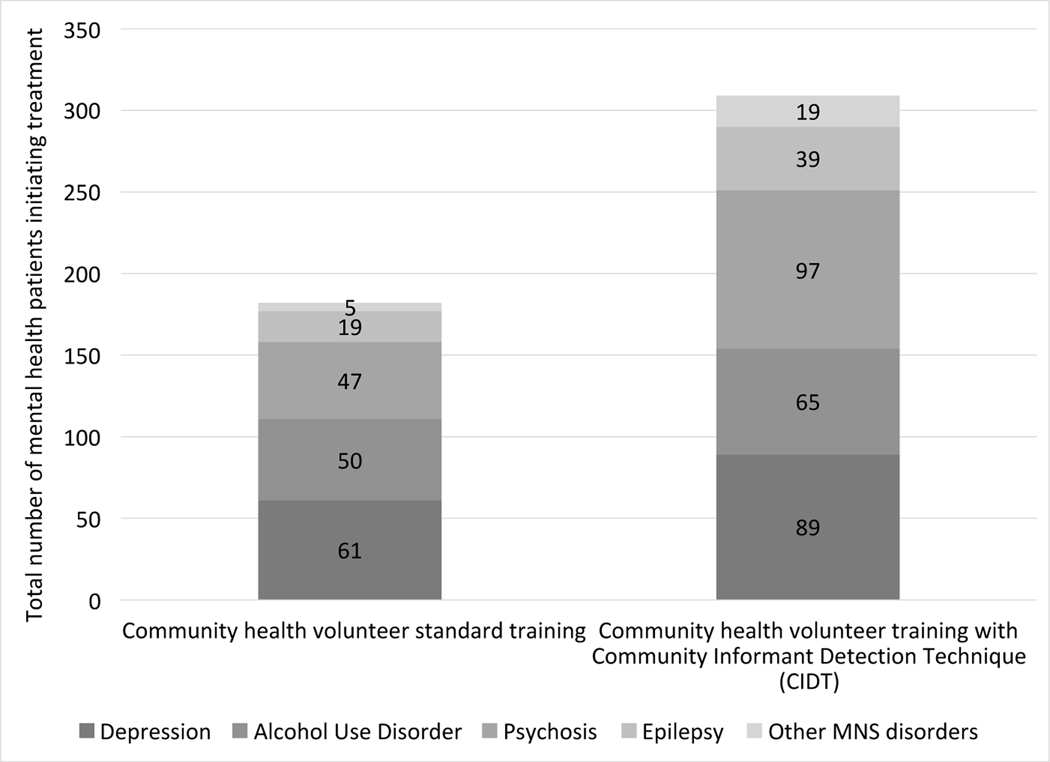
Results: At health facilities where volunteers received CIDT training, 309 patients were registered as having depression, psychosis, alcohol use disorder, or epilepsy, compared with 182 patients at facilities where volunteers received standard training. The median number of patients registered was 47% greater at facilities where CIDT training was included (24 patients) than at facilities with standard training (16 patients) (p=0.04, r=0.42). The difference in the number of registered patients remained significant when the analysis factored in the population catchment (N=18 patients [CIDT] versus N=14 [standard] per 10,000 population; p=0.05, r=0.40).
Conclusions: The median number of patients registered as having a mental illness was 47% greater at primary care facilities in which community health volunteers used the CIDT than at facilities where volunteers received standard training. Proactive case finding holds promise for increasing help seeking for mental health care.
Keywords: Community mental health services, Nonpsychiatric professionals & Detection; community health workers; community mental health services; developing countries; help-seeking behavior.
Figures
References
-
- Eaton J, McCay L, Semrau M, et al. : Scale up of services for mental health in low-income and middle-income countries. Lancet 378, 2011 - PubMed
-
- Patel V, Chisholm D, Parikh R, et al. : Addressing the burden of mental, neurological, and substance use disorders: key messages from Disease Control Priorities, 3rd edition. The Lancet 387:1672–85, 2016 - PubMed
-
- Aghukwa CN: Care seeking and beliefs about the cause of mental illness among Nigerian psychiatric patients and their families. Psychiatric Services 63:616–8, 2012 - PubMed
Publication types
MeSH terms
Grants and funding
LinkOut - more resources
Full Text Sources
Medical