. 2020 May;29(Suppl 3):s139-s146.
doi: 10.1136/tobaccocontrol-2020-055630.

Longitudinal pathways of exclusive and polytobacco cigarette use among youth, young adults and adults in the USA: findings from the PATH Study Waves 1-3 (2013-2016)

Affiliations

Longitudinal pathways of exclusive and polytobacco cigarette use among youth, young adults and adults in the USA: findings from the PATH Study Waves 1-3 (2013-2016)

Kristie A Taylor et al. Tob Control. 2020 May.

Abstract

Objective: Cigarettes are the most harmful and most prevalent tobacco product in the USA. This study examines cross-sectional prevalence and longitudinal pathways of cigarette use among US youth (12-17 years), young adults (18-24 years) and adults 25+ (25 years and older).

Design: Data were drawn from the first three waves (2013-2016) of the Population Assessment of Tobacco and Health Study, a nationally representative, longitudinal cohort study of US adults and youth. Respondents with data at all three waves (youth, N=11 046; young adults, N=6478; adults 25+, N=17 188) were included in longitudinal analyses.

Results: Among Wave 1 (W1) any past 30-day (P30D) cigarette users, more than 60%, persistently used cigarettes across three waves in all age groups. Exclusive cigarette use was more common among adult 25+ W1 P30D cigarette users (62.6%), while cigarette polytobacco use was more common among youth (57.1%) and young adults (65.2%). Persistent exclusive cigarette use was the most common pathway among adults 25+ and young adults; transitioning from exclusive cigarette use to cigarette polytobacco use was most common among youth W1 exclusive cigarette users. For W1 youth and young adult cigarette polytobacco users, the most common pattern of use was persistent cigarette polytobacco use.

Conclusions: Cigarette use remains persistent across time, regardless of age, with most W1 P30D smokers continuing to smoke at all three waves. Policy efforts need to continue focusing on cigarettes, in addition to products such as electronic nicotine delivery systems that are becoming more prevalent.

Keywords: non-cigarette tobacco products; prevention; surveillance and monitoring.


Conflict of interest statement

Competing interests: WMC reports long-term stock holdings in General Electric Company, 3M Company, and Pfizer Incorporated, unrelated to this manuscript. No financial disclosures were reported by the other authors of this paper.

Figures
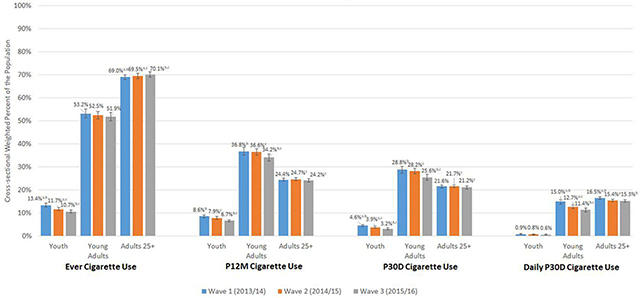
Figure 1.
Figure 1.
Cross-sectional weighted percent of ever, P12M, P30D and daily P30D cigarette use among youth, young adults and adults 25+ in W1, W2 and W3 of the Population Assessment of Tobacco and Health (PATH) Study. Abbreviations: P12M = past 12-month; P30D = past 30-day; W1 = Wave 1; W2 = Wave 2; W3 = Wave 3 W1/W2/W3 ever cigarette use unweighted Ns: youth (ages 12-17) = 1,838/1,428/1,220; young adults (ages 18–24) = 5,963/4,853/4,580; adults 25+ (ages 25 and older) = 19,213/16,790/16,305 W1/W2/W3 P12M cigarette use unweighted Ns: youth = 1,170/965/757; young adults = 4,392/3,564/3,202; adults 25+ = 11,538/9,927/9,267 W1/W2/W3 P30D cigarette use unweighted Ns: youth = 634/481/366; young adults = 3,593/2,799/2,456; adults 25+ = 10,624/8,880/8,275 W1/W2/W3 daily P30D cigarette use unweighted Ns: youth = 127/96/73; young adults = 1,931/1,338/1,138; adults 25+ = 8,236/6,596/6,229 X-axis shows four categories of cigarette use (ever, P12M, P30D, and daily P30D). Y-axis shows weighted percentages of W1, W2, and W3 users. Sample analyzed includes all W1, W2, and W3 respondents at each wave. All respondents with data at one wave are included in the sample for that wave’s estimate and do not need to have complete data at all three waves. The PATH Study cross-sectional (W1) or single-wave weights (W2 and W3) were used to calculate estimates at each wave. W1-W3 ever cigarette use is defined as having smoked cigarettes, even once or twice in lifetime. W1-W3 P12M cigarette use is defined as any cigarette use within the past 12 months. W1-W3 P30D cigarette use is defined as any cigarette use within the past 30 days. W1-W3 daily P30D cigarette use is defined as cigarette use every day within the past 30 days. All use definitions refer to any use that includes exclusive or polytobacco use of cigarettes. a denotes significant difference at p<0.0167 (Bonferroni corrected for three comparisons) between W1 and W2 b denotes significant difference at p<0.0167 (Bonferroni corrected for three comparisons) between W1 and W3 c denotes significant difference at p<0.0167 (Bonferroni corrected for three comparisons) between W2 and W3 The logit-transformation method was used to calculate the 95% confidence intervals. Analyses were run on the W1, W2, and W3 Public Use Files (https://doi.org/10.3886/ICPSR36498.v8).
Figure 2.
Figure 2.
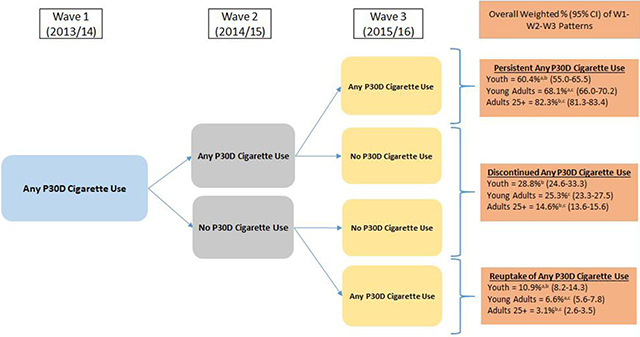
Patterns of W1–W2–W3 persistent any P30D cigarette use, discontinued any P30D cigarette use and reuptake of any P30D cigarette use among W1 any P30D cigarette users. Abbreviations: W1 = Wave 1; W2 = Wave 2; W3 = Wave 3; P30D = past 30-day; CI = confidence interval W1 any P30D cigarette use weighted percentages (95% CI) out of total U.S. population: youth (ages 12–17) = 4.5% (4.1–5.0); young adults (ages 18–24) = 28.3% (26.8–29.7); adults 25+ (ages 25 and older) = 21.3% (20.7–22.0) Analysis included W1 youth, young adults, and adults 25+ P30D cigarette users with data at all three waves. Respondent age was calculated based on age at W1. W3 longitudinal (all-waves) weights were used to calculate estimates. These rates vary slightly from those reported in Figure 1 or Supplemental Table 1 because this analytic sample in Figure 2 includes only those with data at each of the three waves to examine weighted longitudinal use and non-use pathways. Any P30D cigarette use was defined as any cigarette use within the past 30 days. Respondents could be missing data on other P30D tobacco product use and still be categorized into the following three groups: 1) Persistent any P30D cigarette use: Defined as exclusive or cigarette polytobacco use at W2 and W3. 2) Discontinued any P30D cigarette use: Defined as any noncigarette tobacco use or no tobacco use at either W2 and W3 or just W3. 3) Reuptake of any P30D cigarette use: Defined as discontinued any cigarette use at W2 and any cigarette use at W3. a denotes significant difference at p<0.0167 (Bonferroni corrected for three comparisons) between youth and young adults b denotes significant difference at p<0.0167 (Bonferroni corrected for three comparisons) between youth and adults 25+ c denotes significant difference at p<0.0167 (Bonferroni corrected for three comparisons) between young adults and adults 25+ The logit-transformation method was used to calculate the 95% CIs. Analyses were run on the W1, W2, and W3 Public Use Files (https://doi.org/10.3886/ICPSR36498.v8).

References

    1. Center for Behavioral Health Statistics and Quality. 2016 National Survey on Drug Use and Health: Detailed Tables. Rockville, MD: Substance Abuse and Mental Health Services Administration; 2017.
    1. Kasza KA, Ambrose BK, Conway KP, et al. Tobacco-Product Use by Adults and Youths in the United States in 2013 and 2014. N Engl J Med. 2017;376(4):342–353. - PMC - PubMed
    1. Soneji S, Sargent J, Tanski S. Multiple tobacco product use among US adolescents and young adults. Tobacco control 2016;25(2):174–180. - PMC - PubMed
    1. Lee YO, Hebert CJ, Nonnemaker JM, Kim AE. Multiple tobacco product use among adults in the United States: cigarettes, cigars, electronic cigarettes, hookah, smokeless tobacco, and snus. Prev Med. 2014;62:14–19. - PubMed
    1. El-Toukhy S, Choi K. A risk-continuum categorization of product use among us youth tobacco users. Nicotine & Tobacco Research. 2016;18(7):1596–1605. - PMC - PubMed

Publication types