Longitudinal pathways of exclusive and polytobacco hookah use among youth, young adults and adults in the USA: findings from the PATH Study Waves 1-3 (2013-2016)
- PMID: 32321849
- PMCID: PMC7523186
- DOI: 10.1136/tobaccocontrol-2020-055625
Longitudinal pathways of exclusive and polytobacco hookah use among youth, young adults and adults in the USA: findings from the PATH Study Waves 1-3 (2013-2016)
Abstract
Objective: The goal of this study is to examine cross-sectional rates of use and longitudinal pathways of hookah use among US youth (ages 12-17), young adults (ages 18-24), and adults 25+ (ages 25 and older).
Design: Data were drawn from the first three waves (2013-2016) of the Population Assessment of Tobacco and Health Study, a nationally representative, longitudinal cohort study of US adults and youth. Respondents with data at all three waves (youth, n=11 046; young adults, n=6478; adults 25+, n=17 188) were included in longitudinal analyses.
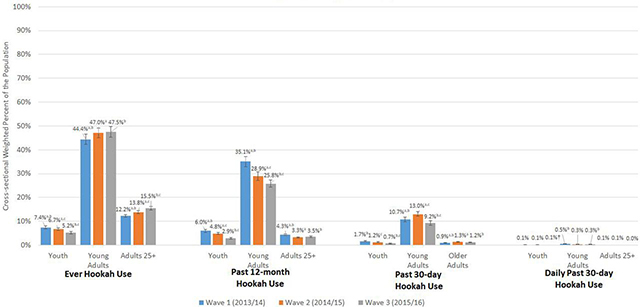
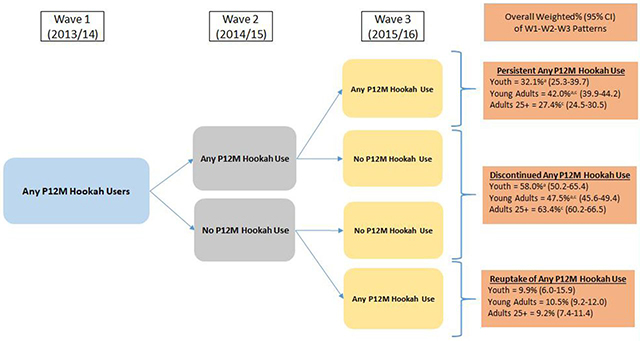
Results: Young adults had higher ever, past 12-month (P12M) and past 30-day cross-sectional prevalence of hookah use at each wave than youth or adults 25+. The majority of Wave 1 (W1) hookah users were P12M users of other tobacco products (youth: 73.9%, young adults: 80.5%, adults 25+: 83.2%). Most youth and adult W1 P12M hookah users discontinued use in Wave 2 or Wave 3 (youth: 58.0%, young adults: 47.5%, adults 25+: 63.4%). Most W1 P12M hookah polytobacco users used cigarettes (youth: 49.4%, young adults: 59.4%, adults 25+: 63.2%) and had lower rates of quitting all tobacco than exclusive hookah users or hookah polytobacco users who did not use cigarettes.
Conclusions: Hookah use is more common among young adults than among youth or adults 25+. Discontinuing hookah use is the most common pathway among exclusive or polytobacco hookah users. Understanding longitudinal transitions in hookah use is important in understanding behavioural outcomes at the population level.
Keywords: non-cigarette tobacco products; prevention; surveillance and monitoring.
© Author(s) (or their employer(s)) 2020. No commercial re-use. See rights and permissions. Published by BMJ.
Conflict of interest statement
Competing interests: WMC reports long-term stock holdings in General Electric Company, 3M Company, and Pfizer Incorporated, unrelated to this manuscript. No financial disclosures were reported by the other authors of this paper.
Figures
References
-
- Singh S, Saini A, Mittal V, Singh U, Singh V. Breath carbon monoxide levels in different forms of smoking. Indian Journal of Chest Diseases and Allied Sciences. 2011;53(1):25. - PubMed
Publication types
MeSH terms
Grants and funding
LinkOut - more resources
Full Text Sources
Miscellaneous