


Initiation of any tobacco and five tobacco products across 3 years among youth, young adults and adults in the USA: findings from the PATH Study Waves 1-3 (2013-2016)
- PMID: 32321852
- PMCID: PMC7534279
- DOI: 10.1136/tobaccocontrol-2019-055573
Initiation of any tobacco and five tobacco products across 3 years among youth, young adults and adults in the USA: findings from the PATH Study Waves 1-3 (2013-2016)
Abstract
Objective: This study reports weighted cross-sectional prevalence of never use of tobacco, and longitudinal past 12-month (P12M), past 30-day (P30D) and frequent P30D any tobacco or specific tobacco product initiation across three 1-year waves. Longitudinal three-wave pathways are examined to outline pathways of exclusive and polytobacco initiation, as well as pathways of new initiators of electronic nicotine delivery systems (ENDS) or cigarettes.
Design: Data were drawn from the first three waves (2013-2016) of the Population Assessment of Tobacco and Health Study, a nationally representative, longitudinal cohort study of US youth and adults. Respondents with data at all three waves (youth, N = 11 046; young adults, N = 6478; adults 25+, N = 17 188) were included in longitudinal analyses.
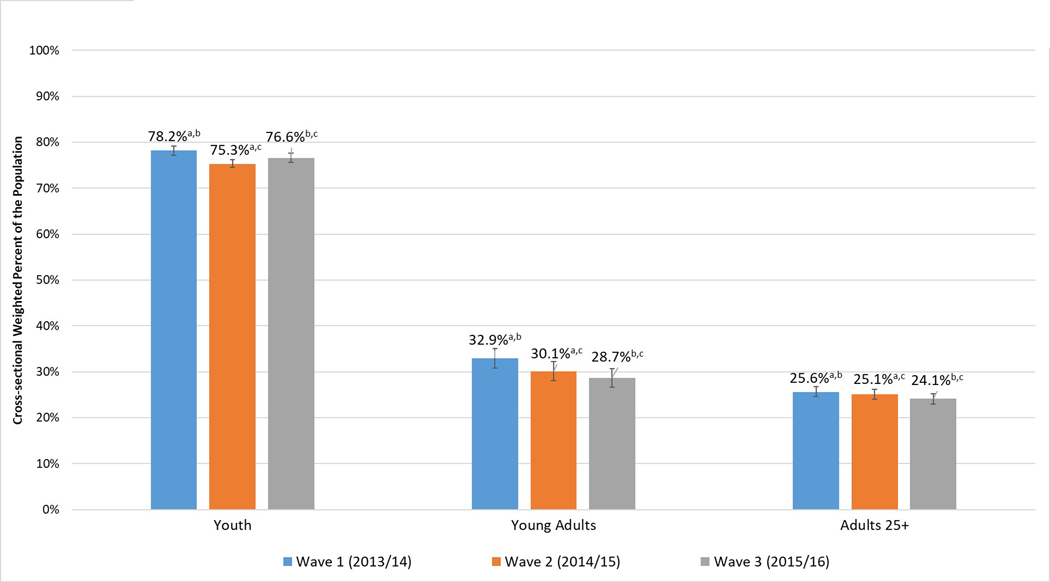
Results: Across the three age groups, weighted cross-sectional analyses revealed never any tobacco use decreased each year from 2013 to 2016, reflecting overall increases in tobacco initiation in the population during this time. Compared with cigarettes, cigars, hookah and smokeless tobacco, ENDS had the highest proportion of P12M initiation from Wave 1 to Wave 3 (W3) for each age group. Among youth Wave 2 P30D initiators of exclusive ENDS or cigarettes, the most common W3 outcome was not using any tobacco (ENDS: 59.0% (95% CI 48.4 to 68.8); cigarettes: 40.3% (95% CI 28.7 to 53.1)).
Conclusions: Initiation rates of ENDS among youth and young adults have increased the number of ever tobacco users in the US prevention strategies across the spectrum of tobacco products which can address youth initiation of tobacco products.
Keywords: non-cigarette tobacco products; prevention; surveillance and monitoring.
© Author(s) (or their employer(s)) 2020. No commercial re-use. See rights and permissions. Published by BMJ.
Conflict of interest statement
Competing interests: WMC reports long-term stock holdings in General Electric Company, 3M Company, and Pfizer Incorporated, unrelated to this manuscript. No financial disclosures were reported by the other authors of this paper.
Figures
References
-
- Miech RA, Schulenberg JE, Johnston LD, Bachman JG, O’Malley PM, & Patrick ME Trends in Lifetime Prevalence of Use of Various Drugs in Grades 8, 10, and 12. 2018.
-
- Hu S, Neff L, Agaku I, et al. Tobacco Product Use Among Adults-United States, 2013– 2014. MMWR Morb Mortal Wkly Rep. 2016;65(27):685. - PubMed
-
- US Department of Health and Human Services. The Health Consequences of Smoking— 50 Years of Progress: A Report of the Surgeon General. Atlanta, GA: US Department of Health and Human Services, Centers for Disease Control and Prevention, National Center for Chronic Disease Prevention and Health Promotion, Office on Smoking and Health; 2014:943.
-
- Lee YO, Hebert CJ, Nonnemaker JM, Kim AE. Youth tobacco product use in the United States. Pediatrics. 2015;135(3):409–415. - PubMed
Publication types
MeSH terms
Grants and funding
LinkOut - more resources
Full Text Sources
Medical
Miscellaneous
