Structure-based design of antiviral drug candidates targeting the SARS-CoV-2 main protease
- PMID: 32321856
- PMCID: PMC7179937
- DOI: 10.1126/science.abb4489
Structure-based design of antiviral drug candidates targeting the SARS-CoV-2 main protease
Abstract
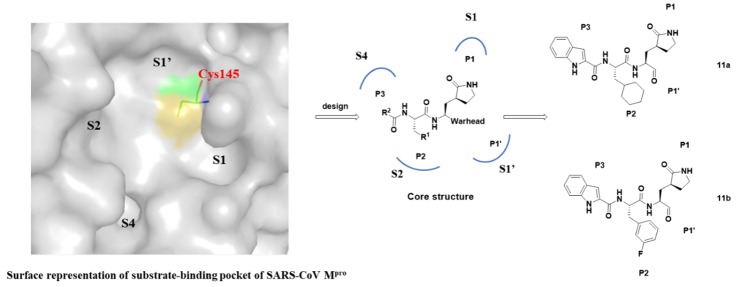
SARS-CoV-2 (severe acute respiratory syndrome coronavirus 2) is the etiological agent responsible for the global COVID-19 (coronavirus disease 2019) outbreak. The main protease of SARS-CoV-2, Mpro, is a key enzyme that plays a pivotal role in mediating viral replication and transcription. We designed and synthesized two lead compounds (11a and 11b) targeting Mpro Both exhibited excellent inhibitory activity and potent anti-SARS-CoV-2 infection activity. The x-ray crystal structures of SARS-CoV-2 Mpro in complex with 11a or 11b, both determined at a resolution of 1.5 angstroms, showed that the aldehyde groups of 11a and 11b are covalently bound to cysteine 145 of Mpro Both compounds showed good pharmacokinetic properties in vivo, and 11a also exhibited low toxicity, which suggests that these compounds are promising drug candidates.
Copyright © 2020 The Authors, some rights reserved; exclusive licensee American Association for the Advancement of Science. No claim to original U.S. Government Works.
Figures


Comment in
-
Promising inhibitors targeting Mpro: an ideal strategy for anti-SARS-CoV-2 drug discovery.Signal Transduct Target Ther. 2020 Aug 27;5(1):173. doi: 10.1038/s41392-020-00291-8. Signal Transduct Target Ther. 2020. PMID: 32855394 Free PMC article. No abstract available.
-
Structure of SARS-CoV-2 main protease in the apo state.Sci China Life Sci. 2021 Apr;64(4):656-659. doi: 10.1007/s11427-020-1791-3. Epub 2020 Sep 1. Sci China Life Sci. 2021. PMID: 32880863 Free PMC article. No abstract available.
References
-
- Li Q., Guan X., Wu P., Wang X., Zhou L., Tong Y., Ren R., Leung K. S. M., Lau E. H. Y., Wong J. Y., Xing X., Xiang N., Wu Y., Li C., Chen Q., Li D., Liu T., Zhao J., Liu M., Tu W., Chen C., Jin L., Yang R., Wang Q., Zhou S., Wang R., Liu H., Luo Y., Liu Y., Shao G., Li H., Tao Z., Yang Y., Deng Z., Liu B., Ma Z., Zhang Y., Shi G., Lam T. T. Y., Wu J. T., Gao G. F., Cowling B. J., Yang B., Leung G. M., Feng Z., Early Transmission Dynamics in Wuhan, China, of Novel Coronavirus-Infected Pneumonia. N. Engl. J. Med. 382, 1199–1207 (2020). 10.1056/NEJMoa2001316 - DOI - PMC - PubMed
-
- Chan J. F. W., Yuan S., Kok K.-H., To K. K.-W., Chu H., Yang J., Xing F., Liu J., Yip C. C.-Y., Poon R. W.-S., Tsoi H.-W., Lo S. K.-F., Chan K.-H., Poon V. K.-M., Chan W.-M., Ip J. D., Cai J.-P., Cheng V. C.-C., Chen H., Hui C. K.-M., Yuen K.-Y., A familial cluster of pneumonia associated with the 2019 novel coronavirus indicating person-to-person transmission: A study of a family cluster. Lancet 395, 514–523 (2020). 10.1016/S0140-6736(20)30154-9 - DOI - PMC - PubMed
-
- Zhou P., Yang X.-L., Wang X.-G., Hu B., Zhang L., Zhang W., Si H.-R., Zhu Y., Li B., Huang C.-L., Chen H.-D., Chen J., Luo Y., Guo H., Jiang R.-D., Liu M.-Q., Chen Y., Shen X.-R., Wang X., Zheng X.-S., Zhao K., Chen Q.-J., Deng F., Liu L.-L., Yan B., Zhan F.-X., Wang Y.-Y., Xiao G.-F., Shi Z.-L., A pneumonia outbreak associated with a new coronavirus of probable bat origin. Nature 579, 270–273 (2020). 10.1038/s41586-020-2012-7 - DOI - PMC - PubMed
-
- Wu F., Zhao S., Yu B., Chen Y.-M., Wang W., Song Z.-G., Hu Y., Tao Z.-W., Tian J.-H., Pei Y.-Y., Yuan M.-L., Zhang Y.-L., Dai F.-H., Liu Y., Wang Q.-M., Zheng J.-J., Xu L., Holmes E. C., Zhang Y.-Z., A new coronavirus associated with human respiratory disease in China. Nature 579, 265–269 (2020). 10.1038/s41586-020-2008-3 - DOI - PMC - PubMed
Publication types
MeSH terms
Substances
LinkOut - more resources
Full Text Sources
Other Literature Sources
Medical
Molecular Biology Databases
Miscellaneous