. 2020 Apr 22;12(540):eaax9106.
doi: 10.1126/scitranslmed.aax9106.

Gene-edited human stem cell-derived β cells from a patient with monogenic diabetes reverse preexisting diabetes in mice

Affiliations

Gene-edited human stem cell-derived β cells from a patient with monogenic diabetes reverse preexisting diabetes in mice

Kristina G Maxwell et al. Sci Transl Med. .

Abstract

Differentiation of insulin-producing pancreatic β cells from induced pluripotent stem cells (iPSCs) derived from patients with diabetes promises to provide autologous cells for diabetes cell replacement therapy. However, current approaches produce patient iPSC-derived β (SC-β) cells with poor function in vitro and in vivo. Here, we used CRISPR-Cas9 to correct a diabetes-causing pathogenic variant in Wolfram syndrome 1 (WFS1) in iPSCs derived from a patient with Wolfram syndrome (WS). After differentiation to β cells with our recent six-stage differentiation strategy, corrected WS SC-β cells performed robust dynamic insulin secretion in vitro in response to glucose and reversed preexisting streptozocin-induced diabetes after transplantation into mice. Single-cell transcriptomics showed that corrected SC-β cells displayed increased insulin and decreased expression of genes associated with endoplasmic reticulum stress. CRISPR-Cas9 correction of a diabetes-inducing gene variant thus allows for robust differentiation of autologous SC-β cells that can reverse severe diabetes in an animal model.


Conflict of interest statement

Competing interests: L.V.C., N.J.H., and J.R.M. are inventors on patent application (PCT/US19/32643; METHODS AND COMPOSITIONS FOR GENERATING CELLS OF ENDODERMAL LINEAGE AND BETA CELLS AND USES THEREOF) for material described in this manuscript.

Figures

Fig. 1.
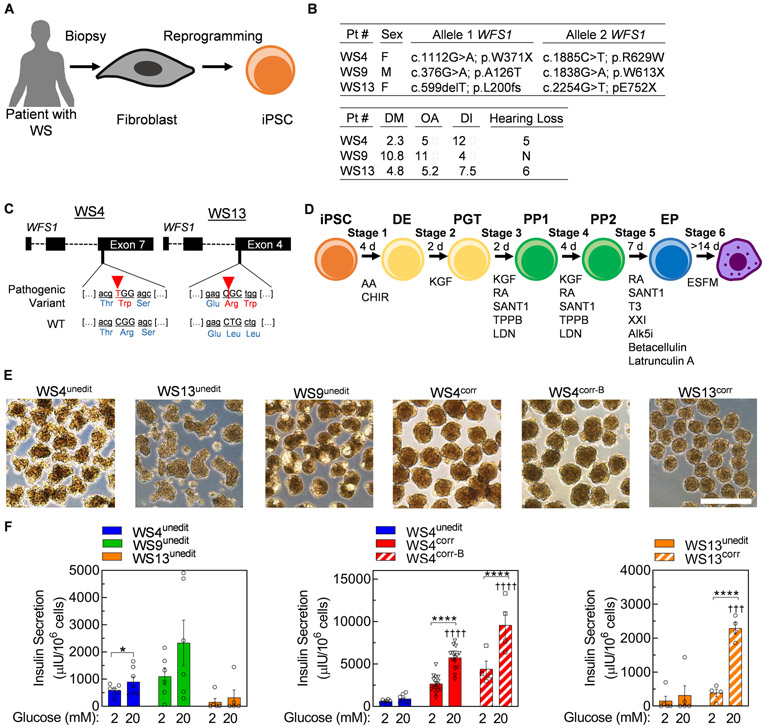
Fig. 1.. CRISPR/Cas9 correction of WFS1 generates functional WS SC-β cells in vitro.
(A) Schematic summary of iPSC generation from patients with WS. (B) Information on the 3 patients, including the genetic location of autosomal recessive pathogenic variants in WFS1 and age of symptom onset. N=none, M=male, F=female, DM=diabetes mellitus, OA=optic atrophy, DI=diabetes insipidus. (C) Gene variants in WFS1 in WS4unedit and WS13unedit iPSCs targeted for CRISPR/Cas9 correction. (D) Schematic of differentiation protocol mimicking embryonic development of pancreatic β cells. (E) Bright field images of stage 6 clusters produced from all cell lines in this study. Scale bar, 500 μm. (F) Static GSIS functional assessment of WS4unedit (n=7), WS9unedit (n=6), and WS13unedit (n=5), WS4corr (n=15) and WS4corr-B (n=4), and WS13corr (n=4) stage 6 cells in an in vitro static GSIS assay. Data with WS4unedit and WS13unedit cells are regraphed to help with comparisons. Y axes differ between panels. *p<0.05, ****p<0.0001 by one-way paired t-test. †††p<0.001, ††††p<0.0001 by two-way unpaired t-test comparing to high glucose in unedited cells. iPSC, induced pluripotent stem cell; DE, definitive endoderm; PGT, primitive gut tube; PP, pancreatic progenitor; EP, endocrine progenitor. Act A, activin A; CHIR, CHIR99021; KGF, keratinocyte growth factor; RA, retinoic acid; LDN, LDN193189; T3, triiodothyronine; Alk5i, Alk5 inhibitor type II; ESFM, enriched serum-free medium.
Fig. 2
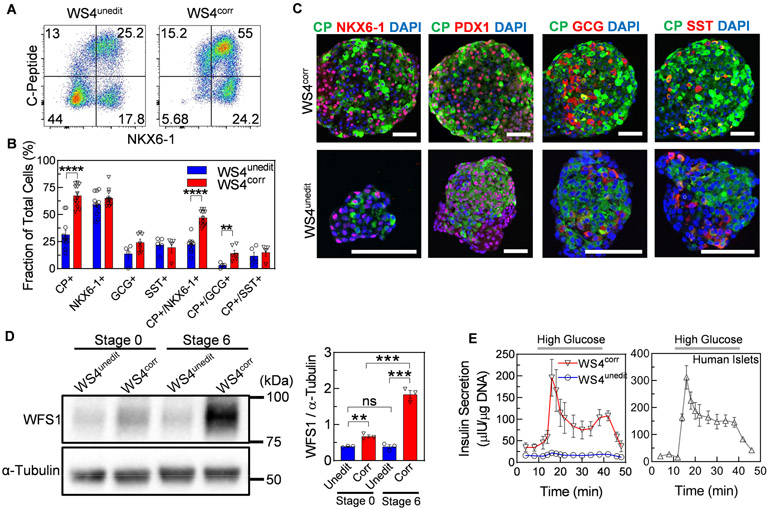
Fig. 2. In vitro characterization of unedited and corrected β cells from iPSCs derived from an individual with WS.
(A) Representative flow cytometry dot plots and (B) quantified fraction of cells expressing or co-expressing pancreatic β cell or islet markers for WS4unedit (n=4-7) and WS4corr (n=4-8) stage 6 cells. **p<0.01, ****p<0.0001 by two-way unpaired t-test. (C) Immunostaining of sectioned WS4corr and WS4unedit stage 6 clusters stained for β cell or islet markers. Scale bar, 100 μm. (D) Western blot (left) and quantified intensity (right) of WFS1 protein in stage 0 and stage 6 WS4corr (n=3) and WS4unedit (n=3) cells. **p<0.01, ***p<0.001 by two-way unpaired t-test. (E) Dynamic human insulin secretion of WS4corr (n=5) and WS4unedit (n=4) stage 6 cells and primary human islets (17). Clusters were perfused with 2 mM glucose except where indicated by high glucose (20 mM). CP, C-peptide; GCG, glucagon; SST, somatostatin.
Fig. 3.
Fig. 3.. Transplantation of gene edited patient-derived β cells into mice reverses preexisting diabetes.
(A) Schematic of diabetes induction with streptozotocin (STZ), transplantation of stage 6 cells containing WS SC-β cells, and nephrectomy of the transplanted mice. (B) Blood glucose measurements before and after STZ treatment, and after transplantation with SC-β cells or human islets. Five groups were studied: Diabetic mice without a transplant (STZ, No Txp; n=7; black), diabetic mice transplanted with WS4unedit stage 6 cells (STZ, WS4unedit Txp; 5x10⁶ cells; n=6; blue), diabetic mice transplanted with human islets (STZ, HI Txp; 4000 IEQ; n=4; dark grey), diabetic mice transplanted with WS4corr stage 6 cells (STZ, WS4corr Txp; 5x10⁶ cells; n=10; red), and non-diabetic mice with a sham transplant (No STZ, No Txp; n=5; light grey). (C) Immunostaining of sectioned kidney explanted from a mouse that had received WS4corr stage 6 cells 2 wk prior. Scale bar, 100 μm. (D) Glucose tolerance test (GTT) 9 d and 10 wk after Txp. Five groups were studied: STZ, No Txp (n=7 at 9 d and 10 wk; black); STZ, WS4unedit Txp (n=6 at 9 d; n=5 at 10 wk; blue); STZ, HI Txp (n=4 at 9 d; dark grey); STZ, WS4corr Txp (n=10 at 9 d; n=9 at 10 wk; red); and No STZ, No Txp (n=5 at 9 d and 10 wk; light grey). (E) Area under the curve (AUC) quantification of GTT data. **p<0.01, ***p<0.001 by Mann-Whitney two-tailed nonparametric test. (F) In vivo GSIS secretion 2 and 10 wk after transplantation for STZ, WS4unedit Txp (n=6 and 5 at 2 and 10 wk; blue); STZ, WS4corr Txp (n=10 and 9 at 2 and 10 wk; red); and STZ, HI Txp (n=4; dark grey) mice at 0 and 60 min after 2 g/kg glucose injection. ns=not significant, **p<0.01 by one-way paired t-test. †p<0.05, †††p<0.001 by two-way unpaired t-test compared to WS4unedit 60 min measurements. (G) Molar ratio of serum human proinsulin to insulin for STZ, WS4unedit Txp (n=5; blue) and STZ, WS4corr Txp (n=9; red) 60 min after 2 g/kg glucose injection 10 wk after transplantation. ***p<0.001 by two-way unpaired t-test. (H) Blood glucose measurements before and after nephrectomy of two STZ, WS4corr Txp (orange) mice compared to remaining non-nephrectomized STZ, WS4corr Txp (n=6; red). CP, C-peptide; GCG, glucagon; SST, somatostatin.
Fig. 4.
Fig. 4.. Single cell transcriptional analysis reveals WS4corr and WS4unedit SC-β cell populations and off-targets.
(A) tSNE projection from unsupervised clustering of transcriptional data from scRNA-seq of WS4unedit and WS4corr stage 6 cells. (B) Calculated percentages of defined cluster populations for WS4unedit and WS4corr stage 6 cells. (C) Heat map of key β cell population gene markers (insulin [INS], chromogranin A [CHGA], SPINK1, ID3) with low/none (grey), medium (yellow), and high (red) expression. NP1, neural progenitor 1; NP2, neural progenitor 2; NP3, neural progenitor 3; PH, polyhormonal; EC, enterochromaffin.
Fig. 5.
Fig. 5.. CRISPR/Cas9 correction of WFS1 improves β cell gene expression in differentiated cells.
(A) Violin plots detailing log-normalized gene expression of β cell and islet markers in the WS4unedit (blue) and WS4corr (red) SC-β cell populations defined in Fig. 4. Log fold change and p-values for violin plots are available in table S3A. (B) Real-time PCR analysis of the total stage 6 population measuring expression of β cell and islet genes for WS4unedit (n=6-13; blue) and WS4corr (n=7-14; red). **p<0.01, ***p<0.001, ****p<0.0001 by Man-Whitney two-tailed nonparametric test. (C), Immunostaining of single-cell dispersed WS4corr and WS4unedit stage 6 cells stained for indicated pancreatic and β cell markers. Scale bar, 50 μm.
Fig. 6.
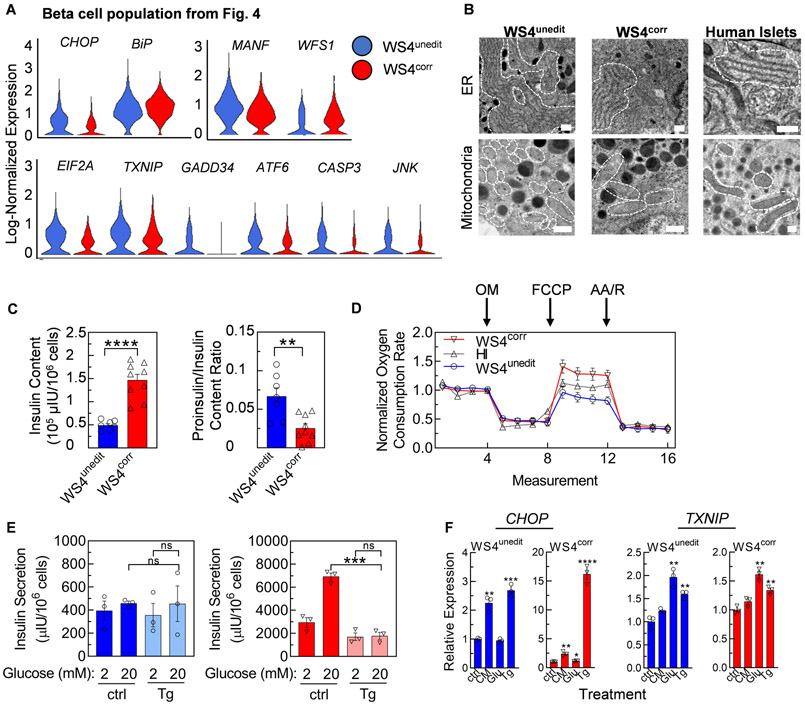
Fig. 6.. CRISPR/Cas9 correction of WFS1 reduces WS SC-β cell stress.
(A) Violin plots detailing log-normalized expression of stress genes in the WS4unedit (blue) and WS4corr (red) SC-β cell populations defined in Fig. 4. Log fold-change and adjusted p-values for violin plots available in table S3B. (B) Representative transmission electron microscopy images of ER (top) and mitochondria (bottom) for WS4unedit, WS4corr SC-β cells, and human islets. White dotted lines outline the ER and mitochondria in the cell cytoplasm. Scale bar, 500 nm. (C) Human insulin content (left) and proinsulin/insulin content ratio (right) of WS4unedit (n=7; blue) and WS4corr (n=9; red) stage 6 cells. **p<0.01, ****p<0.0001 by two-way unpaired t-test. (D) Mitochondrial respiration of WS4unedit stage 6 (n=11; blue), WS4corr stage 6 (n=9; red), and human islets (n=6; dark grey) represented as percentage of baseline oxygen consumption rate measurements. Respiration was interrogated by measuring changes in relative OCR after injection with oligomycin (OM), FCCP, and antimycin A (AA)/rotenone (R). (E) Static GSIS functional assessment of stage 6 cells treated with DMSO or thapsigargin (Tg). n=3. *** p<0.001 by two-way unpaired t-test. ns, not significant. (F) Real-time PCR analysis of bulk stage 6 population measuring expression of stress genes after treatment with cytokine mixture (CM), high glucose (Glu), or Tg. n=4. **p<0.01, ***p<0.001 by two-way unpaired t-test compared to ctrl. ctrl=control.

References

    1. Karagiannis P, Takahashi K, Saito M, Yoshida Y, Okita K, Watanabe A, Inoue H, Yamashita JK, Todani M, Nakagawa M. J. P. r., Induced pluripotent stem cells and their use in human models of disease and development. 99, 79–114 (2018). - PubMed
    1. Takahashi K, Tanabe K, Ohnuki M, Narita M, Ichisaka T, Tomoda K, Yamanaka S. J. c., Induction of pluripotent stem cells from adult human fibroblasts by defined factors. 131, 861–872 (2007). - PubMed
    1. Atkinson MA, Eisenbarth GS, Michels AW, Type 1 diabetes. Lancet 383, 69–82 (2014). - PMC - PubMed
    1. Nathan DM, Long-term complications of diabetes mellitus. N Engl J Med 328, 1676–1685 (1993). - PubMed
    1. Shapiro AM, Lakey JR, Ryan EA, Korbutt GS, Toth E, Warnock GL, Kneteman NM, Rajotte RV, Islet transplantation in seven patients with type 1 diabetes mellitus using a glucocorticoid-free immunosuppressive regimen. N Engl J Med 343, 230–238 (2000). - PubMed

Publication types