. 2020 Apr 15:12:32.
doi: 10.1186/s13098-020-00540-4. eCollection 2020.

Effect of circulating exosomes derived from normal-weight and obese women on gluconeogenesis, glycogenesis, lipogenesis and secretion of FGF21 and fetuin A in HepG2 cells

Affiliations

Effect of circulating exosomes derived from normal-weight and obese women on gluconeogenesis, glycogenesis, lipogenesis and secretion of FGF21 and fetuin A in HepG2 cells

Reza Afrisham et al. Diabetol Metab Syndr. .

Abstract

Background: It is generally accepted that obesity can lead to metabolic disorders such as NAFLD and insulin resistance. However, the underlying mechanism has been poorly understood. Moreover, there is evidence to support the possible role of exosomes in the metabolic homeostasis regulation. Accordingly, we aimed to determine the effect of plasma circulating exosomes derived from obese and normal-weight women on insulin signaling and the secretion of hepatokines in human liver cells.

Methods: Plasma exosomes isolated from four obese (O-Exo) women and four normal-weight (N-Exo) female candidates were characterized for size, zeta potential, and CD63 protein expression and were used for stimulation of HepG2 cells. Then, cell viability, as well as levels of glycogen and triglyceride (TG), were evaluated. Levels of fetuin-A and FGF21 were measured using the ELISA kit. Expression of glucose 6-phosphatase (G6pase) and phosphoenolpyruvate carboxykinase (PEPCK) genes were determined using qRT-PCR. Western blot analysis was carried out to evaluating the phosphorylation of GSK3β.

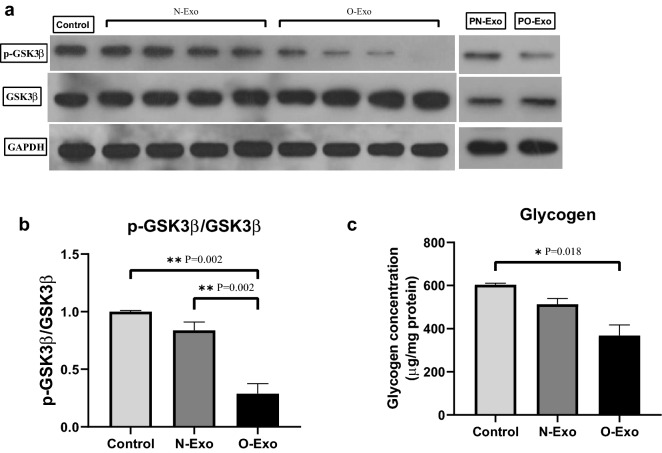
Results: The TG levels increased significantly in the cells treated with O-Exo than the control (vehicle) group (P = 0.005) and normal-weight group (P = 0.018). Levels of p-GSK3β and glycogen were significantly reduced by O-Exo in comparison with control (P = 0.002, P = 0.018, respectively). The mRNA expression of G6pase and PEPCK enzymes increased in the cells treated with O-Exo in comparison with the vehicle group (P = 0.017, P = 0.010, respectively). The levels of FGF21 in the supernatant of cells treated with O-Exo and N-Exo were significantly lower than the control group (P = 0.007).

Conclusion: It appears that obesity-related circulating exosomes can impair insulin signaling pathways and associated components, increase intracellular TG content, and decrease FGF21 secretion in the hepatocytes.

Keywords: Exosome; Hepatokine; Insulin resistance; Obesity; Type 2 diabetes.


Conflict of interest statement

Competing interestsThe authors declare no conflict of interest.

Figures

Fig. 1
Fig. 1
Characterization of plasma exosomes. The isolated exosomes were characterized for size, zeta potential and CD63 protein expression. a The mean hydrodynamic size of the isolated exosoms. b Morphology and size of isolated exosomes using TEM (scale bar, 100 nm). c Western blot results that confirmed the expression of common exosomal protein marker CD63
Fig. 2
Fig. 2
The different values of exosome were used for the determination of the dose. a The different doses of 0.25–64 µg/mL were applied in the MTT assay that the doses of 0.25–4 µg/mL were the optimal doses for the next experiments. b The phosphorylation of GSK3β at Ser-9 position was determined in the cells treated with the doses of 2 and 4 µg/mL PN-Exo and PO-Exo using western blot analysis that c based on p-GSK3β/GSK3β ratio, the dose of 4 µg/mL were detected as the optimal dose for the future treatments (P = 0.014). PN-Exo; pooled exosomes obtained from normal-weight women, PO-Exo; pooled exosomes obtained from obese women. The data are presented as median ± IQR
Fig. 3
Fig. 3
a MTT colorimetric test to measure cell viability following treatment with O-Exo, N-Exo and vehicle (PBS) as control group. b The effect of exosomes on intracellular triglyceride (TG) concentration in HepG2 cells. c Oil red O staining of HepG2 cells treated with vehicle (control group) and pooled exosomes obtained from normal-weight women (normal group) or obese women (obese group). The data are presented as mean ± SEM
Fig. 4
Fig. 4
The effect of exosomes derived from normal-weight and obese women on a the phosphorylation of GSK3β using western blot analysis, b p-GSK3β/GSK3β ratio and c glycogen concentration. PN-Exo; pooled exosomes obtained from normal-weight women, PO-Exo; pooled exosomes obtained from obese women. The data are presented as mean ± SEM
Fig. 5
Fig. 5
The effect of exosomes derived from normal-weight and obese women on a mRNA expression of G6Pase and b mRNA expression of PEPCK enzyme. The data related to PEPCK and G6Pase are presented as mean ± SEM and median ± IQR, respectively
Fig. 6
Fig. 6
The effect of exosomes derived from normal-weight and obese women on a fetuin-A and b FGF21. The data are presented as mean ± SEM

References

    1. Meex RC, Watt MJ. Hepatokines: linking nonalcoholic fatty liver disease and insulin resistance. Nat Rev Endocrinol. 2017;13(9):509. doi: 10.1038/nrendo.2017.56. - DOI - PubMed
    1. Kranendonk ME, Visseren FL, van Herwaarden JA, Nolte-’t Hoen EN, de Jager W, Wauben MH, et al. Effect of extracellular vesicles of human adipose tissue on insulin signaling in liver and muscle cells. Obesity. 2014;22(10):2216–2223. doi: 10.1002/oby.20847. - DOI - PubMed
    1. Kahn BB, Flier JS. Obesity and insulin resistance. J Clin Investig. 2000;106(4):473–481. doi: 10.1172/JCI10842. - DOI - PMC - PubMed
    1. Shi H, Kokoeva MV, Inouye K, Tzameli I, Yin H, Flier JS. TLR4 links innate immunity and fatty acid–induced insulin resistance. J Clin Investig. 2006;116(11):3015–3025. doi: 10.1172/JCI28898. - DOI - PMC - PubMed
    1. Guay C, Regazzi R. Exosomes as new players in metabolic organ cross-talk. Diabetes Obes Metab. 2017;19(Suppl 1):137–146. doi: 10.1111/dom.13027. - DOI - PubMed

LinkOut - more resources