


Unique tooth dislocation into submental space during a pan facial trauma - Importance of an orthopantomogram
- PMID: 32322653
- PMCID: PMC7168764
- DOI: 10.1016/j.tcr.2020.100304
Unique tooth dislocation into submental space during a pan facial trauma - Importance of an orthopantomogram
Erratum in
-
Erratum regarding missing patient consent statement in previously published articles.Trauma Case Rep. 2023 Mar 1;45:100814. doi: 10.1016/j.tcr.2023.100814. eCollection 2023 Jun. Trauma Case Rep. 2023. PMID: 37234592 Free PMC article.
Abstract
Background: There are certain reported cases of unusual displacements of teeth involved in a maxillofacial trauma to the maxillary sinus, nasal cavity, gastrointestinal tract or the airway, if worst. All these usually lead to complication the worst being death. So enquiring about them is a very essential part of surveying a maxillofacial trauma patient involving dentition.
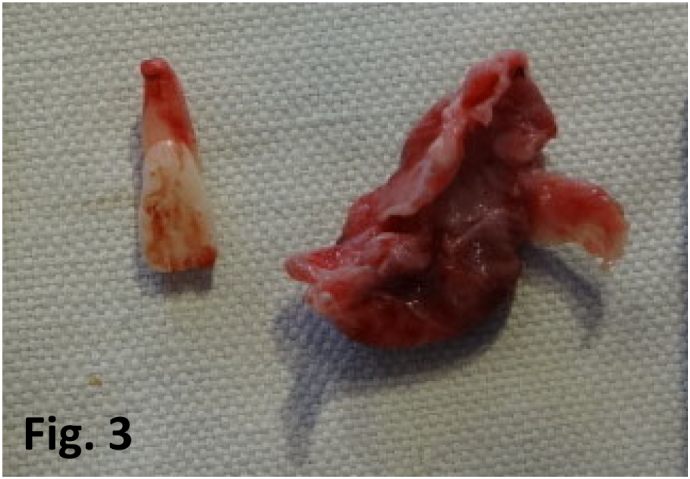
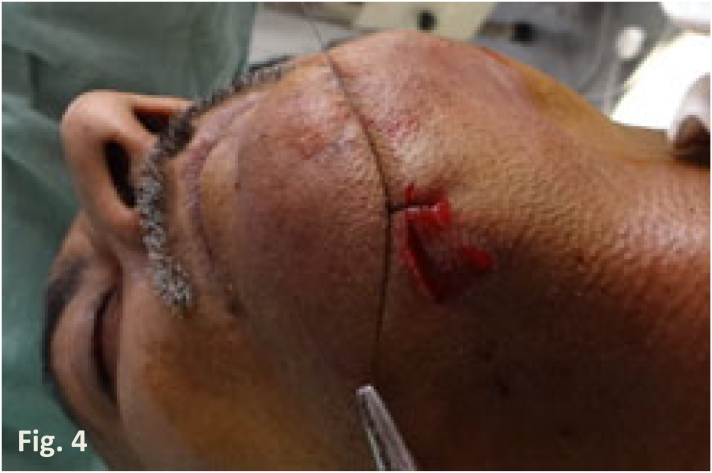
Case: This patient was referred to our department for a dental consultation for his ill-defined firm, mildly tender, non-suppurative, submental swelling unresponsive to medication. He had undergone a polytrauma involving his face two months back. An orthopantomogram was ordered which showed a lower central incisor from the fracture site had slipped through the fracture gap into the submental space possibly missed by the CT scan. There was also a lower border splaying at the fracture site. A layer-wise dissection was done extra-orally to retrieve the tooth.
Conclusion: This case envisages the importance of an OPG as an adjuvant to the basic radiographic study, in the emergency room, for a patient with oral and maxillofacial trauma. It also establishes the importance of a meticulous secondary survey, including counting the number of teeth and establishing a correct occlusion to avoid a complication and re-operation. Besides, a medical negligence lawsuit can also arise as some teeth may slip to lungs even.
Keywords: Maxillofacial trauma; Orthopantomogram; Secondary survey; Tooth displacement.
© 2020 Published by Elsevier Ltd.
Conflict of interest statement
The authors report no conflicts of interest. The authors alone are responsible for the content and writing of the paper.
Figures


References
-
- Michael J., Donald M.B., Swinburn Elizabeth. Tooth in the perioral tissues: a complication of craniofacial trauma. Am. J. Emerg. Med. January 2005;23(1):87–88. - PubMed
-
- Chrcanovic B., Bueno S., Silveira D., Luis N., Custódio A. Traumatic displacement of maxillary permanent incisor into the nasal cavity. Oral Maxillofac. Surg. September 2010;14(3):175–182. - PubMed
-
- Henderson C.T., Engel J., Schlesinger P. Foreign body ingestion: review and suggested guidelines for management. Endoscopy. March 1987;19(2):68–71. - PubMed
-
- Cubukcu C.E., Aydin U., Ozbek S. Delayed removal of a primary incisor embedded in the upper lip after dental trauma: a case report about the importance of soft tissue examination. Dent. Traumatol. 2011;27(4):314–317. - PubMed
Publication types
LinkOut - more resources
Full Text Sources
Miscellaneous
