


Immune Responses Regulated by Cannabidiol
- PMID: 32322673
- PMCID: PMC7173676
- DOI: 10.1089/can.2018.0073
Immune Responses Regulated by Cannabidiol
Abstract
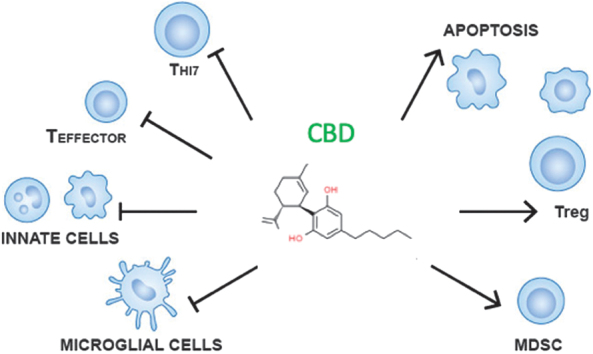
Introduction: Cannabidiol (CBD) as Epidiolex® (GW Pharmaceuticals) was recently approved by the U.S. Food and Drug Administration (FDA) to treat rare forms of epilepsy in patients 2 years of age and older. Together with the increased societal acceptance of recreational cannabis and CBD oil for putative medical use in many states, the exposure to CBD is increasing, even though all of its biological effects are not understood. Once such example is the ability of CBD to be anti-inflammatory and immune suppressive, so the purpose of this review is to summarize effects and mechanisms of CBD in the immune system. It includes a consideration of reports identifying receptors through which CBD acts, since the "CBD receptor," if a single one exists, has not been definitively identified for the myriad immune system effects. The review then provides a summary of in vivo and in vitro effects in the immune system, in autoimmune models, with a focus on experimental autoimmune encephalomyelitis, and ends with identification of knowledge gaps. Conclusion: Overall, the data overwhelmingly support the notion that CBD is immune suppressive and that the mechanisms involve direct suppression of activation of various immune cell types, induction of apoptosis, and promotion of regulatory cells, which, in turn, control other immune cell targets.
Keywords: cannabidiol; immune response; inflammation.
© James M. Nichols and Barbara L.F. Kaplan 2020; Published by Mary Ann Liebert, Inc.
Conflict of interest statement
No competing financial interests exist.
Figures
References
-
- Mechoulam R, Hanus L. Cannabidiol: an overview of some chemical and pharmacological aspects. Part I: chemical aspects. Chem Phys Lipids. 2002;121:35–43 - PubMed
-
- Mechoulam R, Shvo Y. Hashish. I. The structure of cannabidiol. Tetrahedron. 1963;19:2073–2078 - PubMed
-
- Hanus LO, Tchilibon S, Ponde DE, et al. Enantiomeric cannabidiol derivatives: synthesis and binding to cannabinoid receptors. Org Biomol Chem. 2005;3:1116–1123 - PubMed
-
- Gaoni Y, Mechoulam R. Isolation, structure, and partial suntheis of an active constituent of hashish. J Am Chem Soc. 1964;86:1646–1647
-
- Institute of Medicine; Joy JE, Watson SJ Jr., Benson JA. Marijuana and medicine: assessing the science base. National Academies Press: Washington, DC, 1999 - PubMed
Publication types
LinkOut - more resources
Full Text Sources
Other Literature Sources
