Review
. 2020 Jul;165(7):1517-1526.
doi: 10.1007/s00705-020-04628-0. Epub 2020 Apr 22.

The emergence of SARS, MERS and novel SARS-2 coronaviruses in the 21st century

Affiliations
Review

The emergence of SARS, MERS and novel SARS-2 coronaviruses in the 21st century

Vivaldo Gomes da Costa et al. Arch Virol. 2020 Jul.

Abstract

At the beginning of the 21st century, a new deadly infectious disease known as severe acute respiratory syndrome (SARS) was recognized as a global public health threat. Subsequently, ten years after the initial SARS cases occurred in 2002, new cases of another atypical respiratory disease caused worldwide concern. This disease became known as Middle East respiratory syndrome (MERS) and was even more lethal than SARS. Currently, history has repeated itself with the emergence of a new Chinese epidemic at the end of 2019. For this respiratory disease, called COVID-19, a novel coronavirus (SARS-CoV-2) was identified as the etiologic agent. In sum, SARS, MERS and COVID-19 are caused by recently discovered coronaviruses that cause flu-like illnesses, but with a clinical outcome that tends to be more severe. As a result of the current importance of coronaviruses in global public health, we conducted a review to summarize and update, above all, the epidemiological historical aspects of the three major diseases in humans caused by coronaviral infection.


Conflict of interest statement

All authors declare that they have no conflict of interest.

Figures

Fig. 1
Fig. 1
Viral replication cycle in eukaryotic cells. The virus binds to a cell-surface receptor (ACE2 for SARS-CoV and SARS-CoV-2; DPP4 for MERS-CoV), and fusion of the virion and cell membrane occurs on the cell surface or from within endosomes, depending on the virus. The fusion is triggered by low pH, leading to the release of the nucleocapsid into the cytoplasm. The viral genome is translated to produce proteins 1a and 1ab (the latter by recoding ribosomal translation or ribosomal frameshift). These 1a and 1ab proteins are processed by viral proteases to produce a variety of viral proteins, including RNA-dependent RNA polymerase (RdRp), proteins that remodel cell membranes to form structures that are used as viral RNA synthesis sites, enzymes that catalyze several steps in the synthesis of the 5’-terminal cap structure of the mRNA, and an exonuclease involved in proofreading during genome replication. The other viral proteins are encoded by a nested set of mRNAs that share a common leader sequence (5’ UTR) at the 5’ end. Discontinuous RNA synthesis occurs during synthesis of the negative RNA strand. Most of the positive strand is not copied, probably because it loosens when the polymerase completes synthesis up to the 5’ UTR. The resulting negative-strand RNAs, with 3’ UTR sequences at the ends, are then copied to form mRNAs. These mRNAs are translated to form the structural and non-structural proteins. M, S and E proteins attached to the membrane are inserted into the lumen of the endoplasmic reticulum and then move to the site of viral assembly, the intermediate compartment of the endoplasmic reticulum-Golgi (ERGIC). Full-length negative-strand RNAs are produced, and these serve as templates for the synthesis of full-length positive-strand RNAs, which are then encapsulated by protein N. The nucleocapsid buds into the ERGIC, acquiring a membrane that contains the proteins S, E and M. Viral particles are transported to the plasma membrane in smooth-walled vesicles and released from the cell by exocytosis when the carrier vesicle fuses with the plasma membrane [26, 28]
Fig. 2
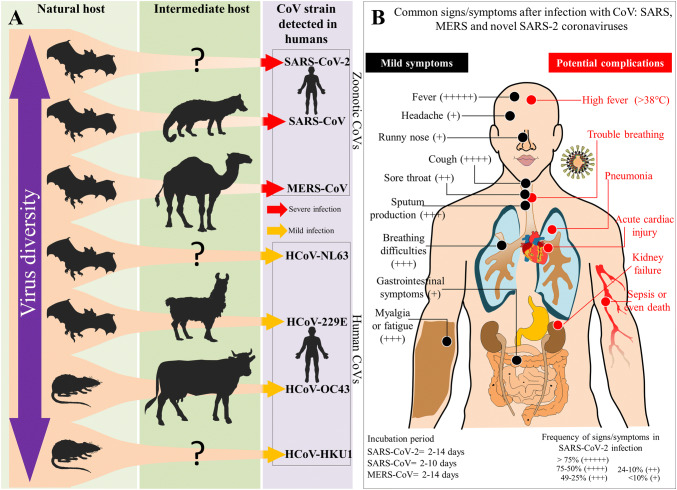
Fig. 2. A.
Summary of the groups of animals that serve as natural and intermediate hosts for the seven CoVs that can cause disease in humans. The different CoVs can cause moderate or severe infections in humans, and some of the intermediate hosts of these viruses are not yet known. B. Infections by different CoVs cause signs and symptoms that overlap regardless of the type of virus that causes the disease. The signs and symptoms can affect different systems and organs, varying from mild symptoms in most cases (fever, cough, myalgia, headache, and runny nose, among other symptoms), which can progress to complications with a worse prognosis (pneumonia, kidney failure, breathing problems, acute cardiac injury, sepsis and death). The incubation period differs between CoVs, generally ranging from 2 to 14 days [, –69]
Fig. 3
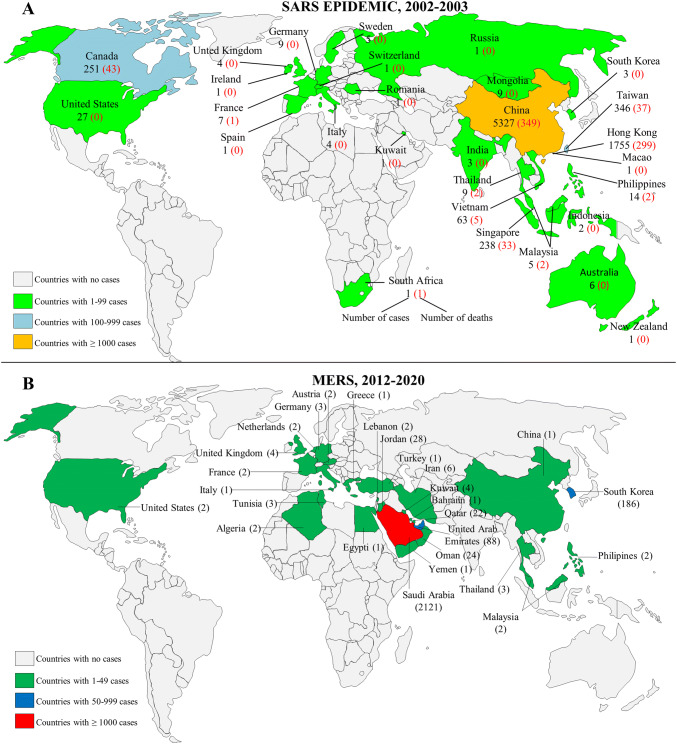
Fig. 3
Current geographic distribution of SARS (A) and MERS (B). Data are from the World Health Organization (https://www.who.int/csr/sars/country/table2004_04_21/en/). http://www.emro.who.int/health-topics/mers-cov/mers-outbreaks.html) and were collected through March 23, 2020
Fig. 4
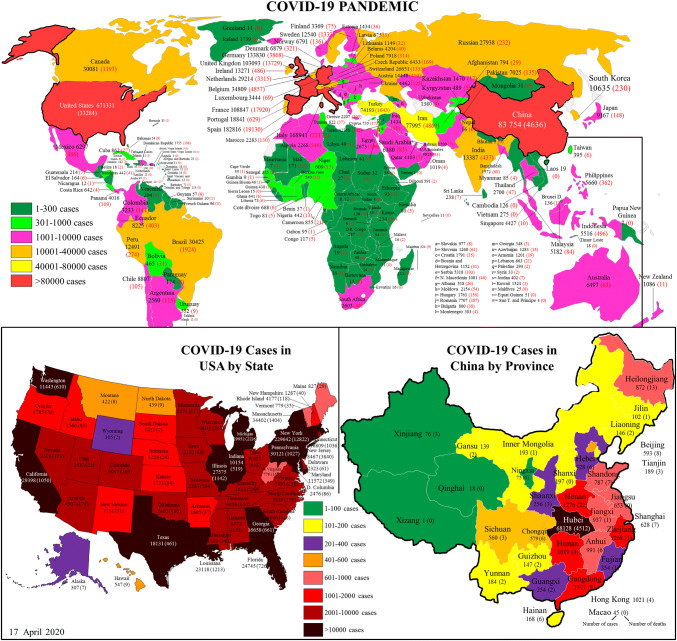
Fig. 4
Current geographic distribution of COVID-19 cases. Data are from the European CDC (https://www.ecdc.europa.eu/en/geographical-distribution-2019-ncov-cases) and were collected through April 17, 2020. At that time, the total number of cases was 2,114,269, with 145,144 deaths

References

    1. Lee C. Porcine epidemic diarrhea virus: An emerging and re-emerging epizootic swine virus. Virol J. 2015;12(1):193. doi: 10.1186/s12985-015-0421-2. - DOI - PMC - PubMed
    1. Bande F, Arshad SS, Hair Bejo M, Moeini H, Omar AR. Progress and challenges toward the development of vaccines against avian infectious bronchitis. J Immunol Res. 2015 doi: 10.1155/2015/424860. - DOI - PMC - PubMed
    1. Vabret A, Mourez T, Gouarin S, Petitjean J, Freymuth F. An outbreak of coronavirus OC43 respiratory infection in Normandy, France. Clin Infect Dis. 2003;36(8):985–989. doi: 10.1086/374222. - DOI - PMC - PubMed
    1. Vabret A, Dina J, Gouarin S, Petitjean J, Tripey V, Brouard J, Freymuth F. Human (non-severe acute respiratory syndrome) coronavirus infections in hospitalised children in France. J Paediatr Child Health. 2008;44(4):176–181. doi: 10.1111/j.1440-1754.2007.01246.x. - DOI - PMC - PubMed
    1. Luo G, Gao SJ, Global Health Concern stirred by emerging viral infections. J Med Virol. 2020 doi: 10.1002/jmv.25683. - DOI - PMC - PubMed

MeSH terms