Review
. 2020 Nov;23(6):1129-1141.
doi: 10.1007/s10071-020-01383-2. Epub 2020 Apr 22.

Multimodal interactions in insect navigation

Affiliations
Review

Multimodal interactions in insect navigation

Cornelia Buehlmann et al. Anim Cogn. 2020 Nov.

Abstract

Animals travelling through the world receive input from multiple sensory modalities that could be important for the guidance of their journeys. Given the availability of a rich array of cues, from idiothetic information to input from sky compasses and visual information through to olfactory and other cues (e.g. gustatory, magnetic, anemotactic or thermal) it is no surprise to see multimodality in most aspects of navigation. In this review, we present the current knowledge of multimodal cue use during orientation and navigation in insects. Multimodal cue use is adapted to a species' sensory ecology and shapes navigation behaviour both during the learning of environmental cues and when performing complex foraging journeys. The simultaneous use of multiple cues is beneficial because it provides redundant navigational information, and in general, multimodality increases robustness, accuracy and overall foraging success. We use examples from sensorimotor behaviours in mosquitoes and flies as well as from large scale navigation in ants, bees and insects that migrate seasonally over large distances, asking at each stage how multiple cues are combined behaviourally and what insects gain from using different modalities.

Keywords: Ants; Cue integration; Insects; Multimodal navigation; Olfaction; Vision.


Conflict of interest statement

All three authors have no conflict of interest.

Figures
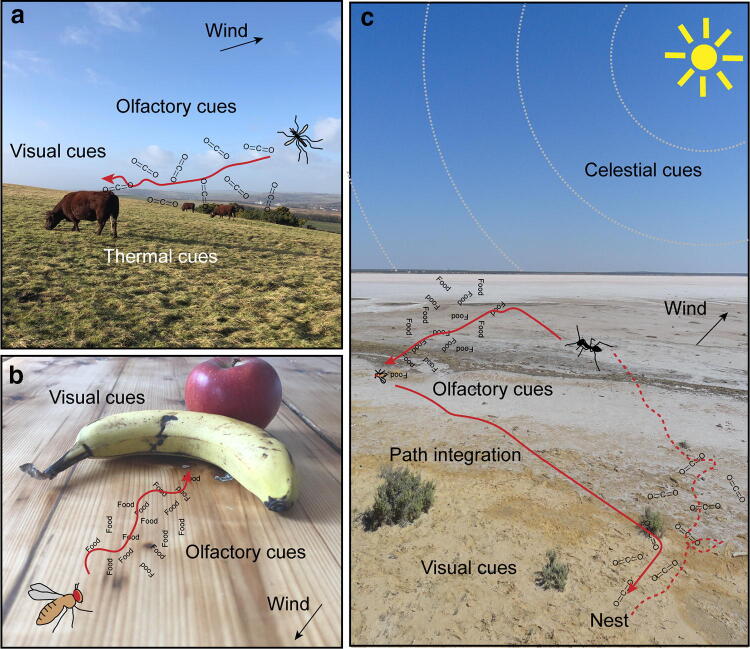
Fig. 1
Fig. 1
Multimodal orientation and navigation in insects. a Attraction to CO2 exhaled by a host activates a strong attraction to visual cues in mosquitoes. Once the mosquito is close to the victim, thermal cues emitted by the host are detected and used for the final approach. Here and below, the paths prior to and following sensory stimulation are shown as red dashed and red solid lines, respectively. b Drosophila flies accurately approach a piece of fruit using both olfactory and visual cues. The presence of visual cues enhances the tracking of an attractive odour plume. c Ants combine innate (e.g. path integration) and learnt navigational strategies to perform long and complex foraging journeys. Idiothetic information, input from sky compasses (e.g. position of the sun and the polarised pattern in the sky shown as grey dashed lines), terrestrial visual information (e.g. from vegetation), prevailing wind direction, and odours emitted by the ants’ nest, dead arthropods and the environment (odour plumes shown in black) are shown here (colour figure online)
Fig. 2
Fig. 2
Multimodal compasses in insects. a Insects derive their orientation with respect to the solar and lunar azimuths either through direct observation (1.) or indirect measures (2. detection of the contrasolar/contralunar azimuth which has the highest degree of polarisation; 3. measurement of chromatic gradients; 4. sampling the polarised light pattern). b Insects also orient with respect to prominent visual features such as the visual panorama (top) or the milky way (bottom). Background fisheye images are sampled from dung beetle habitats in South Africa and provided by Dr James Foster. c Consistent wind provides a short-term orientation cue known to be used by ants and dung beetles. d Insects derive their orientation with respect to the Earth’s North–South axis but the sensory pathways remain unresolved. e Proprioception tracks changes in animal heading iteratively, which is suitable for direction tracking over short durations, for instance, changing direction alters haltere orbits. Insect species combine these multimodal and multiscale compasses differently depending on their navigational need, for example, simple course stabilisation in dung-beetles, central-place navigation in ants, and long-range migration in butterflies
Fig. 3
Fig. 3
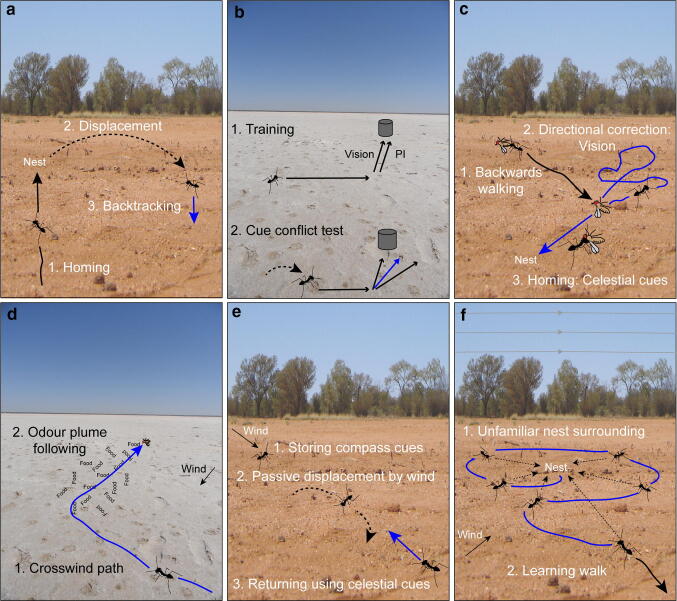
Examples of multimodal interactions in navigating ants. a If an ant runs off her entire PI vector (1.), is captured near her nest entrance and displaced and released at a novel location (2.), she will search for the nest. Ants from visually rich environments do not show random initial directions, rather, their bearings are biased in the nest-to-feeder direction (3.). The recent experience of the visual surroundings near the nest leads to this backtracking behaviour. b Ants are trained to navigate along a route (shown as arrows) using PI and visual guidance (1.). PI and visual cues are used simultaneously and when information from PI and visual guidance are in conflict (2.), ants head in intermediate directions (shown in blue). c Ants with a large piece of food walk backwards (1.). Occasionally they drop their piece of food and perform small loops, allowing familiar visual scenes to correct their heading direction (2.). Backwards walking is resumed with their updated heading subsequently controlled by celestial compass information (3.). d Foraging desert ants combine a high sensitivity to food odours with specific movement patterns that increase the time they spend moving in crosswind paths and this combination of wind (1.) and odour information (2.) increases food detection speeds. e When there are strong gusts of wind, ants ‘clutch’ to the ground to resist being blown away, and compute and store the compass direction of the wind using their current heading and the relative direction of the wind to their body (1.) After they are blown away (2.), ants can use the integrated information to walk back in the direction opposite to the one they had just been blown away (3.). f At the beginning of each ants’ foraging career or when the appearance of the world has changed (1.), ants start with short excursions in the close vicinity of the nest (2.). The characteristically structured elements of these learning walks are shaped by multiple information sources, such as PI, terrestrial visual information, wind direction, or the earth’s magnetic field (shown as grey lines in the sky) (colour figure online)

References

    1. Ardin PB, Mangan M, Webb B. Ant homing ability is not diminished when traveling backwards. Front Behav Neurosci. 2016;10:69. - PMC - PubMed
    1. Avargues-Weber A, Deisig N, Giurfa M. Visual cognition in social insects. Annu Rev Entomol. 2011;56:423–443. - PubMed
    1. Baader AP. The significance of visual landmarks for navigation of the giant tropical ant, Paraponera clavata (Formicidae, Ponerinae) Insect Soc. 1996;43:435–450.
    1. Baker TC, Kuenen LPS. Pheromone source location by flying moths: a supplementary non-anemotactic mechanism. Science. 1982;216:424–426. - PubMed
    1. Bech M, Homberg U, Pfeiffer K. Receptive fields of locust brain neurons are matched to polarization patterns of the sky. Curr Biol. 2014;24:2124–2129. - PubMed