doi: 10.1371/journal.ppat.1008398.
eCollection 2020 Apr.
Drosophila as a model for the gut microbiome
Affiliations
- PMID: 32324814
- PMCID: PMC7179820
- DOI: 10.1371/journal.ppat.1008398
Item in Clipboard
Drosophila as a model for the gut microbiome
PLoS Pathog.
.
No abstract available
Conflict of interest statement
The authors have declared that no competing interests exist.
Figures
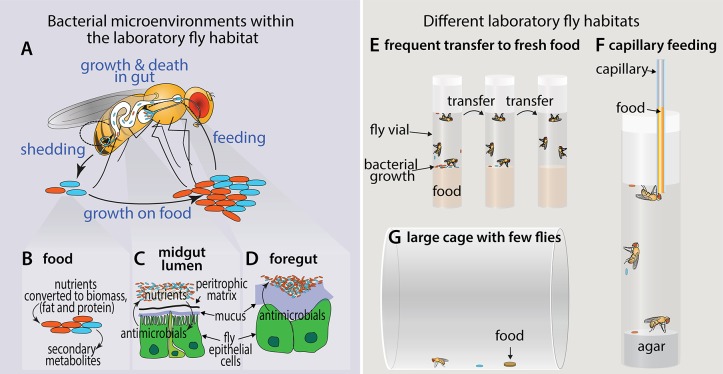
(A) In the laboratory fly vial, many bacteria grow on the food, where they are consumed by both larval and adult flies. A smaller population of bacteria are harbored in the fly gut, where they can be actively consumed by the fly or shed back onto the food. Processes on the food and in the fly gut select for different bacterial compositions [25]. (B) Bacterial metabolism on the food changes the composition of the provided media, converting sugars and other carbohydrates to more protein-rich and fat-rich bacterial biomass, which can contribute to fly nutrition [–20]. (C) Digestive processes in the fly midgut kill bacteria, liberating their nutrients for absorption by the intestinal epithelial cells. Fly cells are protected from the bacteria by a peritrophic matrix [26]. (D) Large populations of bacteria can stably occupy the crop and cardia in the fly foregut [23, 24]. (E–G) Stable versus transient colonization of the fly gut can be distinguished by minimizing exposure to environmental bacteria. These techniques include (E) frequent transfers to fresh food [18, 22], (F) capillary feeding [24], and (G) housing low fly numbers in large enclosures [23].
References
Publication types
MeSH terms
Grants and funding
LinkOut - more resources
Full Text Sources
Molecular Biology Databases