


doi: 10.1016/j.neuron.2020.03.015.
Effective Self-Management for Early Career Researchers in the Natural and Life Sciences
Affiliations
- PMID: 32325057
- PMCID: PMC7665085
- DOI: 10.1016/j.neuron.2020.03.015
Item in Clipboard
Effective Self-Management for Early Career Researchers in the Natural and Life Sciences
Neuron.
.
Abstract
Early career researchers (ECRs) are faced with a range of competing pressures in academia, making self-management key to building a successful career. The Organization for Human Brain Mapping undertook a group effort to gather helpful advice for ECRs in self-management.
Keywords: ECRs; career development; early career researchers; mentoring; networking; self-management.
Copyright © 2020 Elsevier Inc. All rights reserved.
Conflict of interest statement
Declaration of Interests
The authors declare no competing interests.
Figures
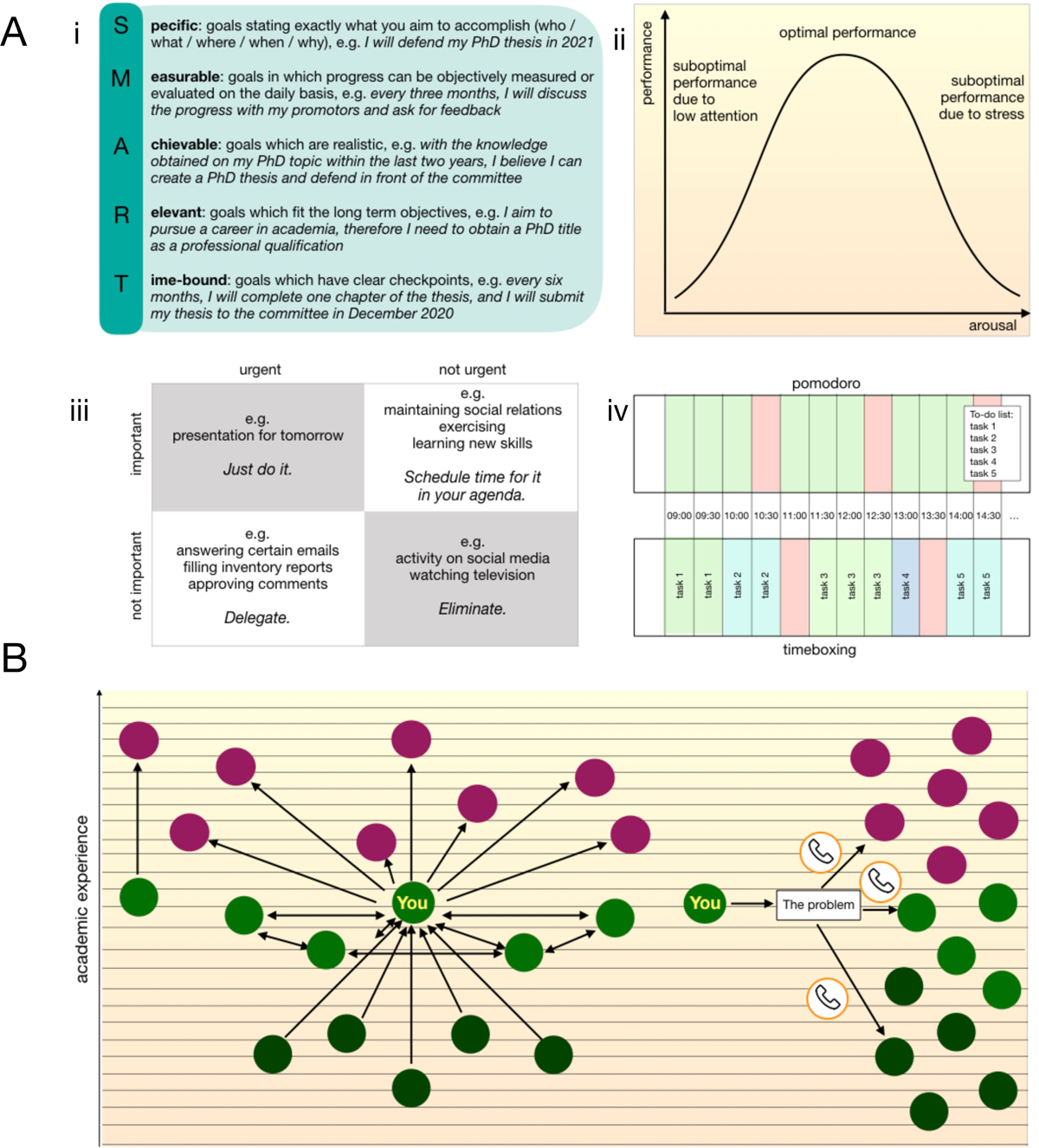
A Popular concepts for goal setting/time management. i: the S.M.A.R.T. approach for setting goals (Raia, 1965), with examples. ii: the Yerkes-Dodson law. There is an optimal level of arousal above which performance decreases due to high stress level. iii: the Eisenhower chart. The key to long term success is to manage important but not urgent tasks, iv: the pomodoro technique and timeboxing for planning work time. In the pomodoro technique, tasks are kept in lists and working time is pre-divided into periods of deep work (green) interleaved with breaks (red). In the timeboxing, every task is assigned with a precise time slot. B Models of mentoring. Left: the traditional, hierarchical view. Middle: modern, multilayered model. The mentee becomes the centre of their own mentoring network, with multiple mentors at different career stages (magenta), peer-coaching with other ECRs at a similar stage (light green), and more junior mentees (dark green). Right: “lifeline”/“advisory board” model: a network of mentors at different career stages serving as an advisory board.
References
-
- Bielczyk* N, Veldsman* M, Ando A, Caldinelli C, Makary M, Nikolaidis A, Scelsi MA, Stefan M, OHBM Student and Postdoc Special Interest Group, Badhwar A (2018). Mentoring early career researchers: Lessons from the Organization for Human Brain Mapping International Mentoring Programme. Eur. J. Neurosci 49, 1069.–. - PubMed
-
- Bielczyk N (2019). What is out there for me? The landscape of post-PhD career tracks. Amazon Digital Services LLC. ISBN-10: 1675579660.
-
- Chekroud SR, Gueorguieva R, Zheutlin AB, Paulus M, Krumholz HM, Krystal JH, Chekroud AM (2018). Association between physical exercise and mental health in 1·2 million individuals in the USA between 2011 and 2015: a cross-sectional study. Lancet Psychiat. 5, 739–746. - PubMed
-
- Cheplygina V (2018). How I fail. Retrieved from http://web.archive.org/web/20180817170504/http://veronikach.com/how-i-fail/
MeSH terms
Grants and funding
LinkOut - more resources
Full Text Sources
