Review
. 2020 Apr 20;12(4):465.
doi: 10.3390/v12040465.

Nipah Virus: Past Outbreaks and Future Containment

Affiliations
Review

Nipah Virus: Past Outbreaks and Future Containment

Vinod Soman Pillai et al. Viruses. .

Abstract

Viral outbreaks of varying frequencies and severities have caused panic and havoc across the globe throughout history. Influenza, small pox, measles, and yellow fever reverberated for centuries, causing huge burden for economies. The twenty-first century witnessed the most pathogenic and contagious virus outbreaks of zoonotic origin including severe acute respiratory syndrome coronavirus (SARS-CoV), Ebola virus, Middle East respiratory syndrome coronavirus (MERS-CoV) and Nipah virus. Nipah is considered one of the world's deadliest viruses with the heaviest mortality rates in some instances. It is known to cause encephalitis, with cases of acute respiratory distress turning fatal. Various factors contribute to the onset and spread of the virus. All through the infected zone, various strategies to tackle and enhance the surveillance and awareness with greater emphasis on personal hygiene has been formulated. This review discusses the recent outbreaks of Nipah virus in Malaysia, Bangladesh and India, the routes of transmission, prevention and control measures employed along with possible reasons behind the outbreaks, and the precautionary measures to be ensured by private-public undertakings to contain and ensure a lower incidence in the future.

Keywords: Nipah; control; emerging virus; outbreak; prevention; transmission.


Conflict of interest statement

The authors declare no conflict of interest.

Figures
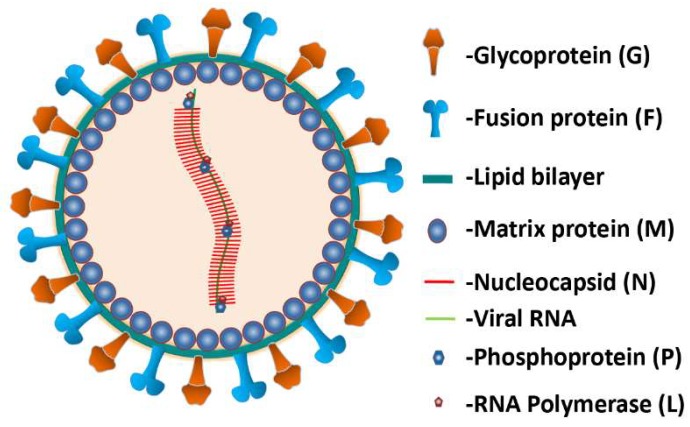
Figure 1
Figure 1
Representation of Nipah virus (NiV) structure. The RNA genome attached to the N, P, and L proteins form the ribonucleoprotein complex which is surrounded by a lipid bilayer envelope studded with two envelope glycoproteins G and F. The RNA encodes six structural proteins: N, P, M, F, G and L. The matrix protein M associates with the inner part of the envelope. The structural proteins, RNA and lipid bilayer are indicated in different colors.
Figure 2
Figure 2
Map of NiV outbreaks and Pteropus fruit bats distribution. In the map, the sites of NiV outbreaks in India, Bangladesh and Malaysia are depicted in different colors. Pteropus bat (the major carriers of NiV) prevalent regions are demarcated by red-dotted line.
Figure 3
Figure 3
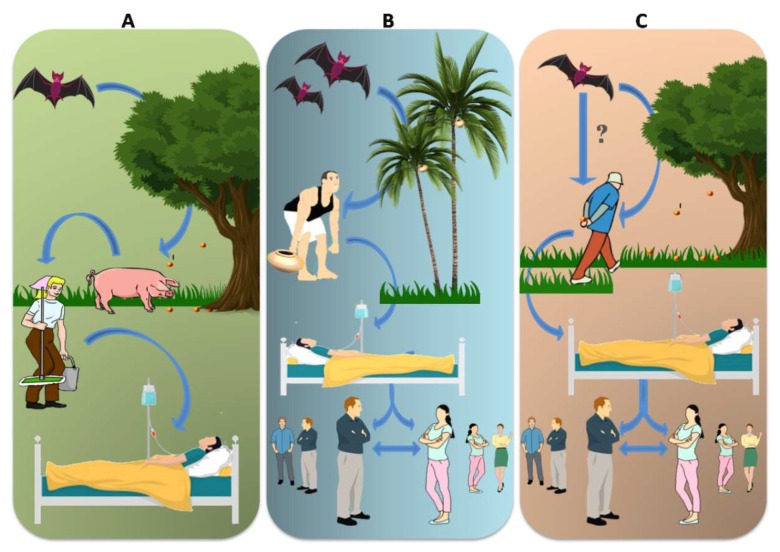
Routes of NiV transmission. Different locations have different routes of transmission. (A) In Malaysia, bat bitten fruits contaminated with NiV-M were consumed by pigs and workers handling the pigs were infected with NiV-M. (B) In Bangladesh, bat saliva- and excreta-contaminated palm sap consumption lead to NiV-B infection in humans and was spread further via nosocomial mode. Infected bats shed the virus in their urine, excreta and saliva. (C) In India, the possibility of direct bat-to-human transmission has been reported in Kerala state, but this was not supported by adequate evidence. Nosocomial spread of NiV-B have been reported in two different states—Kerala and West Bengal.
Figure 4
Figure 4
Outbreak statistics. (A) NiV outbreak across the world with percentage of outbreaks in Malaysia, Bangladesh and India individually. (B) State- and year-wise NiV outbreaks in percentage in India. (C) NiV mortality rate in the Indian states of West Bengal and Kerala.

References

    1. Goh K.J., Tan C.T., Chew N.K., Tan P.S., Kamarulzaman A., Sarji S.A., Wong K.T., Abdullah B.J., Chua K.B., Lam S.K. Clinical features of Nipah virus encephalitis among pig farmers in Malaysia. N. Engl. J. Med. 2000;342:1229–1235. doi: 10.1056/NEJM200004273421701. - DOI - PubMed
    1. Chadha M.S., Comer J.A., Lowe L., Rota P.A., Rollin P.E., Bellini W.J., Ksiazek T.G., Mishra A. Nipah virus-associated encephalitis outbreak, Siliguri, India. Emerg. Infect. Dis. 2006;12:235–240. doi: 10.3201/eid1202.051247. - DOI - PMC - PubMed
    1. Rahman M., Chakraborty A. Nipah virus outbreaks in Bangladesh: A deadly infectious disease. WHO South East Asia J. Public Health. 2012;1:208–212. doi: 10.4103/2224-3151.206933. - DOI - PubMed
    1. Amarasinghe G.K., Ayllon M.A., Bao Y., Basler C.F., Bavari S., Blasdell K.R., Briese T., Brown P.A., Bukreyev A., Balkema-Buschmann A., et al. Taxonomy of the order Mononegavirales: Update 2019. Arch. Virol. 2019;164:1967–1980. doi: 10.1007/s00705-019-04247-4. - DOI - PMC - PubMed
    1. Epstein J.H., Field H.E., Luby S., Pulliam J.R., Daszak P. Nipah virus: Impact, origins, and causes of emergence. Curr. Infect. Dis. Rep. 2006;8:59–65. doi: 10.1007/s11908-006-0036-2. - DOI - PMC - PubMed

MeSH terms

Substances