


Increasing Incidence of Liposarcoma: A Population-Based Study of National Surveillance Databases, 2001-2016
- PMID: 32326423
- PMCID: PMC7215751
- DOI: 10.3390/ijerph17082710
Increasing Incidence of Liposarcoma: A Population-Based Study of National Surveillance Databases, 2001-2016
Abstract
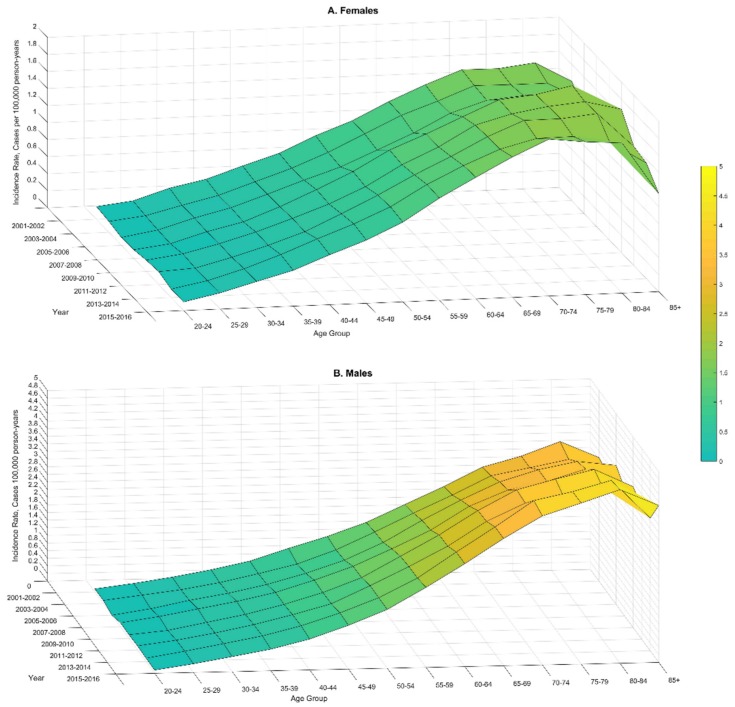
Rare cancers, affecting 1 in 5 cancer patients, disproportionally contribute to cancer mortality. This research focuses on liposarcoma, an understudied rare cancer with unknown risk factors and limited treatment options. Liposarcoma incident cases were identified from the U.S. Surveillance, Epidemiology, and End Result (SEER) program and the combined SEER-National Program of Cancer Registries (CNPCR) between 2001-2016. Incidence rates (age-adjusted and age-specific), 5-year survival, and the time trends were determined using SEER*stat software. Three-dimensional visualization of age-time curves was conducted for males and females. SEER liposarcoma cases represented ~30% (n = 11,162) of the nationwide pool (N = 37,499). Both sources of data showed males accounting for ~60% of the cases; 82%-86% cases were identified among whites. Age-adjusted incidence was greater among males vs. females and whites vs. blacks, whereas survival did not differ by sex and race. The dedifferentiated (57.2%), pleomorphic (64.1%), and retroperitoneal (63.9%) tumors had the worse survival. Nationwide, liposarcoma rates increased by 19%, with the annual percent increase (APC) of 1.43% (95% confidence interval (CI): 1.12-1.74). The APC was greater for males vs. females (1.67% vs. 0.89%) and retroperitoneal vs. extremity tumors (1.94% vs. 0.58%). Thus, incidence increased faster in the high-risk subgroup (males), and for retroperitoneal tumors, the low-survival subtype. The SEER generally over-estimated the rates and time trends compared to nationwide data but under-estimated time trends for retroperitoneal tumors. The time trends suggest an interaction between genetic and non-genetic modifiable risk factors may play a role in the etiology of this malignancy. Differences between SEER and CNCPR findings emphasize the need for nationwide cancer surveillance.
Keywords: Liposarcoma; Surveillance, Epidemiology, and End Result (SEER) program; epidemiology; rare cancers.
Conflict of interest statement
The authors declare that there is no conflict of interest.
Figures
References
-
- National Cancer Institute NCI Dictionary of Cancer Terms. [(accessed on 21 November 2019)]; Available online: https://www.cancer.gov/publications/dictionaries/cancer-terms/def/791790.
-
- Gatta G., Capocaccia R., Botta L., Mallone S., De Angelis R., Ardanaz E., Comber H., Dimitrova N., Leinonen M.K., Siesling S., et al. Burden and centralised treatment in Europe of rare tumours: Results of RARECAREnet—A population-based study. Lancet Oncol. 2017;18:1022–1039. doi: 10.1016/S1470-2045(17)30445-X. - DOI - PubMed
Publication types
MeSH terms
Grants and funding
LinkOut - more resources
Full Text Sources
