Oral l-Cysteine Supplementation Enhances the Long Term-Effect of Topical Basic Fibroblast Growth Factor (bFGF) in Reducing the Corneal Haze after Photorefractive Keratectomy in Myopic Patients
- PMID: 32326563
- PMCID: PMC7243117
- DOI: 10.3390/ph13040067
Oral l-Cysteine Supplementation Enhances the Long Term-Effect of Topical Basic Fibroblast Growth Factor (bFGF) in Reducing the Corneal Haze after Photorefractive Keratectomy in Myopic Patients
Abstract
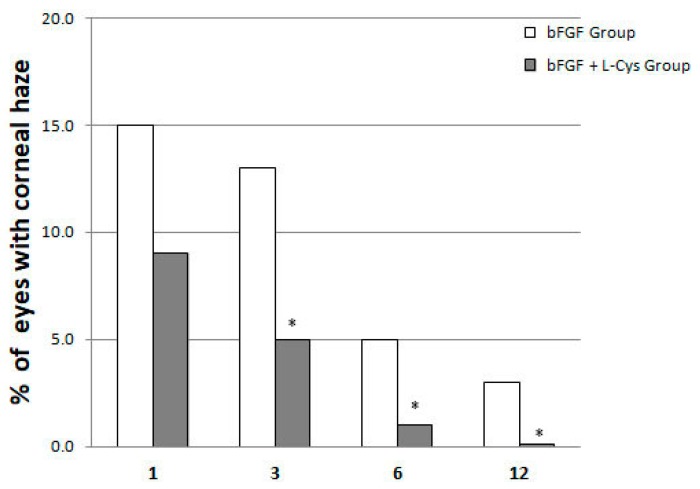
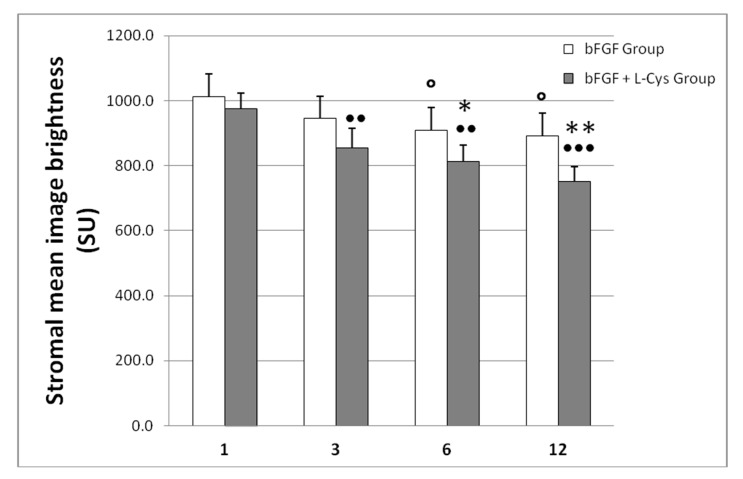
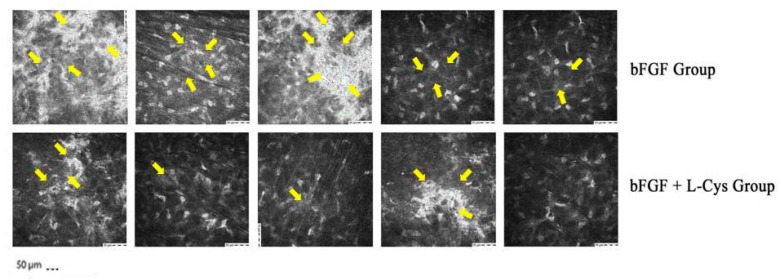
We aimed at evaluating the long-term effects of l-cysteine oral supplementation to basic fibroblast growth factor (bFGF) eye-drops on corneal re-epithelization and transparency in myopic patients subjected to photorefractive keratectomy (PRK). Forty patients subjected to bilateral PRK for myopia were enrolled and randomly divided into two groups receiving an additional therapy together with the standard postoperative treatment consisting in local tobramycin 0.3%, dexamethasone 0.1%, diclofenac 0.1%, and 0.2% hyaluronate. Group 1 included 20 patients (11 males and 9 females; 34.09 ± 8 years of age) receiving only bFGF eye-drops (10 μg/10 μL) four times a day for 7 days starting from the day of surgery; Group 2 included 20 patients (12 males and 8 females; 37.35 ± 11.5 years of age) who were postoperatively administered with topical basic fibroblast growth factor (bFGF; 10 μg/10 μL) four times a day for 7 days plus oral l-cysteine supplementation (500 mg/capsule) once a day for 15 days, starting 7 days before PRK. Patients were followed-up for 12 months. Clinical ophthalmologic parameters were recorded for all the 80 examined eyes. The corneal transparency was evaluated in vivo by slit lamp and confocal microscopy. The data showed that: (a) the corneal haze occurred in a smaller percentage of the patients who were postoperatively administered with topical bFGF plus oral l-cysteine supplementation (Group 2) compared to patients who received only bFGF (Group 1); (b) at 6 months of follow-up, the stromal mean image brightness of the patients belonging to Group 2 was significantly lower than that of the Group 1 (p < 0.03), and, interestingly, the difference was even more evident at 12 month from the treatment (p < 0.001). Moreover, the final mean of the spherical equivalent refraction was -0.06 ± 0.2 D in Group 1 and -0.08 ± 0.3 D in Group 2, whereas the final uncorrected distance visual acuity (UDVA) was equal or superior to 20/25 in 100% of eyes in both Group 1 and 2. Post refractive patients can benefit from the administration of l-cysteine before the surgery and in association with bFGF in the early postoperative period, showing a faster corneal re-epithelization able to prevent corneal haze in the long-term recovery.
Keywords: basic fibroblast growth factor; corneal haze; corneal re-epithelialization; l-cysteine administration; photorefractive keratectomy.
Conflict of interest statement
The authors declare no conflict of interest.
Figures