


A ten-year China-US laboratory collaboration: improving response to influenza threats in China and the world, 2004-2014
- PMID: 32326921
- PMCID: PMC6696701
- DOI: 10.1186/s12889-019-6776-3
A ten-year China-US laboratory collaboration: improving response to influenza threats in China and the world, 2004-2014
Abstract
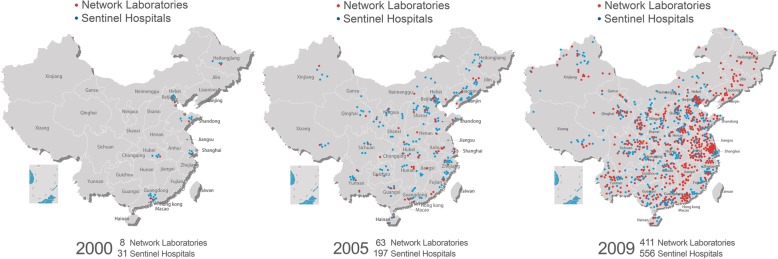
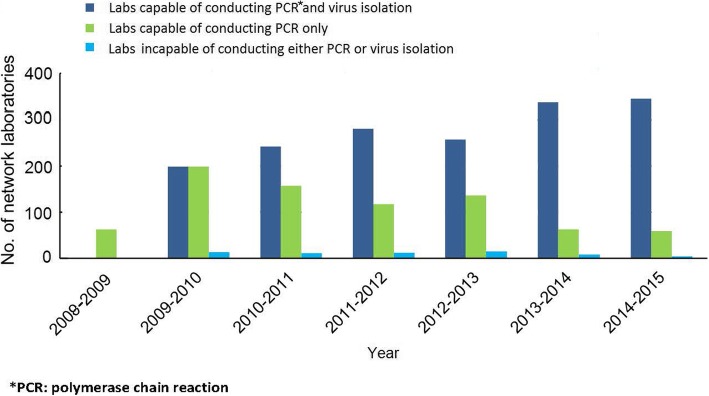
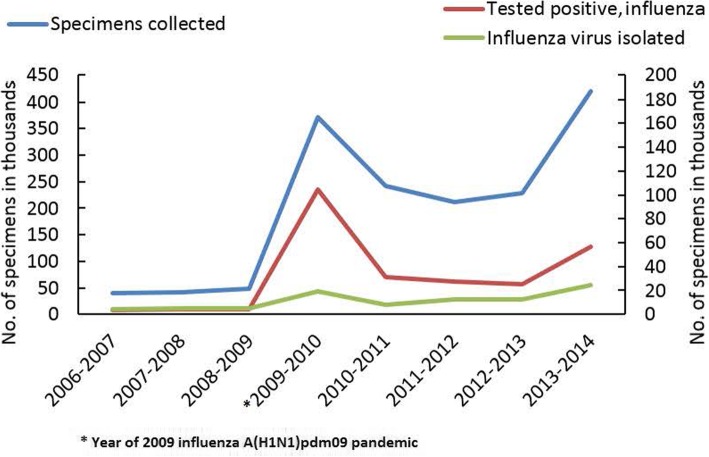
The emergence of severe acute respiratory syndrome (SARS) underscored the importance of influenza detection and response in China. From 2004, the Chinese National Influenza Center (CNIC) and the United States Centers for Disease Control and Prevention (USCDC) initiated Cooperative Agreements to build capacity in influenza surveillance in China.From 2004 to 2014, CNIC and USCDC collaborated on the following activities: 1) developing human technical expertise in virology and epidemiology in China; 2) developing a comprehensive influenza surveillance system by enhancing influenza-like illness (ILI) reporting and virological characterization; 3) strengthening analysis, utilization and dissemination of surveillance data; and 4) improving early response to influenza viruses with pandemic potential.Since 2004, CNIC expanded its national influenza surveillance and response system which, as of 2014, included 408 laboratories and 554 sentinel hospitals. With support from USCDC, more than 2500 public health staff from China received virology and epidemiology training, enabling > 98% network laboratories to establish virus isolation and/or nucleic acid detection techniques. CNIC established viral drug resistance surveillance and platforms for gene sequencing, reverse genetics, serologic detection, and vaccine strains development. CNIC also built a bioinformatics platform to strengthen data analysis and utilization, publishing weekly on-line influenza surveillance reports in English and Chinese. The surveillance system collects 200,000-400,000 specimens and tests more than 20,000 influenza viruses annually, which provides valuable information for World Health Organization (WHO) influenza vaccine strain recommendations. In 2010, CNIC became the sixth WHO Collaborating Centre for Influenza. CNIC has strengthened virus and data sharing, and has provided training and reagents for other countries to improve global capacity for influenza control and prevention.The collaboration's successes were built upon shared mission and values, emphasis on long-term capacity development and sustainability, and leadership commitment.
Keywords: China; Influenza; International cooperation; Laboratory; Surveillance.
Conflict of interest statement
The authors declare that they have no competing interests.
Figures
References
-
- Peng, G. W., He, J. F., Lin, J. Y., Zhou, D. H., Yu, D. W., & Liang, W. J., et al. Eepidemiological study on severe acute respiratory syndrome in Guangdong province. Zhonghua liu xing bing xue za zhi = Zhonghua liuxingbingxue zazhi 2003, 24(5), 350–352. - PubMed
-
- Yu H, Shu Y, Hu S, Hong Z, Gao Z, Chen H, et al. The first confirmed human case of avian influenza a (h5n1) in mainland China. Zhonghua liu xing bing xue za zhi = Zhonghua liuxingbingxue zazhi. 2006;27(4):281–287. - PubMed
-
- Huang W, Li X, Tan M, Wei H, Cheng Y, Guo J, Wang Z, Xiao N, Wang D, Shu Y. Susceptibility of influenza B viruses to neuraminidase inhibitors isolated during 2013-2014 influenza season in mainland China. Bing Du Xue Bao. 2015;31(2):152–156. - PubMed
MeSH terms
Substances
Grants and funding
LinkOut - more resources
Full Text Sources
Medical
Miscellaneous
