


Effect of time interval from diagnosis to treatment for non-small cell lung cancer on survival: a national cohort study in Taiwan
- PMID: 32327476
- PMCID: PMC7204926
- DOI: 10.1136/bmjopen-2019-034351
Effect of time interval from diagnosis to treatment for non-small cell lung cancer on survival: a national cohort study in Taiwan
Abstract
Objectives: This study aimed to determine if treatment delay after non-small cell lung cancer (NSCLC) diagnosis impacts patient survival rate.
Study design: This study is a natural experiment in Taiwan. A retrospective cohort investigation was conducted from 2004 to 2010, which included 42 962 patients with newly diagnosed NSCLC.
Methods: We identified 42 962 patients with newly diagnosed NSCLC in the Taiwan Cancer Registry from 2004 to 2010. We calculated the time interval between diagnosis and treatment initiation. All patients were followed from the index date to death or the end of 2012. Cox proportional hazard models were used to examine the relationship between mortality and time interval.
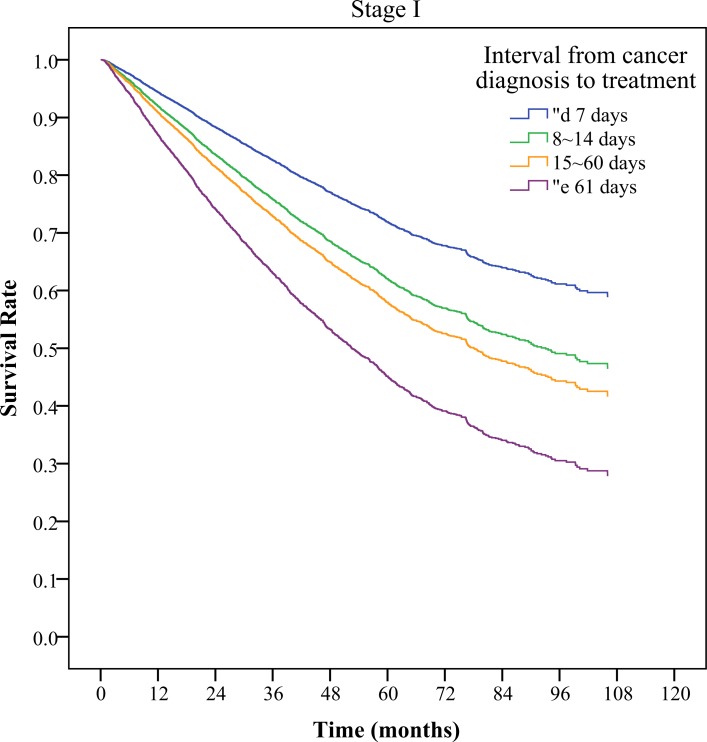
Results: We included 42 962 patients (15 799 men and 27 163 women) with newly diagnosed NSCLC. The mortality rate exhibited a significantly positive correlation to time interval from cancer diagnosis to treatment initiation. The adjusted HRs ranged from 1.04 to 1.08 in all subgroups time interval more than 7 days compared with the counterpart subgroup of the interval from cancer diagnosis to treatment ≤7 days. The trend was also noted regardless of the patients with lung cancer in stage I, stage II and stage III.
Conclusions: There is a major association between time to treat and mortality of patients with NSCLC, especially in stages I and II. We suggest that efforts should be made to minimise the interval from diagnosis to treatment while further study is ongoing to determine causation.
Keywords: delay treatment; lung cancer; non-small cell lung cancer; survival; timeliness of treatment.
© Author(s) (or their employer(s)) 2020. Re-use permitted under CC BY-NC. No commercial re-use. See rights and permissions. Published by BMJ.
Conflict of interest statement
Competing interests: None declared.
Figures
References
-
- Valdés S, García E, Pérez H, et al. . Length of diagnostic delay in patients with non-small-cell lung cancer. MEDICC Rev 2010;12:29-32. - PubMed
Publication types
MeSH terms
LinkOut - more resources
Full Text Sources
Other Literature Sources
Medical
