Meta-Analysis
. 2020 Apr 23;3(1):189.
doi: 10.1038/s42003-020-0921-5.

Predicted loss and gain of function mutations in ACO1 are associated with erythropoiesis

Affiliations
Meta-Analysis

Predicted loss and gain of function mutations in ACO1 are associated with erythropoiesis

Gudjon R Oskarsson et al. Commun Biol. .

Abstract

Hemoglobin is the essential oxygen-carrying molecule in humans and is regulated by cellular iron and oxygen sensing mechanisms. To search for novel variants associated with hemoglobin concentration, we performed genome-wide association studies of hemoglobin concentration using a combined set of 684,122 individuals from Iceland and the UK. Notably, we found seven novel variants, six rare coding and one common, at the ACO1 locus associating with either decreased or increased hemoglobin concentration. Of these variants, the missense Cys506Ser and the stop-gained Lys334Ter mutations are specific to eight and ten generation pedigrees, respectively, and have the two largest effects in the study (EffectCys506Ser = -1.61 SD, CI95 = [-1.98, -1.35]; EffectLys334Ter = 0.63 SD, CI95 = [0.36, 0.91]). We also find Cys506Ser to associate with increased risk of persistent anemia (OR = 17.1, P = 2 × 10-14). The strong bidirectional effects seen in this study implicate ACO1, a known iron sensing molecule, as a major homeostatic regulator of hemoglobin concentration.


Conflict of interest statement

Authors affiliated with deCODE genetics/Amgen Inc., G.R.O., A.O., M.K.M., R.P.K., G.H.H., E.F., F.Z., A.H., E.V.I., G.A.A., B.O.J., H.K., G.S., A.M.K., A.L.L., J.S., L.S., J.K.S., O.B.D., S.B., As.J., Ad.J., S.J., R.L.G., V.T., B.G., G.M., G.T., T.R., H.H., D.F.G., G.L.N., U.T., P.S., and K.S. declare competing interests as employees. The remaining authors declare no competing interests.

Figures

Fig. 1
Fig. 1. Pedigree of carriers of Cys506Ser in ACO1.
All 62 carriers can be traced back to ancestors born in the late 18th century. The founding couple had eight offspring and a current total number of 5,430 descendants. Roman numerals indicate generation, mean hemoglobin concentration is noted below the symbols. square = male, circle = female, diamond = sex unspecified, solid filled object = carrier, half filled object = obligate carrier, red filled object = persistent anemia.
Fig. 2
Fig. 2. Schematic diagram of the ACO1 protein domain structure.
Central core domains 1 (yellow) and 2 (green), domain 3 (blue), linker (gray), and domain 4 (red) (based on Walden et al.). Red lollipops represent cysteine residues required for iron–sulfur binding and aconitase function. Blue lollipops represent the amino acids required for binding to the iron-response element found on mRNA transcripts of various proteins required for stable erythropoiesis. Black arrows represent the sex rare coding variants we report associating with hemoglobin concentration. The axis is the numbers of each of the total 889 amino acids of ACO1. Protein reference: NP_001265281.1.
Fig. 3
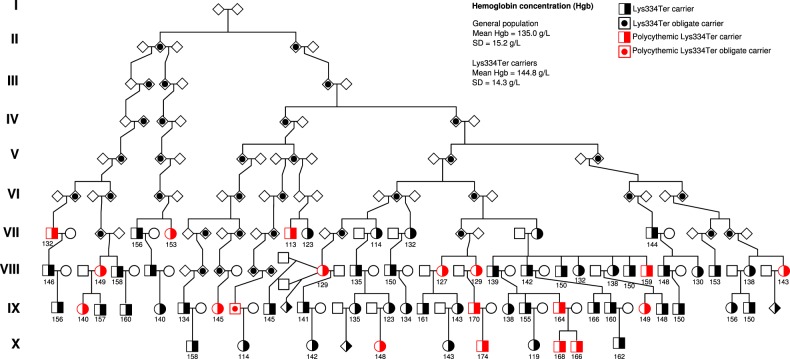
Fig. 3. Pedigree of carriers of Lys334Ter in ACO1.
All 67 carriers can be traced back to a common ancestor in the early 18th century. The founding couple had six offspring and a current total number of 21,423 descendants. Roman numerals indicate generation, year of birth of the founding couple is noted above the symbols and mean hemoglobin concentration is noted below the symbols. Square = male, circle = female, diamond = sex unspecified, solid filled object = carrier, half filled object = obligate carrier, red filled object = polycythemic.

References

    1. Perutz MF, et al. Structure of hæmoglobin: a three-dimensional Fourier synthesis at 5.5-Å. resolution, obtained by X-ray analysis. Nature. 1960;185:416–422. doi: 10.1038/185416a0. - DOI - PubMed
    1. Schechter AN, Dc W. Hemoglobin research and the origins of molecular medicine ASH 50th anniversary review hemoglobin research and the origins of molecular medicine. Blood. 2008;112:3927–3938. doi: 10.1182/blood-2008-04-078188. - DOI - PMC - PubMed
    1. Simpson RJ, McKie AT. Iron and oxygen sensing: a tale of 2 interacting elements? Metallomics. 2015;7:223–231. doi: 10.1039/C4MT00225C. - DOI - PubMed
    1. Rainville N, Jachimowicz E, Wojchowski DM. Targeting EPO and EPO receptor pathways in anemia and dysregulated erythropoiesis. Expert Opin. Ther. Targets. 2016;20:287–301. doi: 10.1517/14728222.2016.1090975. - DOI - PMC - PubMed
    1. Online Mendelian Inheritance in Man, OMIM®. McKusick-Nathans Institute of Genetic Medicine, Johns Hopkins University (Baltimore, MD). https://omim.org/ (2020).

Publication types