. 2021 Jun;39(9):3099-3114.
doi: 10.1080/07391102.2020.1760137. Epub 2020 May 5.

Discovery of potential multi-target-directed ligands by targeting host-specific SARS-CoV-2 structurally conserved main protease

Affiliations

Discovery of potential multi-target-directed ligands by targeting host-specific SARS-CoV-2 structurally conserved main protease

Rakesh S Joshi et al. J Biomol Struct Dyn. 2021 Jun.

Abstract

Severe acute respiratory syndrome coronavirus 2 (SARS-CoV-2) infection has resulted in the current COVID-19 pandemic. Worldwide this disease has infected over 2.5 million individuals with a mortality rate ranging from 5 to 10%. There are several efforts going on in the drug discovery to control the SARS-CoV-2 viral infection. The main protease (MPro) plays a critical role in viral replication and maturation, thus can serve as the primary drug target. To understand the structural evolution of MPro, we have performed phylogenetic and Sequence Similarity Network analysis, that depicted divergence of Coronaviridae MPro in five clusters specific to viral hosts. This clustering was corroborated with the comparison of MPro structures. Furthermore, it has been observed that backbone and binding site conformations are conserved despite variation in some of the residues. These attributes can be exploited to repurpose available viral protease inhibitors against SARS-CoV-2 MPro. In agreement with this, we performed screening of ∼7100 molecules including active ingredients present in the Ayurvedic anti-tussive medicines, anti-viral phytochemicals and synthetic anti-virals against SARS-CoV-2 MPro as the primary target. We identified several natural molecules like δ-viniferin, myricitrin, taiwanhomoflavone A, lactucopicrin 15-oxalate, nympholide A, afzelin, biorobin, hesperidin and phyllaemblicin B that strongly binds to SARS-CoV-2 MPro. Intrestingly, these molecules also showed strong binding with other potential targets of SARS-CoV-2 infection like viral receptor human angiotensin-converting enzyme 2 (hACE-2) and RNA dependent RNA polymerase (RdRp). We anticipate that our approach for identification of multi-target-directed ligand will provide new avenues for drug discovery against SARS-CoV-2 infection.Communicated by Ramaswamy H. Sarma.

Keywords: COVID-19; Coronavirus; MPro; RdRp; SARS-CoV-2 virus; hACE-2; multi-target-directed ligand; protease inhibitor.


Figures
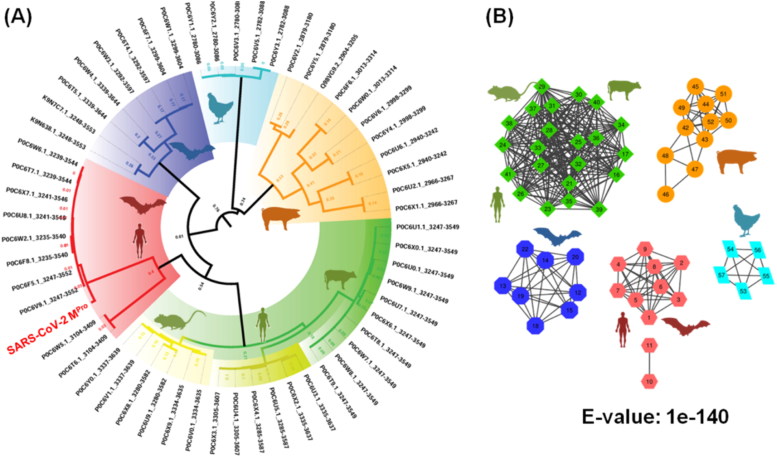
Figure 1.
Figure 1.
Diversity of protease like proteins in the Coronaviridae family. (A) The phylogenetic tree depicts five clusters. Clade-1 (orange) mainly consists of porcine transmissible coronavirus proteases. Clade-2 (blue) covers avian infectious bronchitis virus proteases. Clade-3 (purple) dominates with bat coronavirus sequences; followed by clade-4 (red) shared by the bat and human proteases. Clade-5 (green) has three distinct sub-clades that attribute to different hosts. The first sub-clade of clade 5 corresponds to bovine coronavirus and the third sub-clade exclusively involves murine coronavirus proteases. (B) The sequence similarity network (SSN) of the Coronaviridae proteases showed five clusters at the E-value of 1e-140. The cluster composition of sequences in the five clusters aligns with that of clades in the phylogeny (highlighted with colour code and symbols).
Figure 2.
Figure 2.
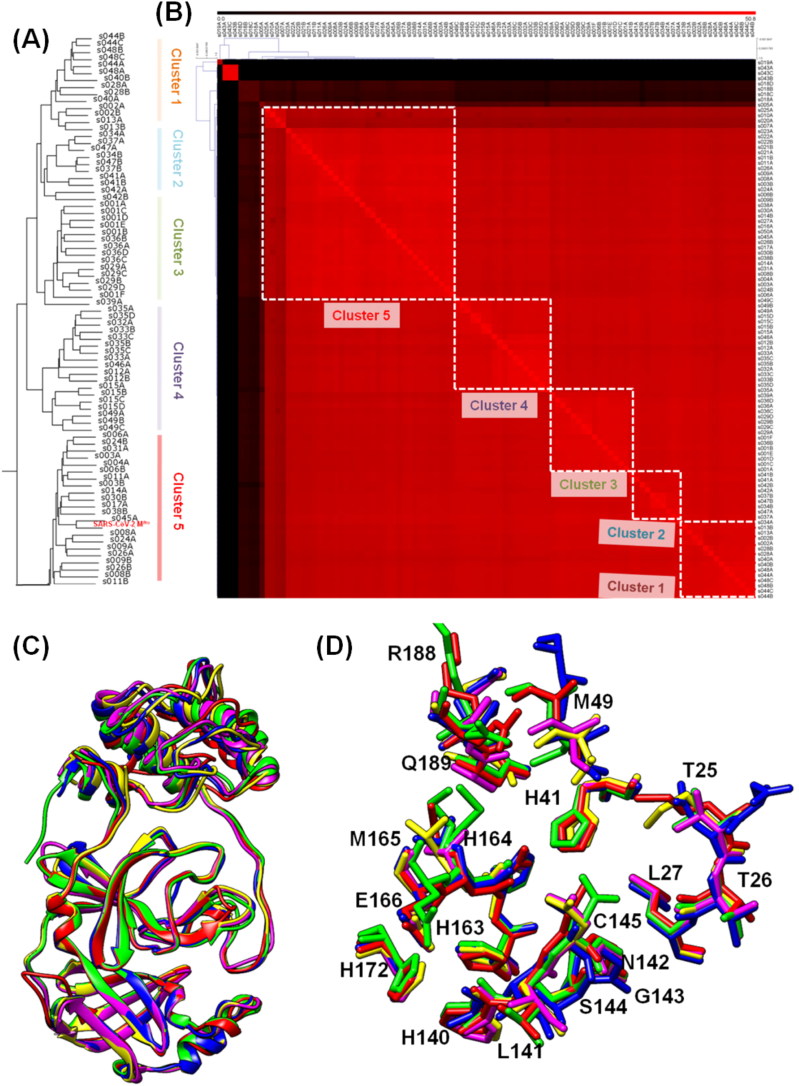
(A) Dendrogram of the 49 structures of SARS-CoV-2 MPro like proteins from the Coronoviridea family (B) Structural similarity matrix of Coronaviridea proteases. Cluster 1,2,3 predominantly have porcine protease structures and cluster 4,5 have structures corresponding to human infectious coronavirus. The dendrogram and matrix both display five clusters (labeled as similar to Figure 1A and B), similar to that observed in phylogenetic analysis, indicating that the sequence variations also depict in the structural analysis of proteases. (C) Structural superimposition of selected proteases from Coronaviridae family, showed RMSD <1Å and the high conservation of the backbone structure (D) Superimposition of the active site and binding site residues displayed conservation of active site pocket shape despite few differences in the residues. This indicated that the substrate recognition and binding efficiency or function of the MPro are conserved across the virus family.
Figure 3.
Figure 3.
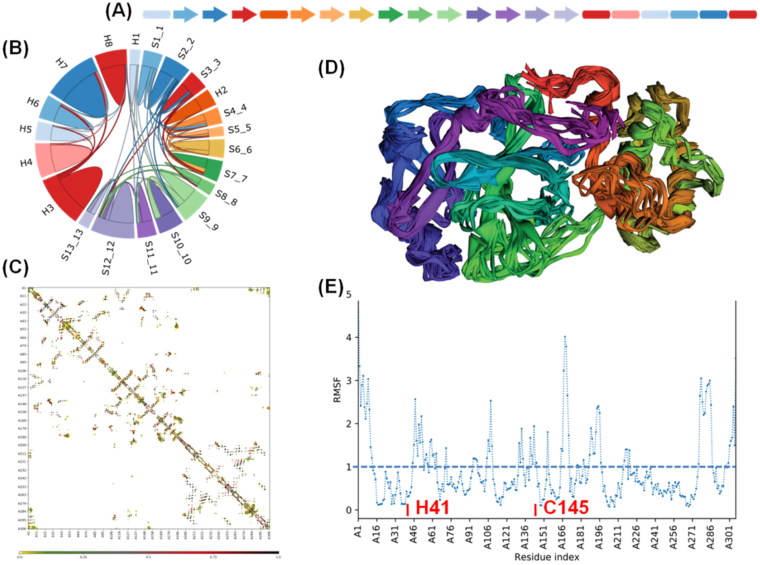
(A) Secondary structure topology indicated that most of the beta-sheets towards the N-terminal end and helices to the C-terminal (B) The chord plot of secondary structure contacts in COVID-19 MPro wherein S indicate beta sheets and H indicate helices. We observed that beta-sheets exhibit more contacts than helices (C) Inter-residue contact map within the MPro. It shows the presence of more interactions in the first 200 residues i.e. towards N-terminus that mainly forms active sites (D) Superimposed topology with colours corresponding to secondary structure elements (E) Root Means Square Fluctuations of the residues from its mean position. High fluctuation (1 Å<RMSF) is seen in the N-terminus as compared to C-terminal. Active site residues (H41, C145) are highlighted and they showed less fluctuation.
Figure 4.
Figure 4.
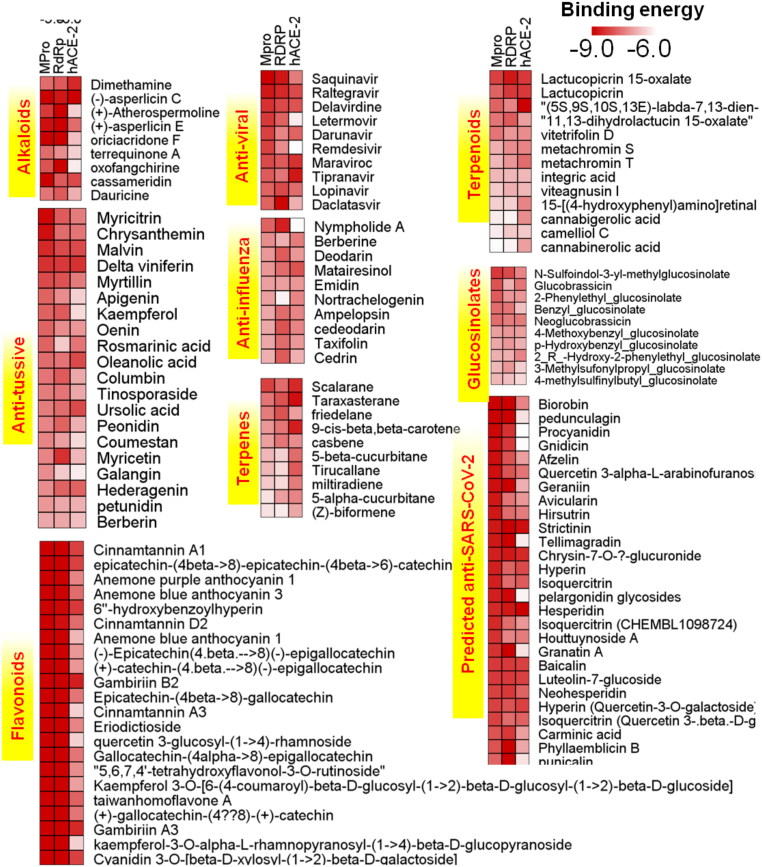
Heatmap of binding energies of top hits for different types of molecules used for screening, namely flavonoids, glucosinolates, anti-tussive, anti-influenza, synthetic anti-viral, terpenes, terpenoids and alkaloids. In general, we noticed strong binding of ligands towards MPro and RdRp as compared to the hACE 2 receptor. Flavonoids showed promising results with better binding affinities than existing synthetic anti-viral drugs. For details of the docking score and names of the ligands check Supplementary Data 3.
Figure 5.
Figure 5.
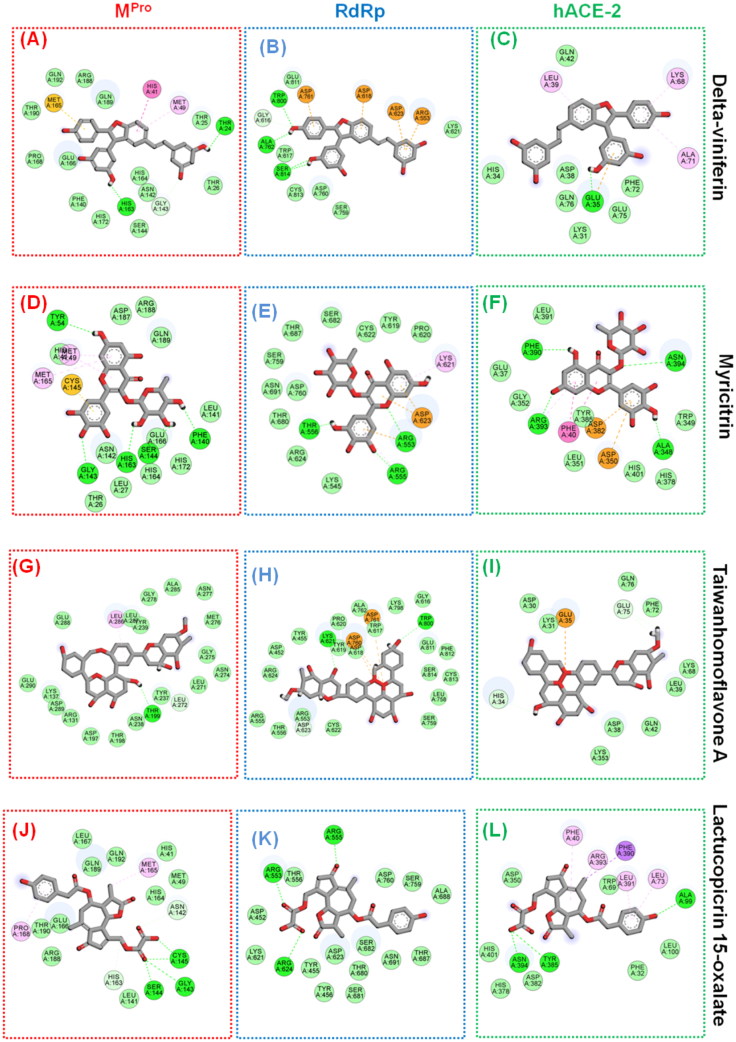
δ-Viniferin with active site residues of (A) MPro (B) RdRp and (C) hACE-2. It is followed by interaction map of myricitrin with (D) MPro (E) RdRp and (F) hACE-2. The interaction type is distinguished by coloured circles (residues). Dashed lines direct to the specific moiety in the ligand. Green residues symbolize van der Waals forces. Pink residues indicate those are involved in Pi-Pi stacking. Light pink indicates alkyl group interactions. Light orange colour indicates Pi-sulphur interactions. Dark orange show pi-anion interactions. Aromatic rings are involved in Pi-Pi, Pi-anion and Pi-sulphur interactions. Intermolecular interaction between Taiwanhomoflavone A with active site residues of (G) MPro, (H) RdRp and (I) hACE-2. Next is the interaction map of Lactucopicrin 15-oxalate with (J) MPro, (K) RdRp and (L) hACE-2.
Figure 6.
Figure 6.
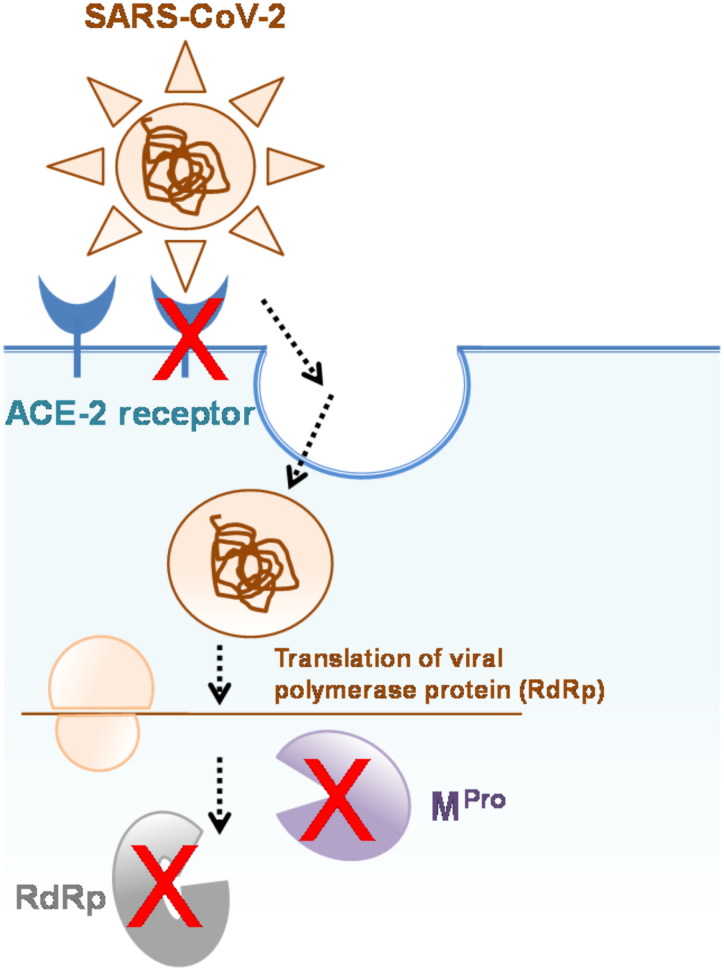
Schematic representing multi-target-directed drug ligands against SARS-CoV-2 infection.

References

    1. Amirian E. S., & Levy J. K. (2020, March). Current knowledge about the antivirals remdesivir (GS-5734) and GS-441524 as therapeutic options for coronaviruses. One Health, 9, 100128 10.1016/j.onehlt.2020.100128 - DOI - PMC - PubMed
    1. Anand K., Ziebuhr J., Wadhwani P., Mesters J. R., & Hilgenfeld R. (2003). Coronavirus main proteinase (3CLpro) Structure: Basis for design of anti-SARS drugs. Science, 300(5626), 1763–1767. 10.1126/science.1085658 - DOI - PubMed
    1. Andersen K. G., Rambaut A., Lipkin W. I., Holmes E. C., & Garry R. F. (2020). The proximal origin of SARS-CoV-2. Nature Medicine, 26(4), 448–450. 10.1038/s41591-020-0820-9 - DOI - PMC - PubMed
    1. Aresta A., Cioffi N., Palmisano F., & Zambonin C. G. (2003). Simultaneous determination of ochratoxin A and cyclopiazonic, mycophenolic, and tenuazonic acids in cornflakes by solid-phase microextraction coupled to high-performance liquid chromatography. Journal of Agricultural and Food Chemistry, 51(18), 5232–5237. 10.1021/jf034385r - DOI - PubMed
    1. Bedford J., Enria D., Giesecke J., Heymann D. L., Ihekweazu C., Kobinger G., Lane H. C., Memish Z., Oh M-d., Sall A. A., Schuchat A., Ungchusak K., & Wieler L. H. (2020). COVID-19: Towards controlling of a pandemic. The Lancet, 395(10229), 1015–1018. 10.1016/S0140-6736(20)30673-5 - DOI - PMC - PubMed

Publication types