. 2020 Feb 4;3(1):14-21.
doi: 10.1093/pcmedi/pbaa002.

A precision medicine approach to managing 2019 novel coronavirus pneumonia

Affiliations

A precision medicine approach to managing 2019 novel coronavirus pneumonia

Minjin Wang et al. Precis Clin Med. .

Abstract

In December 2019, several patients with pneumonia of an unknown cause were detected in Wuhan, China. On 7 January 2020, the causal organism was identified as a new coronavirus, later named as the 2019 novel coronavirus (2019-nCoV). Genome sequencing found the genetic sequence of 2019-nCoV homologous to that of severe acute respiratory syndrome-associated coronavirus. As of 29 January 2020, the virus had been diagnosed in more than 7000 patients in China and 77 patients in other countries. It is reported that both symptomatic and asymptomatic patients with 2019-nCoV can play a role in disease transmission via airborne and contact. This finding has caused a great concern about the prevention of illness spread. The clinical features of the infection are not specific and are often indistinguishable from those of other respiratory infections, making it difficult to diagnose. Given that the virus has a strong ability to spread between individuals, it is of top priority to identify potential or suspected patients as soon as possible-or the virus may cause a serious pandemic. Therefore, a precision medicine approach to managing this disease is urgently needed for detecting and controlling the spread of the virus. In this article, we present such an approach to managing 2019-nCoV-related pneumonia based on the unique traits of the virus recently revealed and on our experience with coronaviruses at West China Hospital in Chengdu, China.

Keywords: 2019-nCoV; COVID-19*; MERS; SARS; coronavirus pneumonia; epidemic; pandemic; precision medicine.


Figures

Figure 1
Figure 1
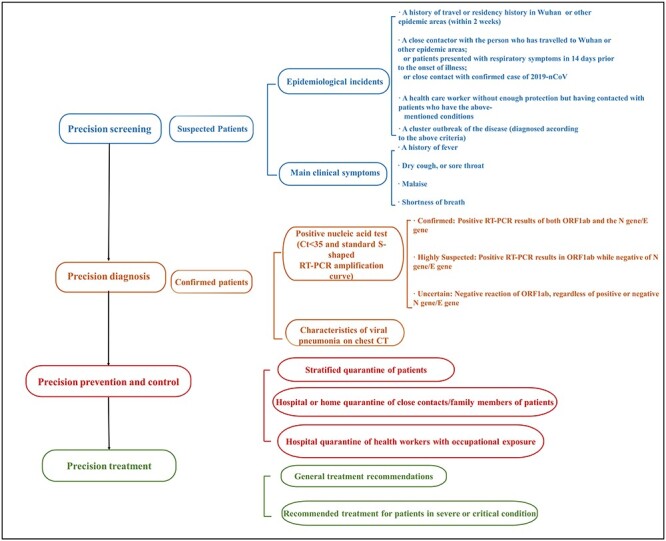
Screening, diagnostic, in-hospital control and prevention, and treatment options for patients infected with 2019-nCoV.
Figure 2
Figure 2
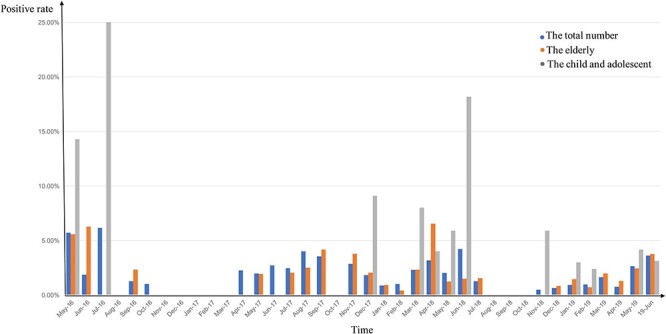
The seasonal prevalence of common HCoVs in Western China, May 2016 to June 2019, at West China Hospital in Chengdu, China. Blue columns: the total number of patients; orange columns: patients older than 60 years old; gray columns: children and adolescents younger than 16 years old. The positive rate is calculated as the number of patients with coronaviral pneumonia in each age group divided by the number of patients with any viral pneumonia in the group.
Figure 3
Figure 3
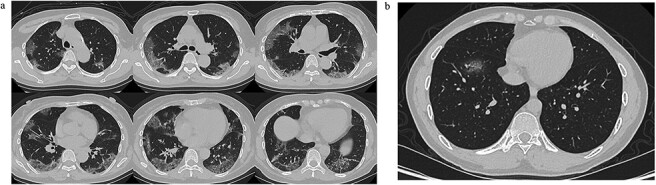
Typical CT images of 2019-nCoV pneumonia. (a) Low-dose high-resolution lung CT images from a 65-year-old man showing bilateral multiple lobar and segmental areas of ground-glass opacity, combined with interlobular septal thickening, on Day 8 after symptom onset. These are typical CT findings of severe cases. (b) A low-dose high-resolution lung CT image from a 34-year-old man showing patchy ground-glass opacity only in the anterior basal segment of right lower lobe on Day 3 after symptom onset. This is typical for mild cases.
Figure 4
Figure 4
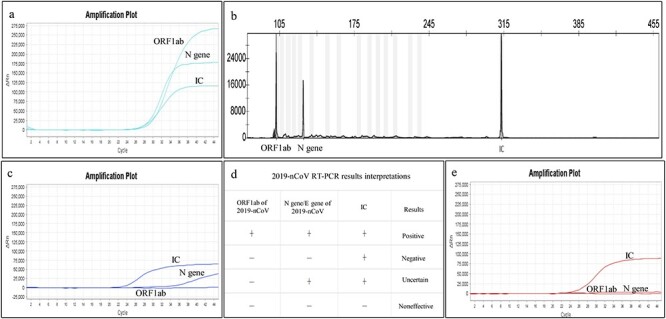
The interpretation criteria of 2019-nCoV nucleic acid test results. RT-PCR was used to detect 2019-nCoV. (a) A positive result of RT-PCR: a standard ‘S’-shaped curve for the amplification curves of ORF1ab, N gene, and internal standard control (IC) and a Ct (cycle threshold) value of less than 35. (b) A multiple PCR combined with capillary electrophoresis fragment analysis positive result of 2019-nCoV. (c) An uncertain result: a standard ‘S’-shaped curve and Ct value of less than 35 for IC, no amplification curve of ORF1ab with unrecognizable Ct value, but a standard amplification curve and Ct value of more than 35 of N gene. When an uncertain result occurs, the test should be done again or done by a different method detection. (d) The interpretations of 2019-nCoV RT-PCR results: only when the fluorescent amplification of ORF1ab, N gene/E gene, and IC are all simultaneously positive can the result be reported as 2019-nCoV detection positive. (e) A negative result: standard ‘S’-shaped curve and Ct value of less than 35 for IC, but no amplification curve for ORF1ab and N gene with their Ct value unrecognizable.
Figure 5
Figure 5
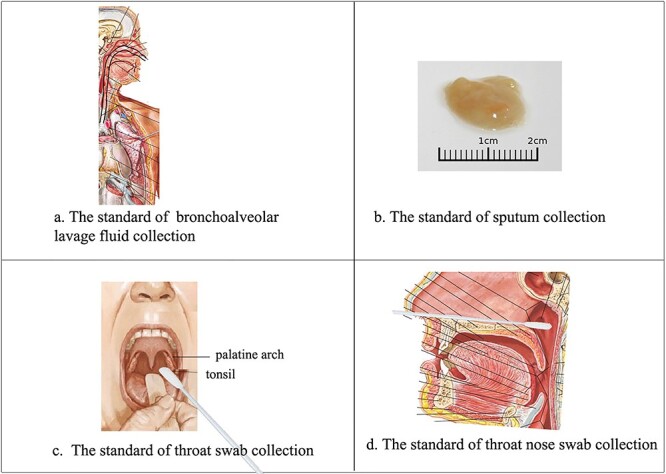
Standardized procedures for collecting clinical samples for 2019-nCoV testing. (a) Bronchoalveolar lavage fluid collection. (b) The optimal sputum specimen is acquired from deep in the lung in the morning and is kept in a sterile container. (c) Technique for swabbing the throat. (d) Technique for swabbing the nose. (Panels a, c, and d are adapted from Netter, Frank H. Atlas of Human Anatomy. Section 2 Head and Neck: Plate 65, Plate 77; Section 4 Thorax: Plate BP 44. Philadelphia (USA): Elsevier, Copyright © 2018).

References

    1. Zhu N, Zhang D, Wang W, et al. . A novel coronavirus from patients with pneumonia in China, 2019. N Engl J Med 2020. doi: 10.1056/NEJMoa2001017. - DOI - PMC - PubMed
    1. Xu X, Chen P, Wang J, et al. . Evolution of the novel coronavirus from the ongoing Wuhan outbreak and modeling of its spike protein for risk of human transmission. Sci China Life Sci 2020. doi: 10.1007/s11427-020-1637-5. - DOI - PMC - PubMed
    1. Cui J, Li F, Shi ZL. Origin and evolution of pathogenic coronaviruses. Nat Rev Microbiol 2019;17:181–92. doi: 10.1038/s41579-018-0118-9. - DOI - PMC - PubMed
    1. National Health Commission of the People’s Republic of China . State Administration of Traditional Medicine of China. The Diagnosis and Treatment Scheme of 2019 Novel Coronavirus. Polit Version 4.0. (Article in Chinese).http://www.nhc.gov.cn/xcs/zhengcwj/202002/573340613ab243b3a7f61df260551d.... (27 January 2020, date last accessed).
    1. World Health Organization . Emergencies preparedness, response. Novel Coronavirus—China. Disease outbreak news: Update 12 January 2020. https://www.who.int/csr/don/12-january-2020-novel-coronavirus-china/en/(12 January 2020, date last accessed).

LinkOut - more resources