Clinical Trial
. 2020 May 13;27(5):736-751.e8.
doi: 10.1016/j.chom.2020.04.003. Epub 2020 Apr 23.

Engineering the Live-Attenuated Polio Vaccine to Prevent Reversion to Virulence

Affiliations
Clinical Trial

Engineering the Live-Attenuated Polio Vaccine to Prevent Reversion to Virulence

Ming Te Yeh et al. Cell Host Microbe. .

Abstract

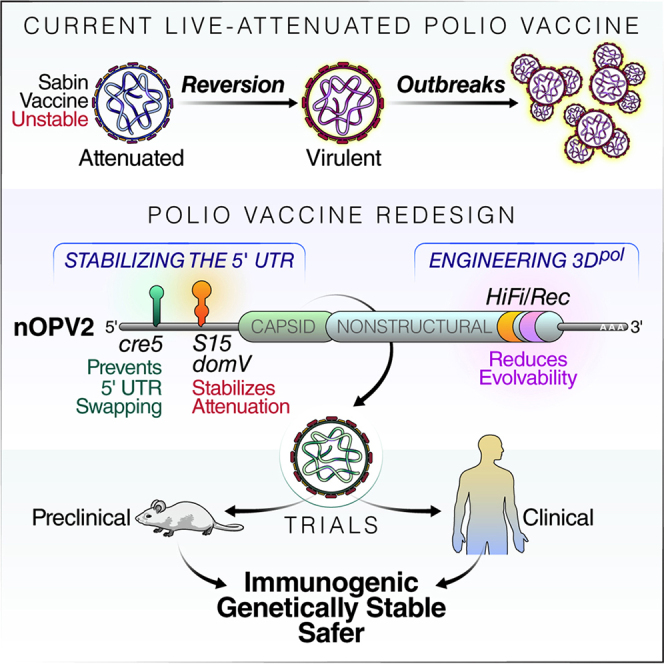
The live-attenuated oral poliovirus vaccine (OPV or Sabin vaccine) replicates in gut-associated tissues, eliciting mucosa and systemic immunity. OPV protects from disease and limits poliovirus spread. Accordingly, vaccination with OPV is the primary strategy used to end the circulation of all polioviruses. However, the ability of OPV to regain replication fitness and establish new epidemics represents a significant risk of polio re-emergence should immunization cease. Here, we report the development of a poliovirus type 2 vaccine strain (nOPV2) that is genetically more stable and less likely to regain virulence than the original Sabin2 strain. We introduced modifications within at the 5' untranslated region of the Sabin2 genome to stabilize attenuation determinants, 2C coding region to prevent recombination, and 3D polymerase to limit viral adaptability. Prior work established that nOPV2 is immunogenic in preclinical and clinical studies, and thus may enable complete poliovirus eradication.

Keywords: OPV2; Sabin 2p; live-attenuated vaccine; poliovirus; poliovirus eradication.


Conflict of interest statement

Declaration of Interests The authors declare no competing interests.

Figures
None
Graphical abstract
Figure 1
Figure 1
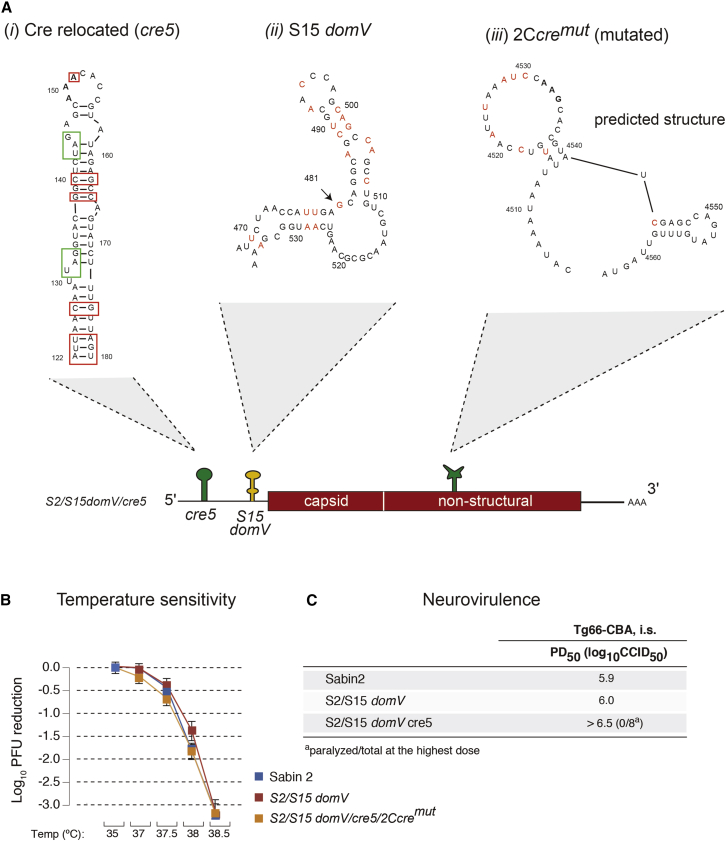
Predicted RNA Secondary Structures of 5′-UTR domV, Relocated cre and Mutated Internal cre (A) Schematic representation of the predicted RNA secondary structures of the following: (i) relocated cre, optimized base-pairs for temperature sensitivity and attenuation phenotypes are shown in red rectangles and “in-frame” STOP codons are shown in green rectangles; (ii) S15 domV, mutated bases to stabilize the RNA structure are shown in red; and (iii) mutated 2C-cre (2Ccremut), shown as a predicted disrupted RNA secondary structure with nucleotide changes for 2C-cre function disruption are shown in red. Sabin2 carrying this structure was nonviable (data not shown). (B and C) Temperature sensitivity (B) shown as mean with SD and neurovirulence (C) of these mutant viruses were evaluated in Vero cells and by intraspinal (i.s.) inoculation of poliovirus into susceptible Tg66 mice, respectively.
Figure 2
Figure 2
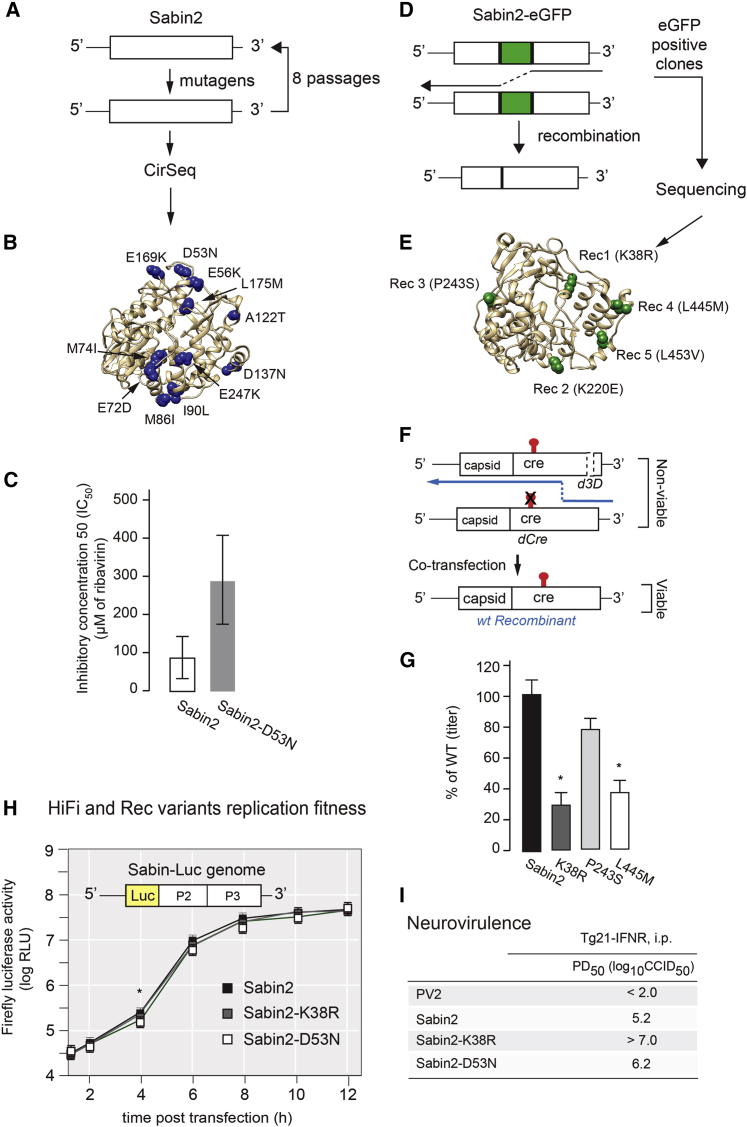
Modifications Were Introduced into 3Dpol to Increase Replication Fidelity and Reduce Recombination Rate (A) To identify high-fidelity variants, Sabin2 virus was grown in HeLa S3 cells at m.o.i. of 0.1 with and without ribavirin under 33°C for 10 h. After eight passages, virus populations were analyzed by CirSeq (Acevedo et al., 2014) to identify fidelity determinants. (B) Distribution of the 11 mutations revealed by CirSeq analysis as potential fidelity determinants on 3Dpol structure. (C) To test for replication fidelity, we used a ribavirin-sensitivity test to determine the inhibitory concentration 50 (IC50). Among the 11 fidelity candidates, HiFi3 (D53N) increased resistance the most to the mutagen ribavirin. The mean values calculated were significantly higher for Sabin-D53N than for Sabin2, with 95% confidence intervals that do not overlap. (D) To identify recombination-rate determinants, the eGFP gene was inserted into the Sabin2 viral genome between P1 and P2 regions to generate Sabin2-eGFP virus. Serial passages of the Sabin2-eGFP virus often lead to eGFP loss because of homologous recombination, but variants with reduced recombination rates can be isolated by selecting eGFP-positive clones. (E) After five passages in HeLa S3 cells, five potential recombination determinants were identified as shown on the 3Dpol structure. (F) Experimental design of the “recombination validation assay.” Viral RNAs with either mutated CRE or truncated 3D RNA polymerase do not produce viable viral progeny when transfected into L929 cells individually. Viable virus may be produced by recombination between the two truncated RNAs. (G) Titers of viral progeny from the “recombination validation assay.” Candidate mutations K38R, P243S, and L445M reduced recombination to 29.0%, 75.8%, and 38.7% to the parental strain Sabin2 (WT), respectively. Asterisk indicates significant difference as compared with WT; p values are 0.0322, 0.2277, and 0.0313 for K38R, P243S, and L445M, respectively. Data are shown as mean with SEM. (H) Effect of HiFi (D53N) and Rec1 (K38R) mutations on Sabin2 replication was initially determined using a luciferase replicon replication assay. Data are shown as mean with SEM. p = 0.0187. (I) Effect of HiFi (D53N) and Rec1 (K38R) mutations on Sabin2 virulence was evaluated by PD50 of each mutant virus determined in PVRTg21 mice.
Figure 3
Figure 3
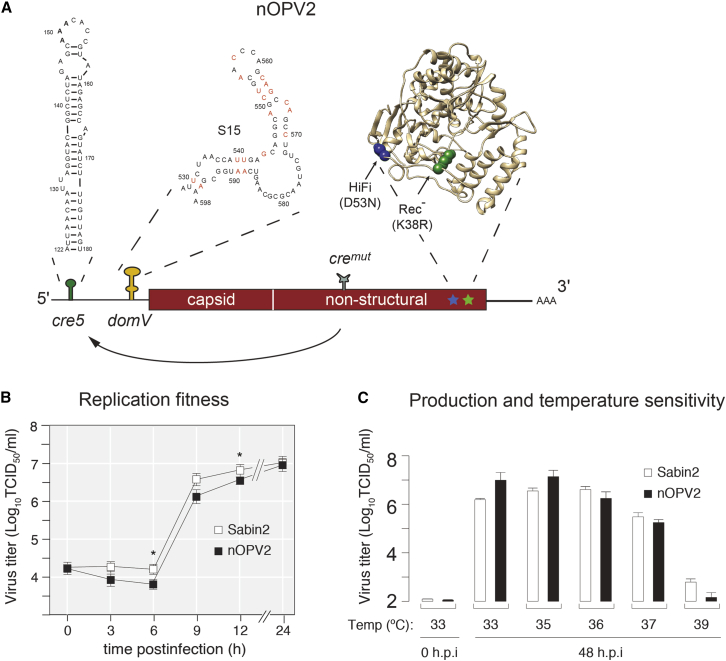
Sabin2 Vaccine Candidate (nOPV2) Design and Growth Phenotype in Cell Culture (A) Schematic of the nOPV2 genome showing modifications and their locations. The sequence of 5′-UTR domain V (S15 domV) prevents an increase in domV thermostability by single-point mutations. To prevent replacement of domV attenuation elements by recombination, the cre element, essential for poliovirus replication, was relocated from its original position in the 2C coding region to the 5′-UTR (5′cre5). The original cre was inactivated by mutations (cremut); 3Dpol mutations HiFi (D53N) and Rec1 (K38R) reduce overall virus adaptation capacity by reducing mutation and recombination rates, respectively. (B) One-step growth analysis of nOPV2 and the current vaccine Sabin2 viruses in Vero cells (33°C) at m.o.i. of 10. Data are shown as mean with SEM. Asterisks represent statistically significant difference between Sabin 2 and nOPV2 production at 6 h (p = 0.0080) and 12 h (p = 0.0197) post-infection. (C) Virus yield in Vero cells 48 h post-infection at different temperatures, m.o.i. = 0.01. Data are shown as mean with SD. Line and boxplots show mean with SD of triplicates.
Figure 4
Figure 4
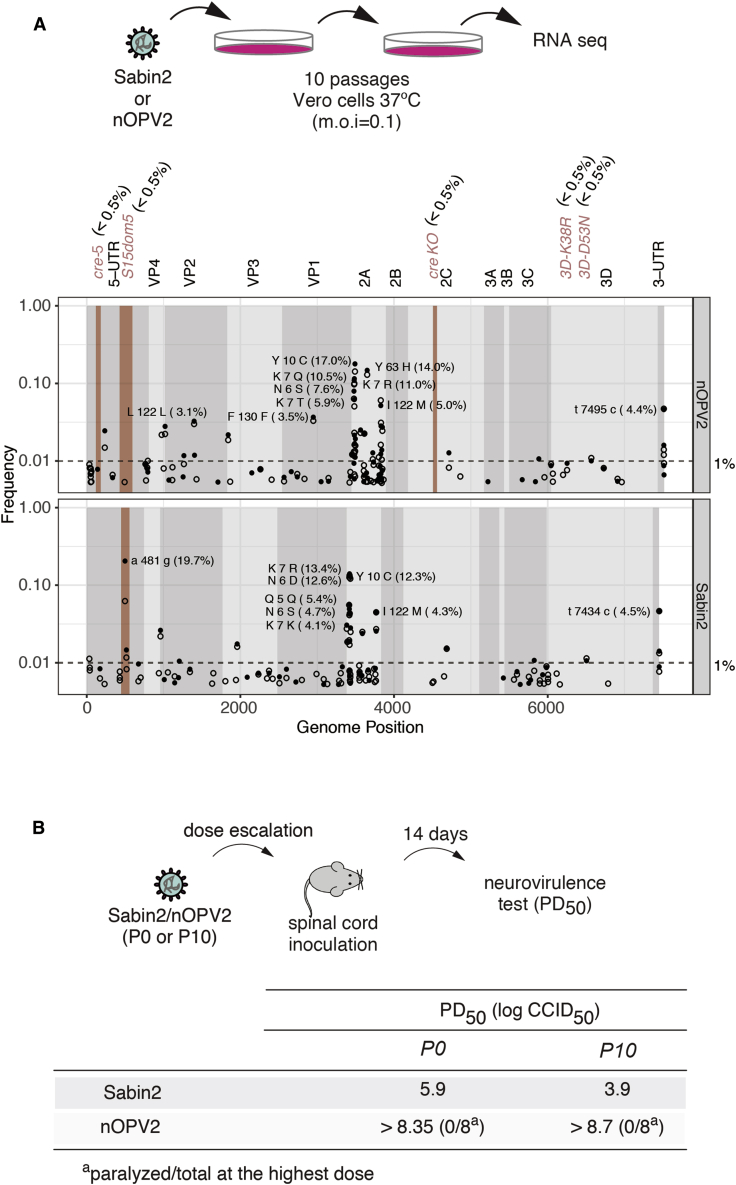
Genetic Stability of nOPV2 in Cell Culture and Animal Model of Infection (A) Virus adaptation to high temperature in Vero cells. At the top, schematic of experimental design. Sabin2 and nOPV2 were grown in Vero cells at 37°C to accelerate virus evolution. After 10 passages, viral genomes of the 10 passage viruses (P10) were analyzed by RNA-seq. At the bottom, Manhattan plot showing frequency of mutations at several locations (5′cre, domV, 2Ccremut, and HiFi/ Rec1) in nOPV2, compared with those in Sabin2. In the domV, the frequency of A481G (19.7%) in Sabin2 is compared with any mutation that increases the thermostability of domV in nOPV2, which is a “gatekeeper” structure involved in regain of virulence. Open circles represent frequencies of mutations observed at passage 8 and solid circles at passage 10. (B) Genetic stability was further validated by comparing PD50 of Sabin2 and nOPV2 before (P0) and after 10 passages (P10) of accelerated evolution at higher temperature as shown in (A). PD50s of Sabin2 and nOPV2 (P0 and P10) were determined by intra-spinally inoculating Tg66 mice and calculated using the Spearman-Karber method.
Figure 5
Figure 5
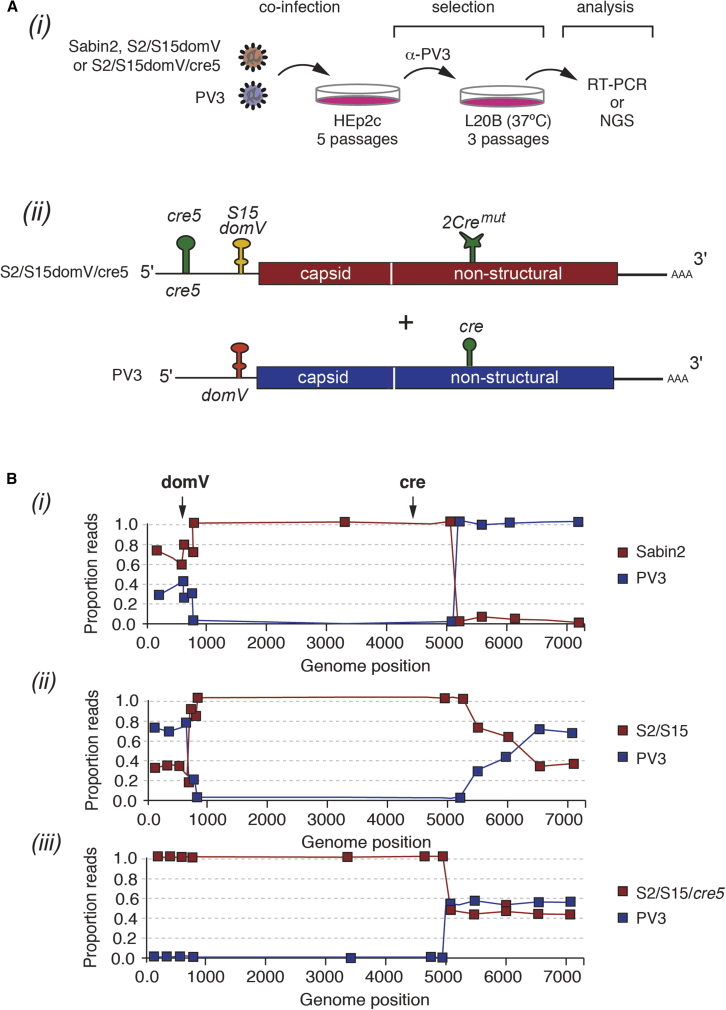
Preventing 5′-UTR Exchange by Recombination with Co-circulating Enteroviruses (A) Schematic of recombination assay (i). Sabin2 or nOPV2 strains were used to coinfect HEp2C cells together with poliovirus type 3 (PV3). After co-infection, type 2 poliovirus recombinants were selected using antibodies directed against poliovirus type 3 and two rounds of replication in L20B at 37°C that selects for high fitness, temperature-resistance variants. Co-infection in HEp2c was repeated five times to increase the chance of recombination. Type 2 strains tested (ii) were as follows: Sabin2; S2/S15 domV, which does not revert by single point mutations, but potentially can acquire a more thermostable domV by recombination with PV3; and S2/S15 domV/cre5, in which 2C cre has been relocated into the 5′-UTR. (B) After five rounds of co-infection and L20B selection, virus populations were sequenced, and the proportion of reads corresponding to PV3 or Sabin2 variants was calculated across the genome. Recombination between PV3 and (i) Sabin2, (ii) S2/S15, and (iii) S2/S15/cre5.
Figure 6
Figure 6
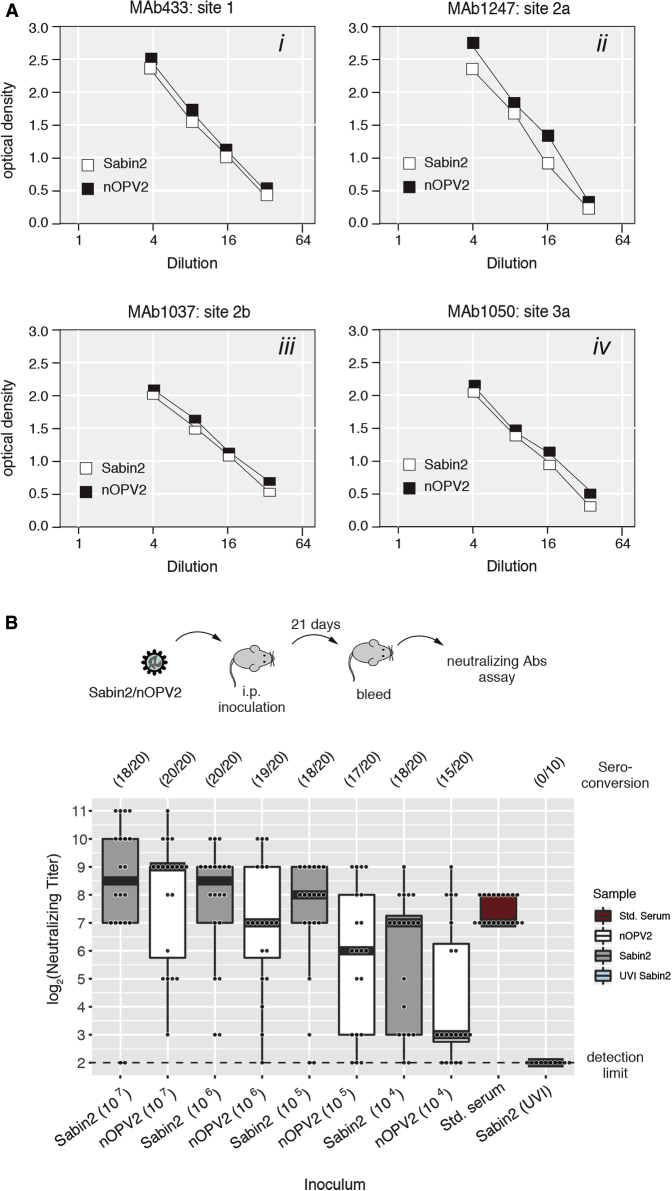
Antigenicity and Immunogenicity of nOPV2 in Mice (A) Reactivities of nOPV2 with monoclonal antibodies against four antigenic sites on the poliovirus type 2 virion were compared to Sabin2 reactivity in ELISA assays. (B) Interferon-receptor knockout, transgenic mice expressing the human poliovirus receptor (IFNAR−/− TgPVR21) were inoculated intraperitoneally with a range of doses (104–107 PFU) of Sabin2 and nOPV2. Mice injected with 107 pfu of ultraviolet light inactivated (UVI) Sabin2 were included as controls. Ten mice were used per condition for Sabin2 and nOPV2 and five mice for Sabin2 (UVI) in each experiment. Data shown were collected from two experiments. Titers of neutralizing antibody (NT) in sera at day 21 were determined by NT assay as described in STAR Methods. Box-and-whisker diagram represents the neutralizing antibody response for each condition. Bars in boxes represent median antibody titers. Whiskers represent the range of non-outliers observations (less than 2.5 IQR from the median). Overlapping dots represent neutralizing antibodies values obtained for each individual mouse. Statistical analysis (two-tailed Mann-Whitney U test) was performed to compare difference in titers of neutralizing antibody induced by Sabin2 and nOPV2: (p value: 0.53707, 0.1564, 0.0775, and 0.0731 for 107, 106, 105, and 104, respectively). Std is serum from a human subject vaccinated with OPV. At the top of the graph, seroconversion frequency (number of individuals that seroconverted over total).
Figure 7
Figure 7
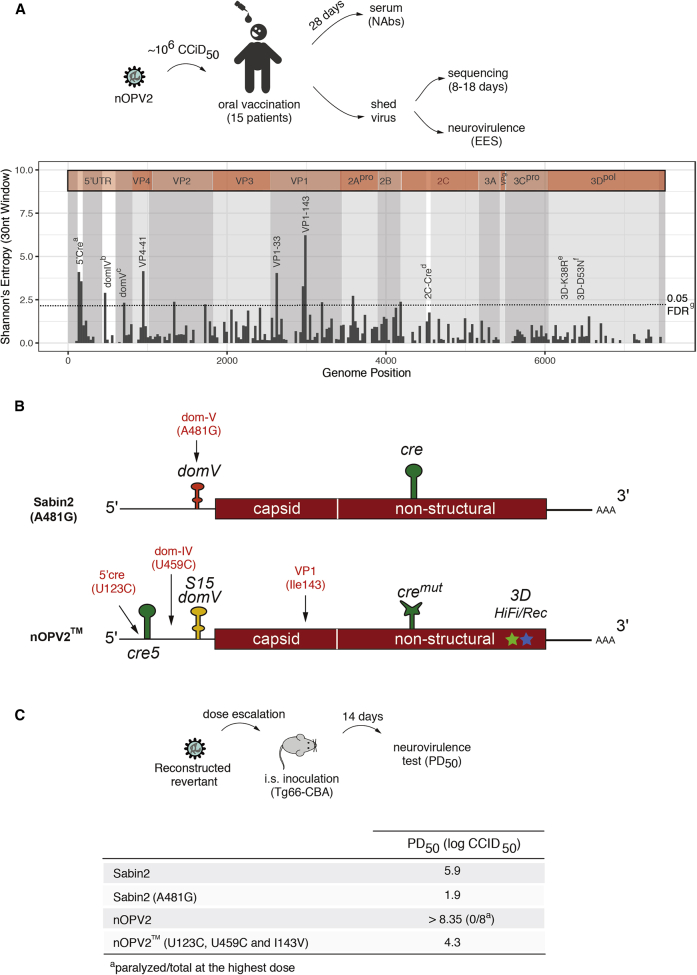
Genetic Stability of nOPV2 in Human Volunteers (A) Top panel: schematic of vaccine administration and analysis in humans. Fifteen volunteers were inoculated with nOPV2 by oral route with 106 cell-culture infectious doses 50% (CCID50). Viruses were isolated from stool samples at 8–18 days post-vaccination. Mean and range of variant frequencies observed in samples from days 8 and 18 for nOPV2 in this trial are compared with data obtained previously for Sabin2 at 14 days post-vaccination with trivalent OPV (tOPV in polio vaccine naive human subjects; Stern et al., 2017). Bottom panel: to highlight regions of diversity across individuals, we used full-genome sequences obtained from all EES samples to calculate the sum of Shannon’s entropy across vaccines along the genome in 30-nucleotide windows. 5′Crea (U123C or G179, mean: 0.68; range: 0.19–1.00), domIVb (nt459, mean: 0.07; range: 0.00–0.40), domVc (any mutation UA to CG that increases domV structural stability, mean: <0.005, the limit of detection); 3De & f (any mutation in 3Dpol at positions HiFi K38R or Rec D53N, mean: <0.005). g95% extreme value test from 10,000 randomly sampled 30mers. We also observed significant increase in Shannon’s entropy in capsid proteins VP4 (position 41) and VP1 (positions 33 and 143). (B) Positions for the most frequent mutations identified from shed viruses: domV A481G in Sabin2 (Evans et al., 1985); U123C (5′ cre), U459C (domIV), and A2969G (VP1-I143V) in nOPV2. (C) Schematic representation for virulence test of reconstructed viruses (top panel). Mutations accumulating at high frequencies in virus isolated from vaccinees (B and Stern et al., 2017) were engineered into infectious molecular clones of Sabin2 or nOPV2 to generate Sabin2 (A481G) and nOPV2 (U123C, U459C, and I143V), respectively. Virulence (PD50) of reconstructed viruses was determined with the Tg66-CBA mouse model after intraspinal inoculation (bottom panel).

Comment in

References

    1. Acevedo A., Brodsky L., Andino R. Mutational and fitness landscapes of an RNA virus revealed through population sequencing. Nature. 2014;505:686–690. - PMC - PubMed
    1. Asturias E.J., Bandyopadhyay A.S., Self S., Rivera L., Sáez-Llorens X., Lopez E., Melgar M., Gaensbauer J.T., Weldon W.C., Oberste M.S., Latin American IPV001BMG Study Group Humoral and intestinal immunity induced by new schedules of bivalent oral poliovirus vaccine and one or two doses of inactivated poliovirus vaccine in Latin American infants: an open-label randomised controlled trial. Lancet. 2016;388:158–169. - PubMed
    1. Bandyopadhyay A.S., Garon J., Seib K., Orenstein W.A. Polio vaccination: past, present and future. Future Microbiol. 2015;10:791–808. - PubMed
    1. Blake I.M., Pons-Salort M., Molodecky N.A., Diop O.M., Chenoweth P., Bandyopadhyay A.S., Zaffran M., Sutter R.W., Grassly N.C. Type 2 Poliovirus Detection after Global Withdrawal of Trivalent Oral Vaccine. N. Engl. J. Med. 2018;379:834–845. - PMC - PubMed
    1. Burns C.C., Shaw J., Jorba J., Bukbuk D., Adu F., Gumede N., Pate M.A., Abanida E.A., Gasasira A., Iber J. Multiple independent emergences of type 2 vaccine-derived polioviruses during a large outbreak in northern Nigeria. J. Virol. 2013;87:4907–4922. - PMC - PubMed

Publication types

MeSH terms

LinkOut - more resources