Practice Guideline
. 2020 Sep 15;76(11):1375-1384.
doi: 10.1016/j.jacc.2020.04.039. Epub 2020 Apr 21.

Management of Acute Myocardial Infarction During the COVID-19 Pandemic: A Position Statement From the Society for Cardiovascular Angiography and Interventions (SCAI), the American College of Cardiology (ACC), and the American College of Emergency Physicians (ACEP)

Affiliations
Practice Guideline

Management of Acute Myocardial Infarction During the COVID-19 Pandemic: A Position Statement From the Society for Cardiovascular Angiography and Interventions (SCAI), the American College of Cardiology (ACC), and the American College of Emergency Physicians (ACEP)

Ehtisham Mahmud et al. J Am Coll Cardiol. .

Abstract

The worldwide pandemic caused by the novel acute respiratory syndrome coronavirus 2 has resulted in a new and lethal disease termed coronavirus disease-2019 (COVID-19). Although there is an association between cardiovascular disease and COVID-19, the majority of patients who need cardiovascular care for the management of ischemic heart disease may not be infected with this novel coronavirus. The objective of this document is to provide recommendations for a systematic approach for the care of patients with an acute myocardial infarction (AMI) during the COVID-19 pandemic. There is a recognition of two major challenges in providing recommendations for AMI care in the COVID-19 era. Cardiovascular manifestations of COVID-19 are complex with patients presenting with AMI, myocarditis simulating an ST-elevation myocardial infarction (STEMI) presentation, stress cardiomyopathy, non-ischemic cardiomyopathy, coronary spasm, or nonspecific myocardial injury, and the prevalence of COVID-19 disease in the U.S. population remains unknown with risk of asymptomatic spread. This document addresses the care of these patients focusing on 1) the varied clinical presentations; 2) appropriate personal protection equipment (PPE) for health care workers; 3) role of the Emergency Department, Emergency Medical System and the Cardiac Catheterization Laboratory; and 4) Regional STEMI systems of care. During the COVID-19 pandemic, primary PCI remains the standard of care for STEMI patients at PCI capable hospitals when it can be provided in a timely fashion, with an expert team outfitted with PPE in a dedicated CCL room. A fibrinolysis-based strategy may be entertained at non-PCI capable referral hospitals or in specific situations where primary PCI cannot be executed or is not deemed the best option.

Keywords: COVID-19; STEMI; acute myocardial infarction; emergency medical system; fibrinolysis; percutaneous coronary intervention.


Figures

Figure 1
Figure 1
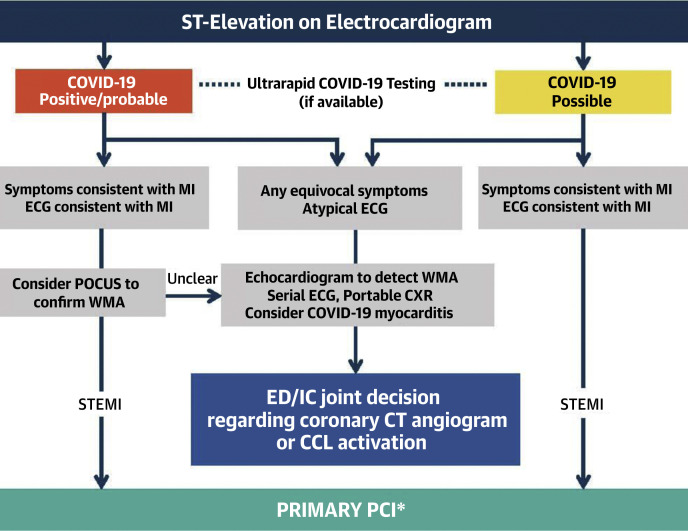
Care for ST Elevation on ECG at Primary PCI Center In COVID-19 positive or probable patients, with classic clinical symptoms and ECG findings, a point of care ultrasound (POCUS) evaluation of cardiac function to assess for a regional wall motion abnormality (WMA) consistent with the ECG finding could be considered. Patients with classic clinical presentation and ECG finding consistent with a STEMI who are COVID-19 possible should proceed to primary PCI. Ultrarapid COVID-19 testing (if available) helps determine the use of a dedicated CCL and postprocedural hospital unit placement. With any equivocal symptoms or ECG findings, a transthoracic echocardiogram, portable chest X-ray and serial ECGs should help determine the need for invasive coronary angiography. In consultation between the emergency department and interventional cardiology, consideration to coronary computed tomography (CT) angiography or CCL activation can then be made. ∗Primary PCI should always be performed with the universal use of personal protection equipment (PPE) for aerosolized and droplet precautions for the entire CCL team. COVID-19 = coronavirus 2019; CCL = cardiac catheterization laboratory; ECG = electrocardiogram; PCI = percutaneous coronary intervention; STEMI = ST-elevation myocardial infarction.
Figure 2
Figure 2
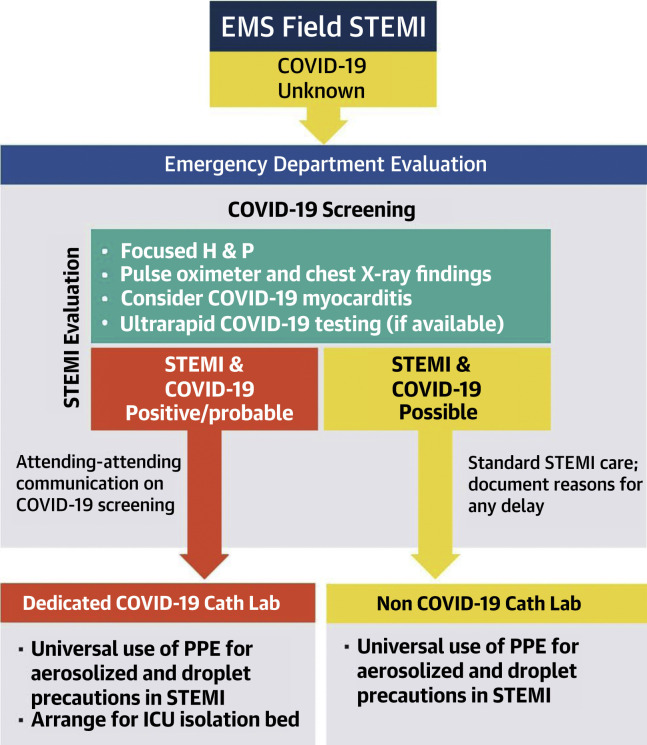
Management Approach to a Field STEMI Patients diagnosed as a field STEMI by the emergency medical system personnel need to be evaluated in the emergency department to assess their COVID-19 status and confirm the diagnosis of an STEMI. Individual patient-level decision making can be pursued as outlined in Figure 1. COVID-19 = coronavirus-2019; STEMI = ST-elevation myocardial infarction.
Figure 3
Figure 3
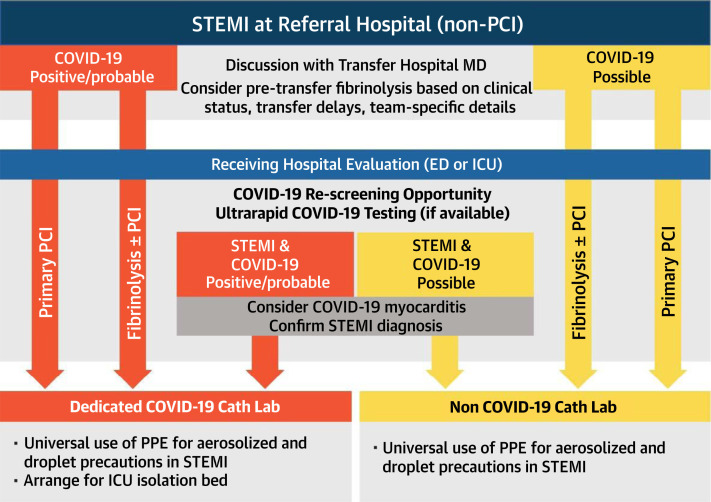
Care Pathway for STEMI at Referral Hospital (Non-PCI Center) The decision to proceed with an initial fibrinolysis or direct transfer to a PCI center is multifactorial, and it will likely vary in different regions. The treatment decision also depends on whether the patient is COVID-19 positive or probable and should be made between the referral hospital physician and PCI center physician. On transfer of a patient with an STEMI from a referral hospital to a PCI center, the patient should be reevaluated for the COVID-19 status and STEMI diagnosis. The patient can then be taken for primary PCI, pharmacoinvasive PCI, or rescue PCI, as indicated. COVID-19 = coronavirus 2019; PCI = percutaneous coronary intervention; STEMI = ST-elevation myocardial infarction.

References

    1. Huang C., Wang Y., Li X. Clinical features of patients infected with 2019 novel coronavirus in Wuhan, China. Lancet. 2020;395:497–506. - PMC - PubMed
    1. Ruan Q., Yang K., Wang W., Jiang L., Song J. Clinical predictors of mortality due to COVID-19 based on an analysis of data of 150 patients from Wuhan, China. Intensive Care Med. 2020;46:846–848. - PMC - PubMed
    1. Wang D., Hu B., Hu C. Clinical characteristics of 138 hospitalized patients with 2019 novel coronavirus-infected pneumonia in Wuhan, China. JAMA. 2020;323:1061–1069. - PMC - PubMed
    1. Shi S., Qin M., Shen B. Association of cardiac injury with mortality in hospitalized patients with COVID-19 in Wuhan, China. JAMA Cardiol. 2020 Mar 25 [E-pub ahead of print] - PMC - PubMed
    1. Guo T., Fan Y., Chen M. Cardiovascular implications of fatal outcomes of patients with coronavirus disease 2019 (COVID-19) JAMA Cardiol. 2020 Mar 27 [E-pub ahead print] - PMC - PubMed

Publication types

MeSH terms