


Outbreak Response Capacity Assessments and Improvements Among Public Health Department Health Care-Associated Infection Programs-United States, 2015-2017
- PMID: 32332484
- PMCID: PMC10887420
- DOI: 10.1097/PHH.0000000000001148
Outbreak Response Capacity Assessments and Improvements Among Public Health Department Health Care-Associated Infection Programs-United States, 2015-2017
Abstract
Context: The Centers for Disease Control and Prevention awarded $85 million to health care-associated infection and antibiotic resistance (HAI/AR) programs in March 2015 as part of Infection Control Assessment and Response (ICAR) activities in the Epidemiology and Laboratory Capacity cooperative agreement Domestic Ebola Supplement.
Program: One goal of this funding was to assess and improve program capacity to respond to potential health care outbreaks (eg, HAI clusters). All 55 funded programs (in 49 state and 6 local health departments) participated.
Implementation: The Centers for Disease Control and Prevention developed guidance and tools for HAI/AR programs to document relevant response capacities, assess policies, and measure progress. HAI/AR programs completed an interim assessment in 2016 and a final progress report in 2017.
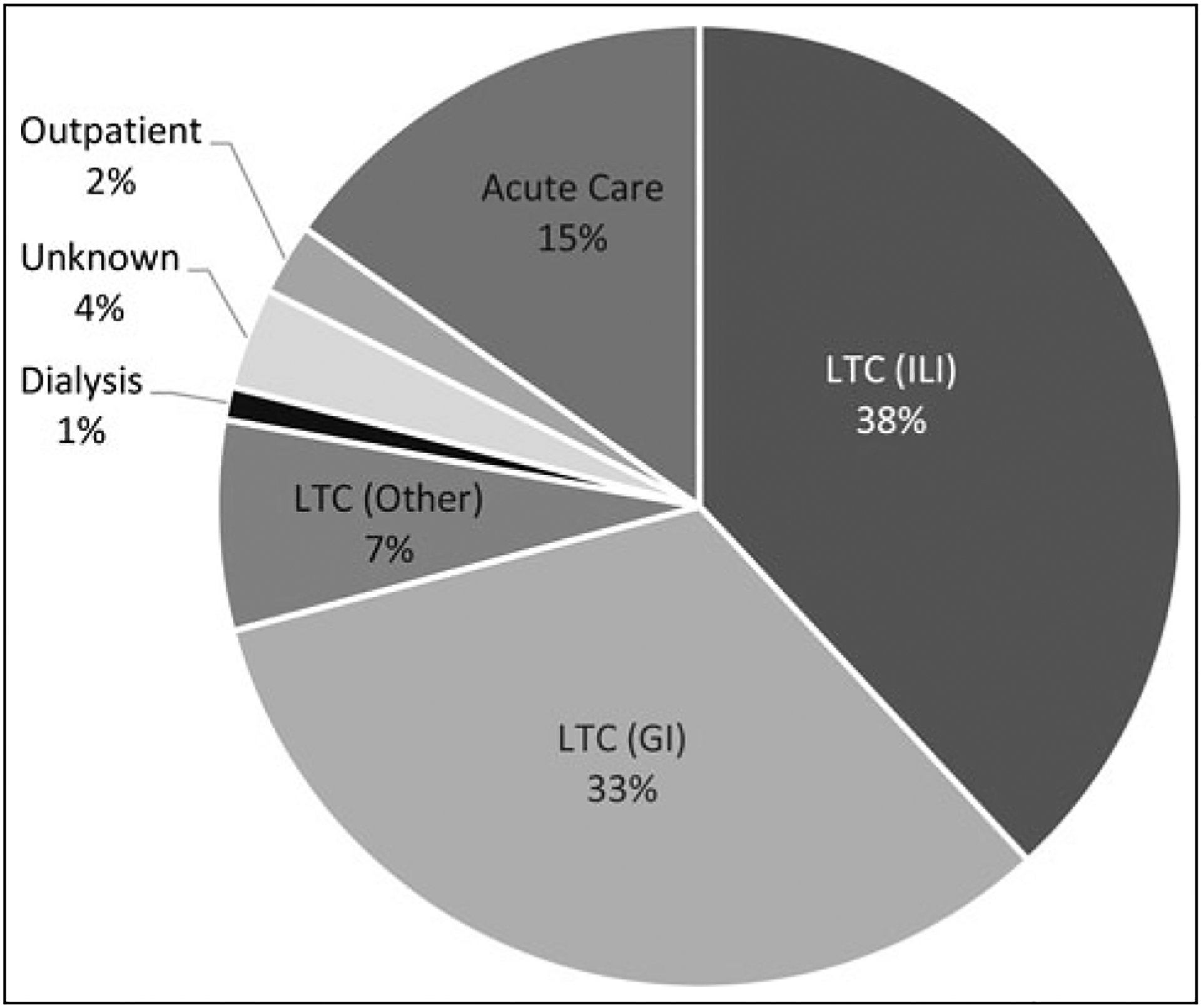
Evaluation: During the project period, 78% (n = 43) of the programs developed new investigation tools, 85% (n = 47) trained staff on outbreak response, and 96% (n = 53) of the programs reported hiring staff to assist with outbreak response activities. Staffing and expertise to support HAI outbreak response increased substantially among awardees reporting staffing limitations on the interim assessment, including in domains such as on-site infection control assessment (n = 20; 83%), laboratory capacity (n = 20; 91%), and data management/analytics (n = 14; 67%). By 2017, reporting requirements in 100% of the programs addressed possible HAI/AR outbreaks; 93% (n = 51) also addressed sentinel events such as identification of novel AR threats. More than 90% (n = 50) of programs enhanced capacities for tracking response activities; in 2016, these systems captured 6665 events (range, 3-1379; median = 46). Health departments also reported wide-ranging efforts to engage regulatory, public health, and health care partners to improve HAI/AR outbreak reporting and investigation.
Discussion: Broad capacity for responding to HAI/AR outbreaks was enhanced using Ebola ICAR supplemental funding. As response activities expand, health department programs will be challenged to continue building expertise, reporting infrastructure, investigation resources, and effective relations with health care partners.
Copyright © 2020 Wolters Kluwer Health, Inc. All rights reserved.
Conflict of interest statement
The authors declare no conflicts of interest.
Figures
References
-
- Van Beneden CA, Pietz H, Kirkcaldy RD, et al. Early identification and prevention of the spread of Ebola—United States. In: CDC’s response to the 2014–2016 Ebola epidemic—West Africa and United States. MMWR Suppl. 2016;65(S3):75–84. https://www.cdc.gov/mmwr/volumes/65/su/su6503a11.htm. Accessed January 21, 2020. - PubMed
-
- Domestic Ebola Supplement to Epidemiology and Laboratory Capacity for Infectious Diseases (ELC)—building and strengthening epidemiology, laboratory and health information systems capacity in state and local health departments. https://www.grants.gov/web/grants/view-opportunity.html?oppId=271714. Accessed January 21, 2020.
-
- Centers for Disease Control and Prevention. Epidemiology and Laboratory Capacity for Infectious Diseases (ELC) cooperative agreement. https://www.cdc.gov/ncezid/dpei/epidemiology-laboratory-capacity.html. Accessed January 21, 2020.
-
- Centers for Disease Control and Prevention. Containment strategy responding to emerging AR threats. https://www.cdc.gov/hai/containment/index.html. Accessed January 21, 2020.
-
- Patel PR, Srinivasan A, Perz J. Developing a broader approach to management of infection control breaches in health care settings. Am J Infect Control. 2008;36(10):685–690. - PubMed
MeSH terms
Grants and funding
LinkOut - more resources
Full Text Sources
Medical
Research Materials
