


The correlation between the number of vaginal examinations during active labor and febrile morbidity, a retrospective cohort study
- PMID: 32334543
- PMCID: PMC7183634
- DOI: 10.1186/s12884-020-02925-9
The correlation between the number of vaginal examinations during active labor and febrile morbidity, a retrospective cohort study
Abstract
Background: The association between the number of vaginal examinations (VEs) performed during labor and the risk of infection is unclear. The literature regarding this issue is not consensual, and the available studies are relatively small. Therefore, we aimed to study the association between the number of VEs during labor, and maternal febrile morbidity, in a very large cohort.
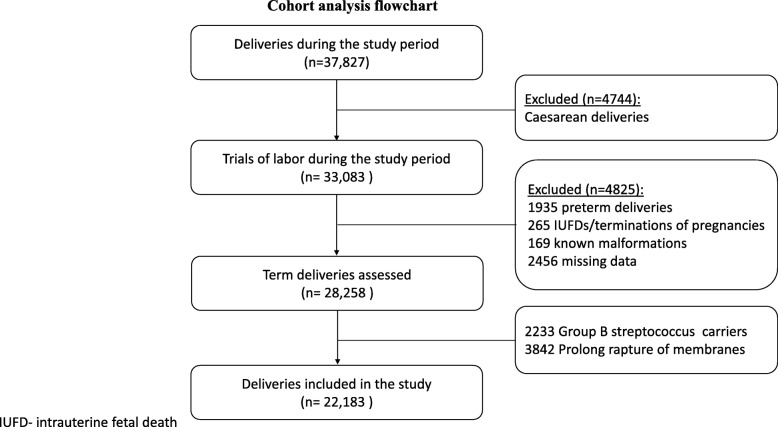
Methods: This is a retrospective cohort study. All women who delivered vaginally ≥37 weeks, at our institute, between 2008 and 2017 were included. Patients who underwent cesarean delivery or who were treated with prophylactic antibiotics, or had a fever ≥38.0 °C prior to the first VE were excluded. Cases of intrauterine fetal death, known malformations, or missing data were excluded as well. The cohort was divided according to the number of VEs performed: up to 4 VEs (n = 9716), 5-6 VEs (n = 4624), 7-8 VEs (n = 2999), and 9 or more VEs (n = 4844). The rates of intrapartum febrile morbidity (intrapartum fever and chorioamnionitis), postpartum febrile morbidity (postpartum fever and endometritis), and peripartum febrile morbidity (any of the mentioned complications) were compared.
Results: Overall, 22,183 women were included in the study. On multivariate analysis, we found that performing 5 VEs or more during labor was independently associated with intrapartum febrile morbidity (5-6 VEs: aOR = 1.83, 95% CI (1.29-2.61), 7-8 VEs: aOR = 2.65 95% CI (1.87-3.76), 9 or more VEs aOR = 3.47 95% CI (2.44-4.92)), postpartum febrile morbidity (5-6 VEs: aOR = 1.29, 95% CI (1.09-1.86), 7-8 VEs: aOR = 1.94 95% CI (1.33-2.83), 9 or more VEs aOR = 1.91 95% CI (1.28-2.82)), and peripartum morbidity (5-6 VEs: aOR = 1.48, 95% CI (1.15-1.91), 7-8 VEs: aOR = 2.15 95% CI (1.66-2.78), 9 or more VEs: aOR = 2.57 95% CI (1.97-3.34)).
Conclusion: The number of VEs performed during labor is directly correlated with febrile morbidity. Performing five or more VEs during labor is independently associated with febrile morbidity; For intrapartum and peripartum febrile morbidity the risk rises as more VEs are performed.
Keywords: Febrile morbidity; Intrapartum fever; Postpartum fever; Vaginal delivery; Vaginal examination.
Conflict of interest statement
The authors declare that they have no competing interests.
References
-
- Downe S, Gyte GM, Dahlen HG, Singata M. Routine vaginal examinations for assessing progress of labour to improve outcomes for women and babies at term. Cochrane Database Syst Rev. 2013:7 [cited 2018 13 Oct]. - PubMed
-
- (UK) NCC for W and CH. Normal labour: first stage. 2007 [cited 2018 13 Oct].
-
- Newton ER. Chorioamnionitis and intraamniotic infection. Clin Obstet Gynecol, 1993. 36(4):795–808 [cited 2018 1 Nov]. - PubMed
MeSH terms
LinkOut - more resources
Full Text Sources
Medical
