


Case series of glans injuries during voluntary medical male circumcision for HIV prevention - eastern and southern Africa, 2015-2018
- PMID: 32334596
- PMCID: PMC7183662
- DOI: 10.1186/s12894-020-00613-6
Case series of glans injuries during voluntary medical male circumcision for HIV prevention - eastern and southern Africa, 2015-2018
Abstract
Background: Male circumcision confers partial protection against heterosexual HIV acquisition among men. The President's Emergency Plan for AIDS Relief (PEPFAR) has supported > 18,900,000 voluntary medical male circumcisions (VMMC). Glans injuries (GIs) are rare but devastating adverse events (AEs) that can occur during circumcision. To address this issue, PEPFAR has supported multiple interventions in the areas of surveillance, policy, education, training, supply chain, and AE management.
Methods: Since 2015, PEPFAR has conducted surveillance of GIs including rapid investigation by the in-country PEPFAR team. This information is collected on standardized forms, which were reviewed for this analysis.
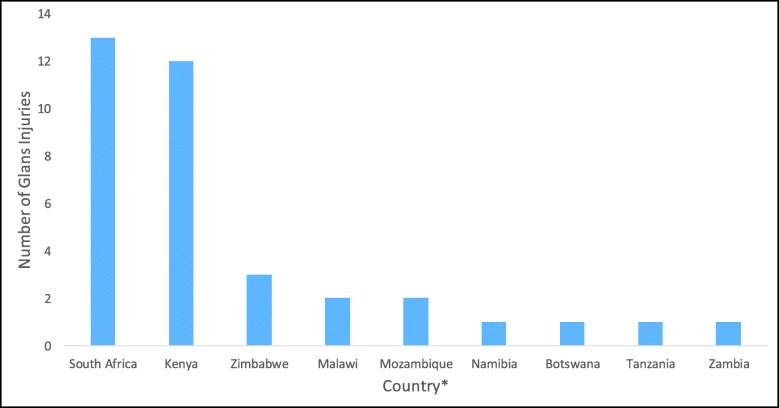
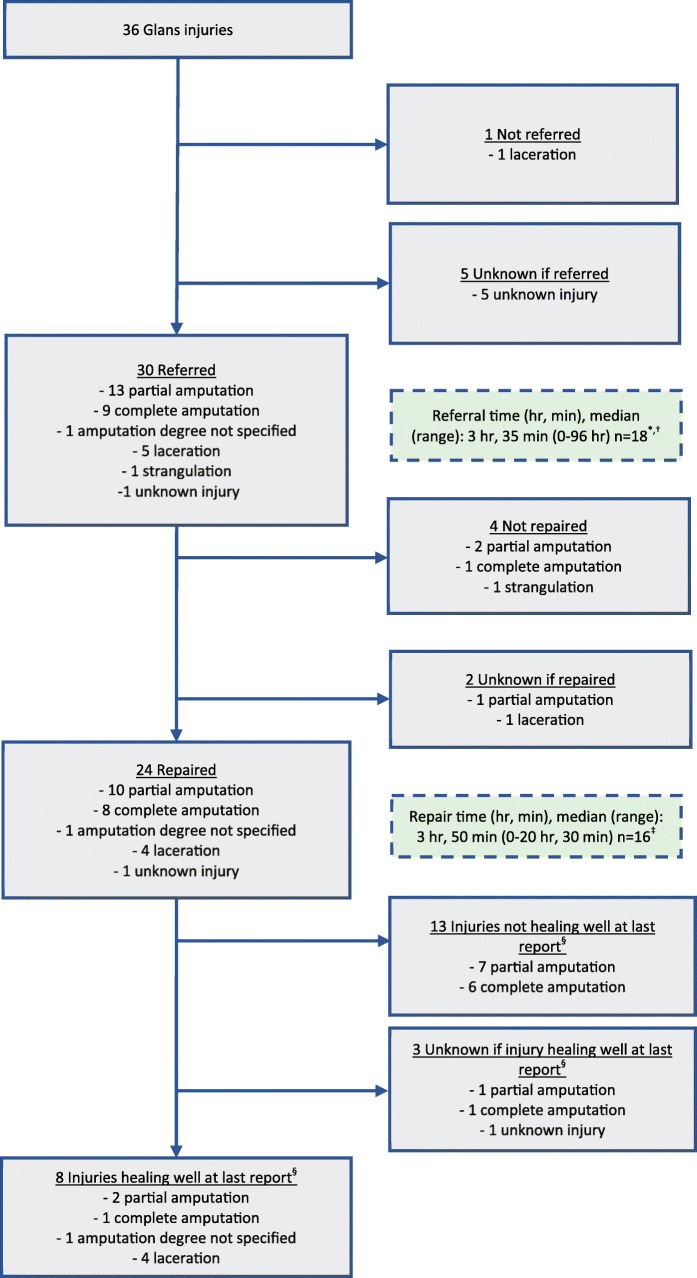
Results: Thirty-six GIs were reported from 2015 to 2018; all patients were < 15 years old (~ 0·7 per 100,000 VMMCs in this age group) with a decreasing annual rate (2015: 0.7 per 100,000 VMMCs; 2018: 0.4 per 100,000 VMMC; p = 0.02). Most (64%) GIs were partial or complete amputations. All amputations among 10-14 year-olds occurred using the forceps-guided (FG) method, as opposed to the dorsal-slit (DS) method, and three GIs among infants occurred using a Mogen clamp. Of 19 attempted amputation repairs, reattached tissue was viable in four (21%) in the short term. In some cases, inadequate DS method training and being overworked, were found.
Conclusion: Following numerous interventions by PEPFAR and other stakeholders, GIs are decreasing; however, they have not been eliminated and remain a challenge for the VMMC program. Preventing further cases of complete and partial amputation will likely require additional interventions that prevent use of the FG method in young patients and the Mogen clamp in infants. Improving management of GIs is critical to optimizing outcomes.
Keywords: Amputation; HIV; Intraoperative complications; Male circumcision.
Conflict of interest statement
The authors declare that they have no competing interests.
Figures
References
-
- Joint United Nations Programme on HIV/AIDS (UNAIDS). On the fast-track to end AIDS. [online]. Geneva: UNAIDS. 2015. Available from URL: http://www.unaids.org/sites/default/files/media_asset/20151027_UNAIDS_PC....[Cited 2019 June 18].
-
- PEPFAR. PEPFAR Latest Global Results Fact Sheet [online]. 2018. Available from URL: https://www.pepfar.gov/documents/organization/287811.pdf.[Cited 2019 mar 6].
-
- American Academy of Pediatrics Task Force on Circumcision. Male circumcision. Pediatrics. 2012;130(3):e756–85. - PubMed
MeSH terms
LinkOut - more resources
Full Text Sources
Medical
