


The role of community-wide wearing of face mask for control of coronavirus disease 2019 (COVID-19) epidemic due to SARS-CoV-2
- PMID: 32335167
- PMCID: PMC7177146
- DOI: 10.1016/j.jinf.2020.04.024
The role of community-wide wearing of face mask for control of coronavirus disease 2019 (COVID-19) epidemic due to SARS-CoV-2
Abstract
Background: Face mask usage by the healthy population in the community to reduce risk of transmission of respiratory viruses remains controversial. We assessed the effect of community-wide mask usage to control coronavirus disease 2019 (COVID-19) in Hong Kong Special Administrative Region (HKSAR).
Methods: Patients presenting with respiratory symptoms at outpatient clinics or hospital wards were screened for COVID-19 per protocol. Epidemiological analysis was performed for confirmed cases, especially persons acquiring COVID-19 during mask-off and mask-on settings. The incidence of COVID-19 per million population in HKSAR with community-wide masking was compared to that of non-mask-wearing countries which are comparable with HKSAR in terms of population density, healthcare system, BCG vaccination and social distancing measures but not community-wide masking. Compliance of face mask usage in the HKSAR community was monitored.
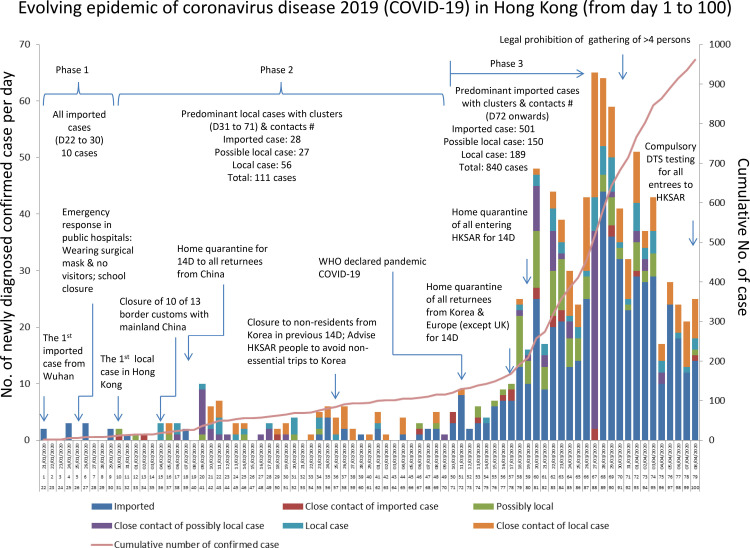
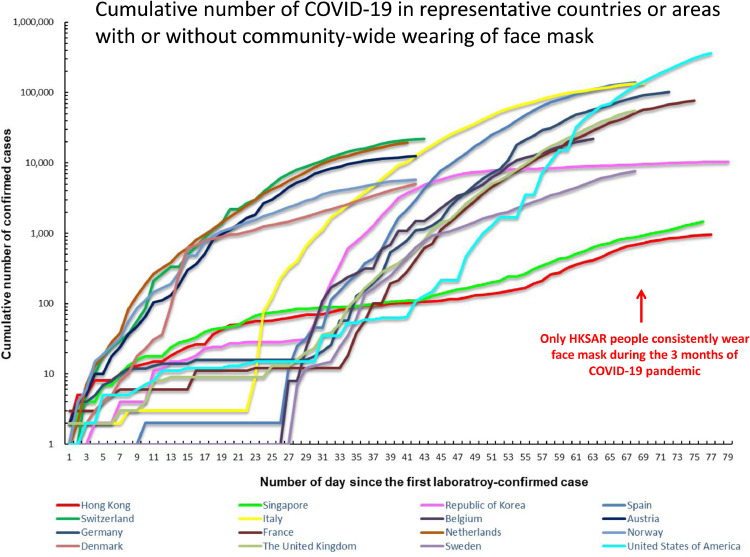
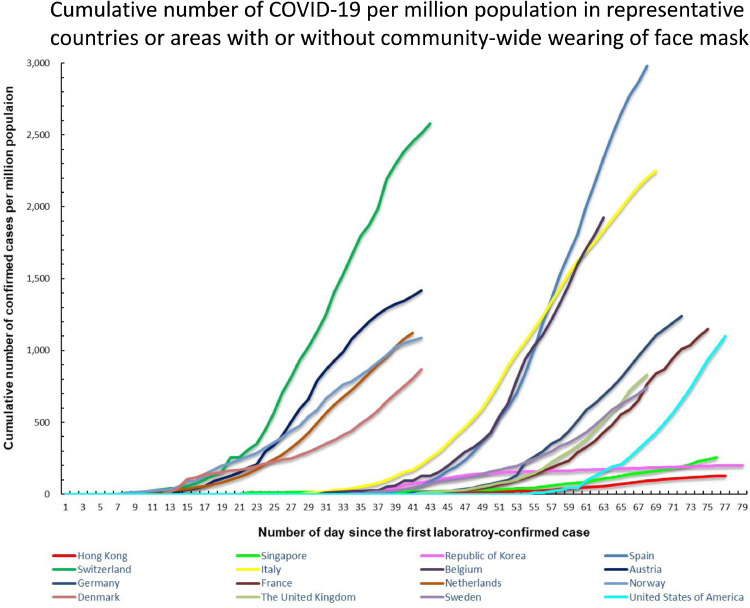
Findings: Within first 100 days (31 December 2019 to 8 April 2020), 961 COVID-19 patients were diagnosed in HKSAR. The COVID-19 incidence in HKSAR (129.0 per million population) was significantly lower (p<0.001) than that of Spain (2983.2), Italy (2250.8), Germany (1241.5), France (1151.6), U.S. (1102.8), U.K. (831.5), Singapore (259.8), and South Korea (200.5). The compliance of face mask usage by HKSAR general public was 96.6% (range: 95.7% to 97.2%). We observed 11 COVID-19 clusters in recreational 'mask-off' settings compared to only 3 in workplace 'mask-on' settings (p = 0.036 by Chi square test of goodness-of-fit).
Conclusion: Community-wide mask wearing may contribute to the control of COVID-19 by reducing the amount of emission of infected saliva and respiratory droplets from individuals with subclinical or mild COVID-19.
Keywords: COVID-19; Community; Coronavirus; Epidemic; Face mask; SARS-COV-2.
Copyright © 2020 The British Infection Association. Published by Elsevier Ltd. All rights reserved.
Conflict of interest statement
Declaration of Competing Interest All authors report no conflicts of interest relevant to this article.
Figures
Comment in
-
A tale of two cities: A comparison of Hong Kong and Singapore's early strategies for the Coronavirus Disease 2019 (COVID-19).J Infect. 2020 Sep;81(3):e51-e52. doi: 10.1016/j.jinf.2020.06.058. Epub 2020 Jun 25. J Infect. 2020. PMID: 32593657 Free PMC article. No abstract available.
-
Mass masking as a way to contain COVID-19 and exit lockdown in low- and middle-income countries.J Infect. 2020 Sep;81(3):e1-e5. doi: 10.1016/j.jinf.2020.07.015. Epub 2020 Jul 17. J Infect. 2020. PMID: 32682733 Free PMC article.
References
-
- WHO Director-General's opening remarks at the media briefing on COVID-19 - 11 March 2020. 2020. https://www.who.int/dg/speeches/detail/who-director-general-s-opening-re...Accessed 10 April 2020.
-
- The Centre for health protection closely monitors cluster of pneumonia cases on Mainland. Press release of the department of health, Hong Kong Special Administrative Region. 2019. https://www.info.gov.hk/gia/general/201912/31/P2019123100667.htmAccessed 10 April 2020.
-
- Coronavirus disease 2019 (COVID-19). Situation Report – 79. World Health Organization. 2020. https://www.who.int/docs/default-source/coronaviruse/situation-reports/2...Accessed 10 April 2020.
MeSH terms
LinkOut - more resources
Full Text Sources
Medical
Miscellaneous
