Meta-Analysis
. 2021 Nov;26(6):1515-1524.
doi: 10.1007/s10741-020-09960-w.

The transverse aortic constriction heart failure animal model: a systematic review and meta-analysis

Affiliations
Meta-Analysis

The transverse aortic constriction heart failure animal model: a systematic review and meta-analysis

Lena Bosch et al. Heart Fail Rev. 2021 Nov.

Abstract

The transverse aortic constriction (TAC) model is frequently used to study adverse cardiac remodeling upon pressure overload. We set out to define the most important characteristics that define the degree of cardiac remodeling in this model. A systematic review and meta-analyses were performed on studies using the TAC mouse/rat model and reporting echocardiographic outcome parameters. We included all animal studies in which a constriction around the transverse aorta and at least one of the predefined echocardiography or MRI outcome parameters were assessed. A total of 502 articles and > 3000 wild-type, untreated animals undergoing TAC were included in this study and referenced to a control group. The duration of aortic constriction correlated to the degree of adverse remodeling. However, the mouse data is strongly biased by the preferential use of male C57Bl/6 mice (66% of studies). Furthermore, mostly ketamine/xylazine anesthetics, 27G needle constriction, and silk sutures are used. Nonetheless, despite the homogeneity in experimental design, the model contained a substantial degree of heterogeneity in the functional outcome measures. When looking at study quality, only 12% reported randomization, 23% mentioned any sort of blinding, 25% adequately addressed the outcomes, and an amazingly low percentage (2%) showed sample size calculation. Meta-analyses did not detect specific study characteristics that explained the heterogeneity in the reported outcome measures, however this might be related to the strong bias towards the use of specific mouse lines, sex as well as age or to poor reporting of characteristics of study quality.

Keywords: Animal model; Hear failure; Meta-analysis; Systematic review; Transverse aortic constriction.


Conflict of interest statement

The authors declare that they have no conflict of interest.

Figures
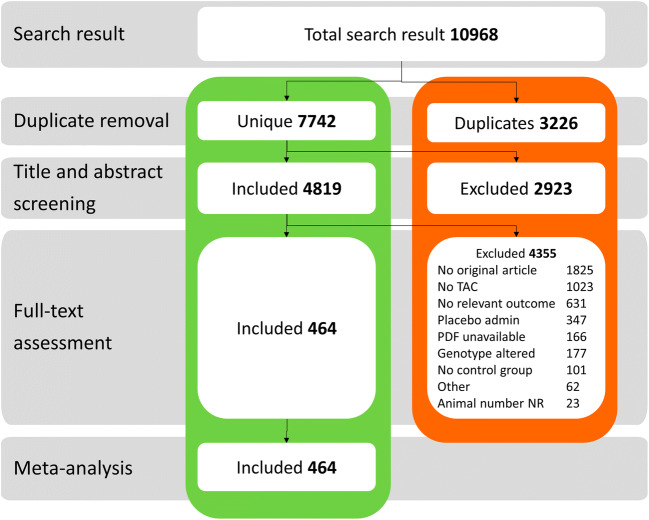
Fig. 1
Fig. 1
Flow chart of study selection process. Our systematic search in Pubmed and EMBASE yielded 7742 unique publications. After title and abstract screening, articles were screened full text of which 4355 were excluded based on exclusion criteria. Data from 464 articles was included in meta-analysis and quality assessment. TAC transverse aortic constriction, admin administration, other possible reasons: additional surgery such as ovariectomy, methods not mentioned clearly, for instance duration of TAC not stated, NR not reported
Fig. 2
Fig. 2
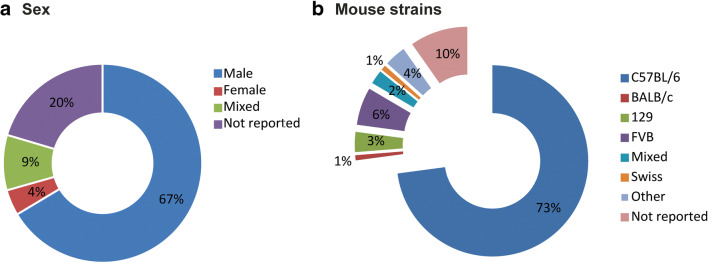
Distribution of sex and mouse strain. Distribution of a sex of the animals in all included studies and b mouse strains of included mouse studies (absolute numbers of a total of 500)
Fig. 3
Fig. 3
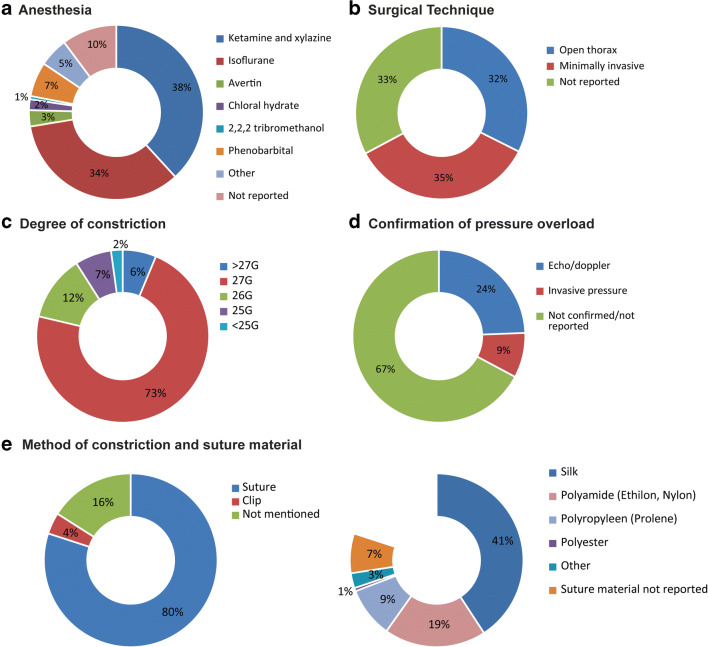
Study characteristics. Distribution of a anesthetics used during TAC or sham surgery, b surgical technique, c degree of constriction, d confirmation of pressure overload, and e method of constriction and suture materials (absolute numbers of a total of 500)
Fig. 4
Fig. 4
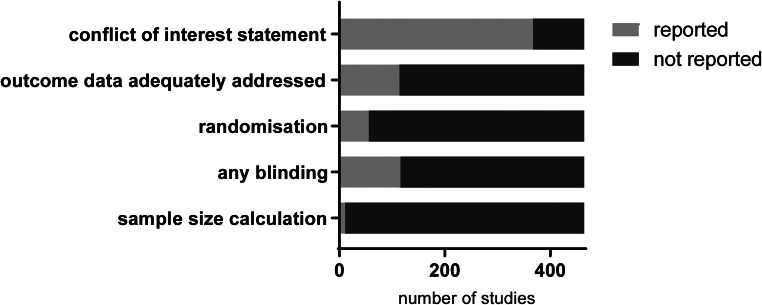
Data quality. Reporting of study quality indicators; conflict of interest statement, outcome data adequately addressed, blinding, randomization, and sample size calculation in the 464 included articles
Fig. 5
Fig. 5
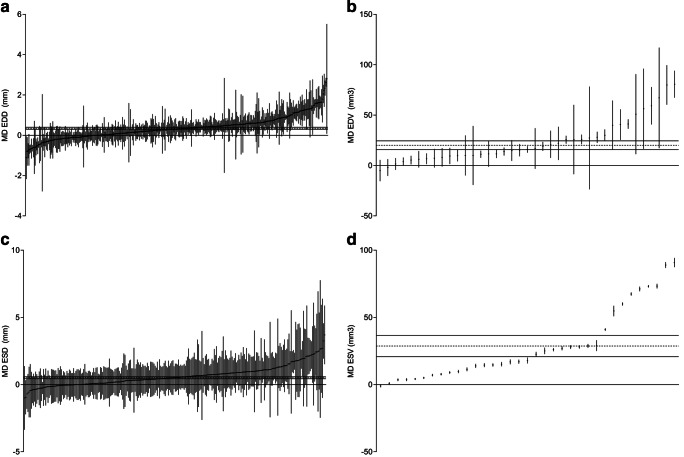
TAC induces severe structural remodeling of the heart. Forest plots of the effect of TAC on a end diastolic diameter (EDD; n = 314 comparisons), b end diastolic volume (EDV; n = 39), c end systolic diameter (ESD; n = 270), and d end systolic volume (ESV; n = 35). Data are presented as raw mean difference (MD) and 95% confidence intervals (95%CI). In all analyses, the pooled MD and 95%CI (horizontal dotted line and black line) indicate an increase outcome after TAC, when compared with controls
Fig. 6
Fig. 6
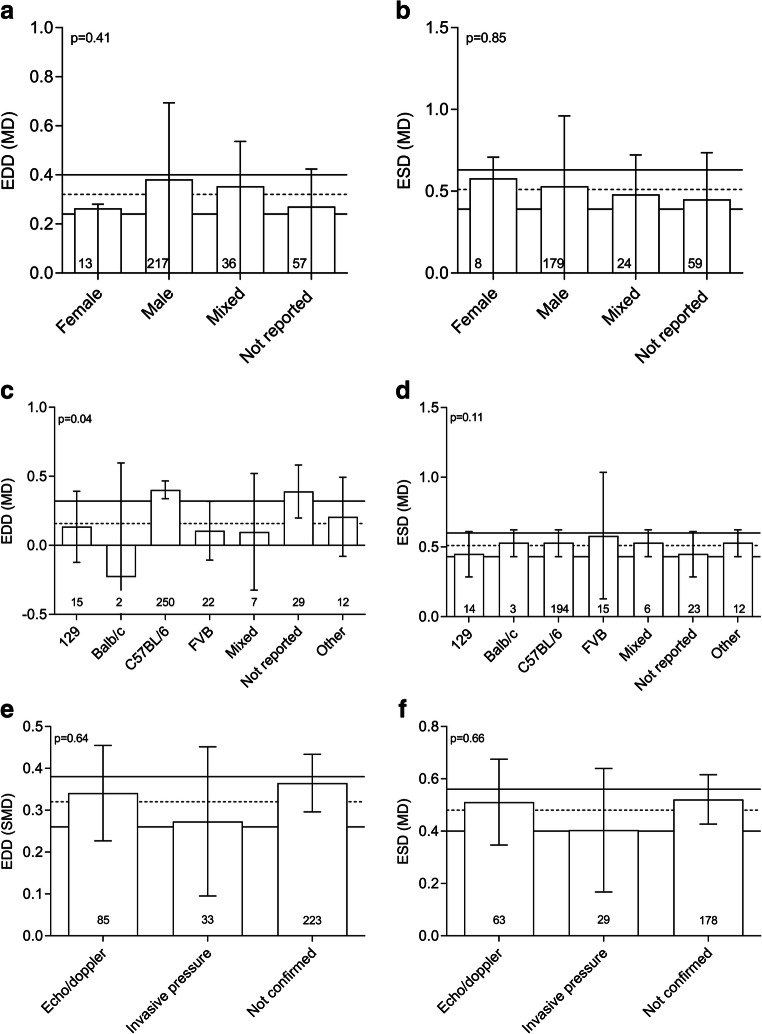
Influence of sex, mouse strain, and confirmation of pressure overload on end diastolic and end systolic diameters. Effect of sex (a), mouse strain (b), and confirmation of pressure overload on the outcome parameters EDD and ESD (MD). Horizontal dotted and solid lines represent pooled effect and its 95% confidence interval. In each bar, the number of comparisons contributing data is indicated
Fig. 7
Fig. 7
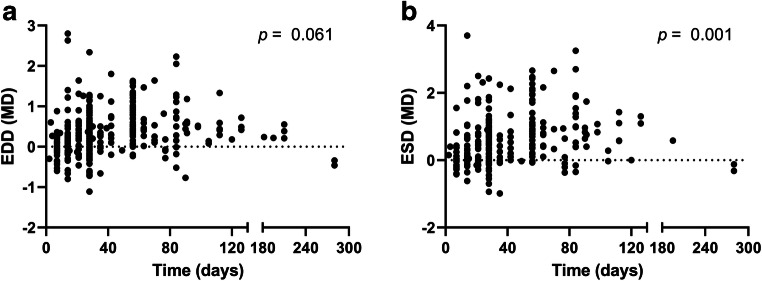
Correlation between duration of TAC and end diastolic and end systolic diameters. Effect of duration on TAC on EDD (a) and ESD (b) increase. Graph depicts mean difference in EDD and ESD for each individual comparison. p value derived from linear regression analysis

References

    1. Bui AL, Horwich TB, Fonarow GC. Epidemiology and risk profile of heart failure. Nat Rev Cardiol. 2011;8(1):30–41. doi: 10.1038/nrcardio.2010.165. - DOI - PMC - PubMed
    1. Frantz S, Bauersachs J, Ertl G. Post-infarct remodelling: contribution of wound healing and inflammation. Cardiovasc Res. 2009;81(3):474–481. doi: 10.1093/cvr/cvn292. - DOI - PMC - PubMed
    1. Rockman HA, Ross RS, Harris AN, Knowlton KU, Steinhelper ME, Field LJ, Ross J, Jr, Chien KR. Segregation of atrial-specific and inducible expression of an atrial natriuretic factor transgene in an in vivo murine model of cardiac hypertrophy. Proc Natl Acad Sci U S A. 1991;88(18):8277–8281. doi: 10.1073/pnas.88.18.8277. - DOI - PMC - PubMed
    1. Xia Y, Lee K, Li N, Corbett D, Mendoza L, Frangogiannis NG. Characterization of the inflammatory and fibrotic response in a mouse model of cardiac pressure overload. Histochem Cell Biol. 2009;131(4):471–481. doi: 10.1007/s00418-008-0541-5. - DOI - PMC - PubMed
    1. Mohammed SF, Storlie JR, Oehler EA, Bowen LA, Korinek J, Lam CS, Simari RD, Burnett JC, Jr, Redfield MM. Variable phenotype in murine transverse aortic constriction. Cardiovasc Pathol. 2012;21(3):188–198. doi: 10.1016/j.carpath.2011.05.002. - DOI - PMC - PubMed

Publication types