


Multiple Myeloma Incidence and Mortality Around the Globe; Interrelations Between Health Access and Quality, Economic Resources, and Patient Empowerment
- PMID: 32335971
- PMCID: PMC7485361
- DOI: 10.1634/theoncologist.2020-0141
Multiple Myeloma Incidence and Mortality Around the Globe; Interrelations Between Health Access and Quality, Economic Resources, and Patient Empowerment
Abstract
Background: The interrelation between the worldwide incidence, mortality, and survival of patients with multiple myeloma (MM) and relevant factors such as Health Care Access and Quality (HAQ) index, gross domestic product (GDP), health care expenditures, access to cancer drugs, and patient empowerment has not been addressed before.
Material and methods: Epidemiologic data were obtained from the International Agency for Research on Cancer. The mortality-to-incidence ratio (expressed as 1-MIR) was used as proxy for 5-year survival. Information on health expenditure was obtained from Bloomberg Health-Care Efficacy ranking, the HAQ Index was used as a measure of available health care. For patient empowerment, visits to the Web site of the International Myeloma Foundation were used as proxy. Data on GDP and population per country were assessed from the International Monetary Fund and the United Nations Population Division, respectively. Possible associations were analyzed using Spearman's rank-order correlation.
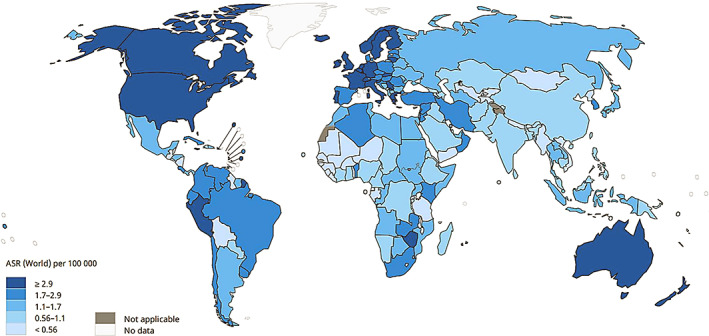
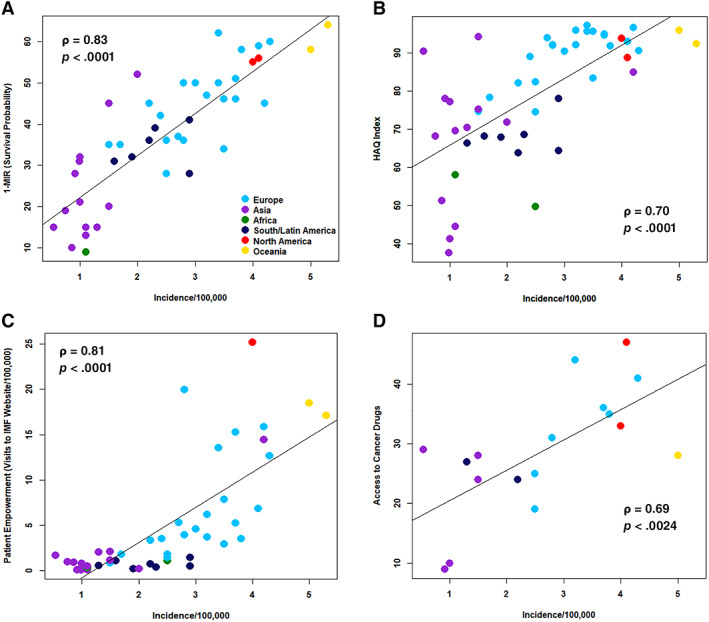
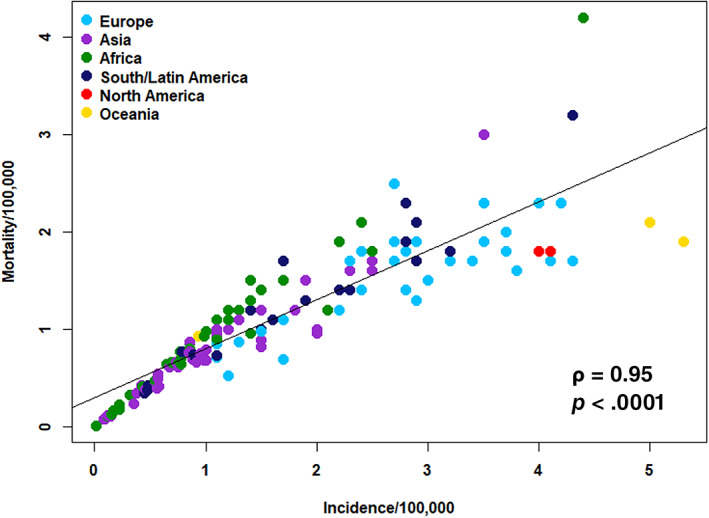
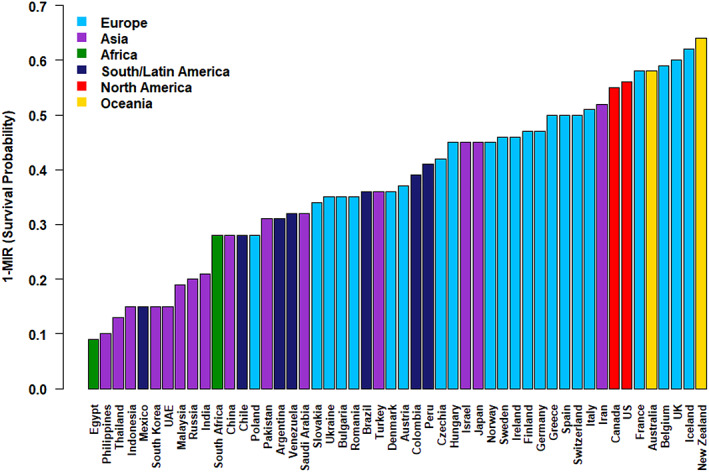
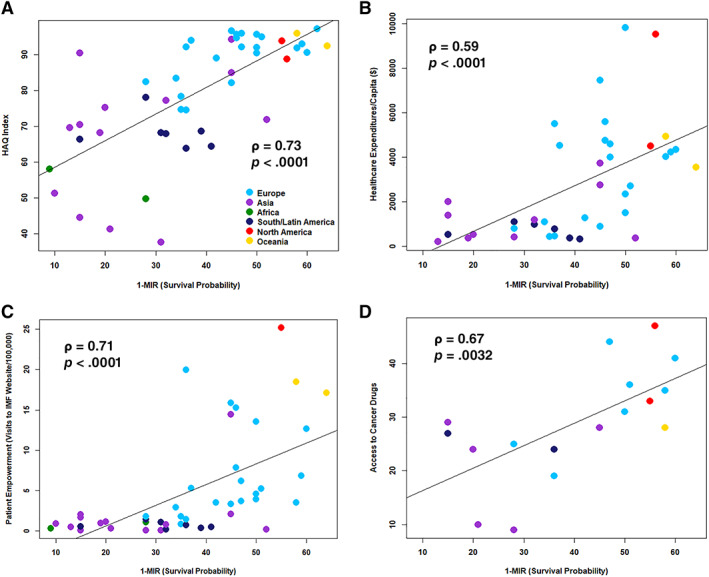
Results: The worldwide incidence of MM is currently 160,000, and mortality is 106,000. Age-standardized myeloma incidence varies between 0.54 and 5.3 per 100,000 and correlates with 1-MIR, patient empowerment, HAQ Index, and access to cancer drugs. The 1-MIR varies between 9% and 64% and is closely related to myeloma incidence, HAQ Index, patient empowerment, access to cancer drugs, and health care expenditures.
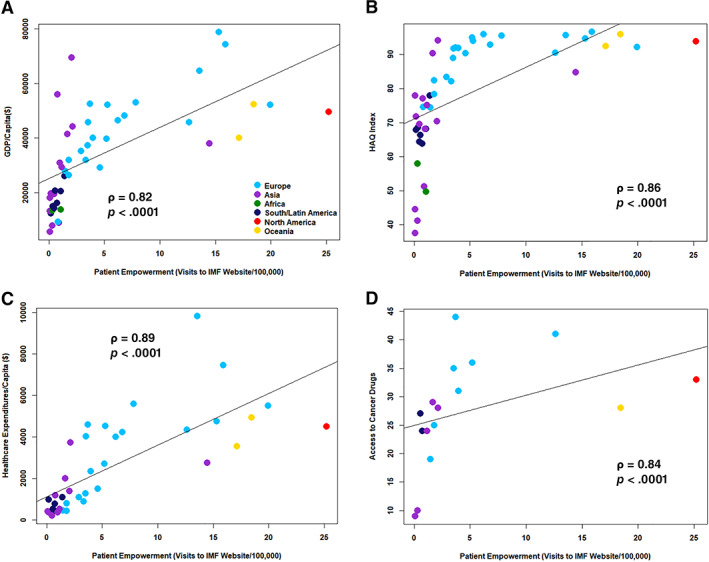
Conclusion: The global incidence and outcome of MM shows significant disparities, indicating under-recognition and suboptimal treatment in many parts of the globe. Results also highlight the importance of economic resources, access to and quality of health care, and patient education for improving diagnosis and survival of patients with MM.
Implications for practice: Multiple myeloma accounts for 10% of all hematological malignancies and has moved to the forefront of clinical interest because of the significant advances in medical treatment. Diagnosis depends on laboratory tests, imaging, and professional expertise, particularly in patients without a significant M-component. The present data show a substantial worldwide variation in incidence and mortality, that is mainly due (apart from variations due to ethnicity and lifestyle) to disparities in access to and quality of health care, a parameter strongly related to the economic development of individual countries. Improvement of quality of care and, consequently, in outcome is associated with patient empowerment.
Keywords: Health care quality and access; Incidence; Mortality; Mortality-to-incidence ratio; Multiple myeloma; Patient empowerment.
© 2020 The Authors. The Oncologist published by Wiley Periodicals, Inc. on behalf of AlphaMed Press.
Conflict of interest statement
Figures
References
-
- Ferlay J, Colombet M, Soerjomataram I et al. Estimating the global cancer incidence and mortality in 2018: GLOBOCAN sources and methods. Int J Cancer 2019;144:1941–1953. - PubMed
-
- Asadzadeh Vostakolaei F, Karim‐Kos HE, Janssen‐Heijnen ML et al. The validity of the mortality to incidence ratio as a proxy for site‐specific cancer survival. Eur J Public Health 2011;21:573–577. - PubMed
-
- Sunkara V, Hébert JR. The application of the mortality‐to‐incidence ratio for the evaluation of cancer care disparities globally. Cancer 2016;122:487–848. - PubMed
Publication types
MeSH terms
LinkOut - more resources
Full Text Sources
Medical
