Comparative Study
. 2020 Nov-Dec;9(6):485-493.
doi: 10.1016/j.jasc.2020.04.003. Epub 2020 Apr 6.

EBUS-FNA cytologic-histologic correlation of PD-L1 immunohistochemistry in non-small cell lung cancer

Affiliations
Comparative Study

EBUS-FNA cytologic-histologic correlation of PD-L1 immunohistochemistry in non-small cell lung cancer

Rachel Jug et al. J Am Soc Cytopathol. 2020 Nov-Dec.

Abstract

Introduction: Immune checkpoint pathway markers induce immune tolerance to non-small cell lung cancer (NSCLC). Therapeutic antibodies targeting the programmed cell death 1 (PD-1)/programmed cell death ligand 1 (PD-L1) pathway have demonstrated efficacy in tumors expressing relatively high PD-L1 levels. Minimally invasive endobronchial ultrasound-guided fine needle aspiration allows patients with inoperable tumors or comorbidities to attain a confirmatory diagnosis. The aims of the present study were to determine whether PD-L1 testing is equivalent to cytology and biopsy or resection specimens at different tumor proportion score cutoffs and for different NSCLC subtypes.

Materials and methods: Data were retrospectively collected for patients with paired NSCLC cytology and surgical resection specimens from May 4, 2007 to May 4, 2017. The Food and Drug Administration-approved Dako PD-L1 immunohistochemistry 22C3 pharmDx kit was used to measure PD-L1 on paired cytology cell block and biopsy or resection specimens, and the PD-L1 tumor proportion scores were recorded. Statistical analysis of categorical and continuous variables was performed using SAS, version 9.4.

Results: A total of 53 paired cytology and resection samples (27 adenocarcinoma, 25 squamous cell carcinoma, and 1 unclassified) were analyzed. Supposing the resection specimen to reflect the true PD-L1 expression, the sensitivity, specificity, positive predictive value, negative predictive value, and overall agreement for the cytology method was 73.3%, 65.2%, 73.3%, 65.2%, and 69.8%, respectively. For high PD-L1 expression (≥50%), the cytology method demonstrated an overall agreement of 79.2%. The overall agreement between methods was 81.5% and 76% for cases of adenocarcinoma and squamous cell carcinoma, respectively.

Conclusions: NSCLC cytology samples from endobronchial ultrasound-guided fine needle aspiration are suitable for PD-L1 testing, especially using a high PD-L1 expression cutoff of ≥50% and for adenocarcinoma.

Keywords: Checkpoint inhibitor; EBUS-FNA; FNA; Non–small cell lung cancer; PD-L1.


Conflict of interest statement

Declarations of interest: none

Figures

Figure 1:
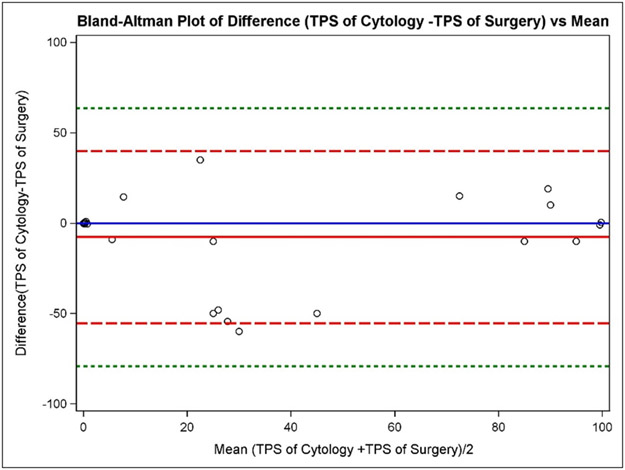
Figure 1:. Bland-Altman Plot of difference in tumor proportion score (TPS) of cytological versus surgical method compared to the mean.
Bland-Altman plot used to show the difference between the methods (Cytologic TPS – Surgical TPS) against the average (Cytologic TPS – Surgical TPS)/2 with the addition of a horizontal line at (Cytologic TPS – Surgical TPS) =0 (solid blue line), the mean of the difference (Cytologic TPS – Surgical TPS) (solid red line), dotted lines at ± 2SD (dashed red lines), and dotted lines at ± 3SD (dashed green lines). The 2 standard deviation limits (dashed red lines) provide an estimate of where 95% of the differences should lie if the differences are normally distributed. Plotting the horizontal line at (Cytologic TPS – Surgical TPS) =0 and comparing the location of the horizontal line at the mean of the difference (Cytologic TPS – Surgical TPS) aids in determining bias in one direction or another. In this case, the mean of the difference (Cytologic TPS – Surgical TPS) is very close to the (Cytologic TPS – Surgical TPS) =0 line, indicating that TPS of Cytology measures are, on average, similar to TPS of Surgery. When TPS is greater than 60% or less than 10%, the two methods are more likely to agree with each other.
Figure 2:
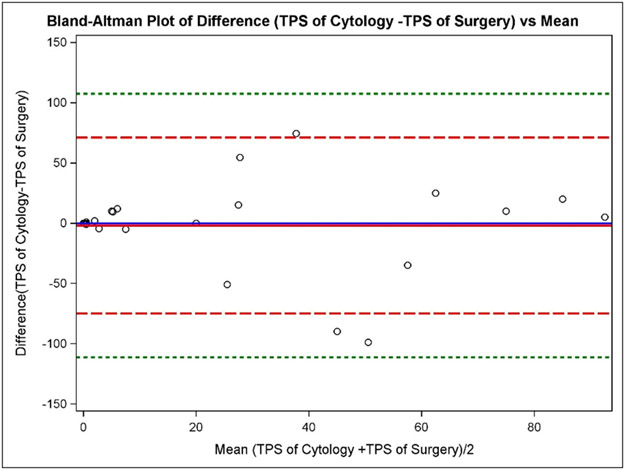
Figure 2:. Bland-Altman plot of the difference in the tumor proportion score (TPS) of the cytological versus surgical methods compared to the mean in adenocarcinoma specimens.
Bland-Altman plot used to show the difference between the methods (Cytologic TPS – Surgical TPS) against the average (Cytologic TPS – Surgical TPS)/2 with the addition of a horizontal line at (Cytologic TPS – Surgical TPS) =0 (solid blue line), the mean of the difference (Cytologic TPS – Surgical TPS) (solid red line), dotted lines at ± 2SD (dashed red lines), and dotted lines at ± 3SD (dashed green lines). The mean of the difference (Cytologic TPS – Surgical TPS) is very close to the (Cytologic TPS – Surgical TPS) =0 line, indicating that TPS of cytology measures are, on average, similar to TPS of surgery.
Figure 3:
Figure 3:. Bland-Altman plot of the difference in the tumor proportion score (TPS) of the cytological versus surgical methods compared to the mean in squamous cell carcinoma specimens.
Bland-Altman plot used to show the difference between the methods (Cytologic TPS – Surgical TPS) against the average (Cytologic TPS – Surgical TPS)/2 with the addition of a horizontal line at (Cytologic TPS – Surgical TPS) =0 (solid blue line), the mean of the difference (Cytologic TPS – Surgical TPS) (solid red line), dotted lines at ± 2SD (dashed red lines), and dotted lines at ± 3SD (dashed green lines). The mean of the difference (Cytologic TPS – Surgical TPS) is very close to the (Cytologic TPS – Surgical TPS) =0 line, indicating that TPS of cytology measures are, on average, similar to TPS of surgery.

References

    1. Ilie M, Hofman V, Dietel M, Soria JC, Hofman P. Assessment of the PD-L1 status by immunohistochemistry: challenges and perspectives for therapeutic strategies in lung cancer patients. Virchows Arch. 2016;468(5):511–525. - PubMed
    1. Chen F, Zhang Y, Parra E, et al. Multiplatform-based Molecular Subtypes of Non-Small Cell Lung Cancer. Oncogene. 2017;36(10):1384–1393. - PMC - PubMed
    1. Yu H, Boyle TA, Zhou C, Rimm DL, Hirsch FR. PD-L1 Expression in Lung Cancer. J Thorac Oncol. 2016;11(7):964–975. - PMC - PubMed
    1. Kwok G, Yau TCC, Chiu JW, Tse E, Kwong Y-L. Pembrolizumab (Keytruda). Hum Vaccin Immunother. 2016;12(11):2777–2789. - PMC - PubMed
    1. Garon EB, Rizvi NA, Hui R, et al. Pembrolizumab for the treatment of non-small-cell lung cancer. N Engl J Med. 2015;372(21):2018–2028. - PubMed

Publication types

MeSH terms