


Comparing the Effect of Bupivacaine and Ropivacaine in Cesarean Delivery with Spinal Anesthesia
- PMID: 32337166
- PMCID: PMC7144247
- DOI: 10.5812/aapm.94155
Comparing the Effect of Bupivacaine and Ropivacaine in Cesarean Delivery with Spinal Anesthesia
Abstract
Background: Spinal anesthesia is the most common technique used for cesarean delivery due to some advantages compared to regional anesthesia. It is easily performed and provides a rapid onset of block. Though bupivacaine is a generally used long-acting amide type local anesthetic drug for spinal anesthesia, ropivacaine may sometimes be selected.
Objectives: This prospective, randomized, double-blinded study was aimed at comparing clinical efficacy and safety between ropivacaine and bupivacaine during cesarean section.
Methods: After getting ethical committee approval and written informed consent, 65 women who referred to Imam Khomeini Hospital of Ahvaz, Iran in 2018 were chosen for elective cesarean delivery under spinal anesthesia. They were randomly allocated to receive either ropivacaine 1% (n = 33) or bupivacaine 0.5% (n = 32). Afterwards, the differences in the anesthetic efficacy, vital signs, and hemodynamics of participants between the two groups were recorded.
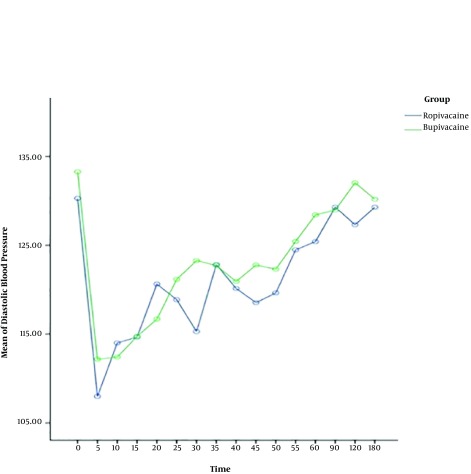
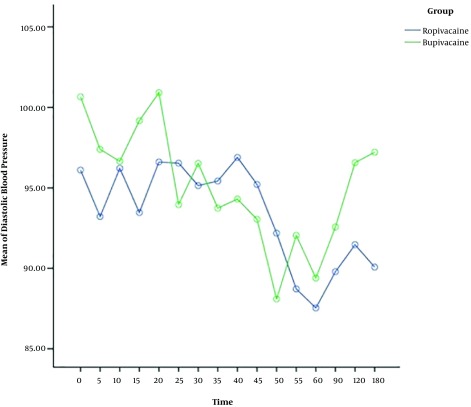
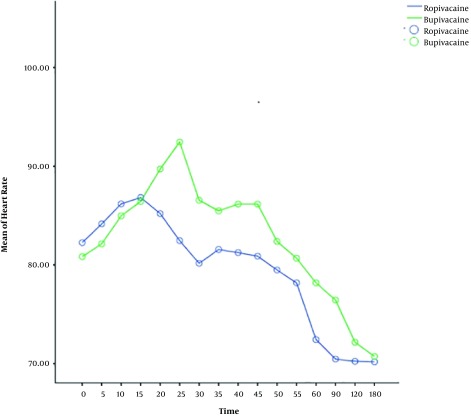
Results: Duration of sensory block was shorter in the ropivacaine group than bupivacaine group (132.5 ± 21.6 min vs. 175.8 ± 26.2 min; P < 0.001). Ropivacaine also produced a shorter duration of motor blockade than bupivacaine (124.8 ± 20.2 min vs. 168.2 ± 21.7 min; P < 0.001). There is no difference between the two groups in terms of systolic and diastolic blood pressure, but the heart rate of patients in the bupivacaine group is significantly higher than the ropivacaine group.
Conclusions: The results suggest that ropivacaine and bupivacaine are two efficient drugs in anesthesia in the cesarean section, ropivacaine is a better choice due to little influence on the hemodynamics and shorter duration of sensory block and motor block which are useful for the recovery and also safe to the patients.
Keywords: Bupivacaine; Caesarean Section; Motor Block; Ropivacaine; Sensory Block; Spinal Anesthesia.
Copyright © 2020, Author(s).
Conflict of interest statement
Conflict of Interests: The authors report no conflicts of interest in this work.
Figures
References
-
- Cunninghan FG, Kenneth L, Bloom SL, Hauth JC, Rouse DJ, Spong CY. Williams obstetrics. 23rd ed. New York: McGraw Hill; 2014. p. 872.
-
- Stoelting R, Miller R. Basics of anesthesia. 6th ed. Philadelphia: Churchill Livingstone Elsevier; 2015.
-
- Arzola C, Wieczorek PM. Efficacy of low-dose bupivacaine in spinal anesthesia for cesarean delivery. Obstet Anesth Digest. 2012;32(3):194–5. doi: 10.1097/01.aoa.0000417618.03038.1f. - DOI
-
- Golmohammadi M, Mansuri P, Jafari Javid M, Khalkhali HR, Aghdashi M. [Comparison of the effects of colloid loading before and after spinal anesthesia to prevent maternal hypotension in cesarean section.]. J Adv Med Biomed Res. 2013;21(89):1–9.
LinkOut - more resources
Full Text Sources