. 2020 Jun 5;19(6):2511-2515.
doi: 10.1021/acs.jproteome.0c00119. Epub 2020 May 8.

Crystal-C: A Computational Tool for Refinement of Open Search Results

Affiliations

Crystal-C: A Computational Tool for Refinement of Open Search Results

Hui-Yin Chang et al. J Proteome Res. .

Abstract

Shotgun proteomics using liquid chromatography coupled to mass spectrometry (LC-MS) is commonly used to identify peptides containing post-translational modifications. With the emergence of fast database search tools such as MSFragger, the approach of enlarging precursor mass tolerances during the search (termed "open search") has been increasingly used for comprehensive characterization of post-translational and chemical modifications of protein samples. However, not all mass shifts detected using the open search strategy represent true modifications, as artifacts exist from sources such as unaccounted missed cleavages or peptide co-fragmentation (chimeric MS/MS spectra). Here, we present Crystal-C, a computational tool that detects and removes such artifacts from open search results. Our analysis using Crystal-C shows that, in a typical shotgun proteomics data set, the number of such observations is relatively small. Nevertheless, removing these artifacts helps to simplify the interpretation of the mass shift histograms, which in turn should improve the ability of open search-based tools to detect potentially interesting mass shifts for follow-up investigation.

Keywords: LC-MS; liquid chromatography coupled to mass spectrometry; open search; peptide identification; post-translational modifications.


Figures
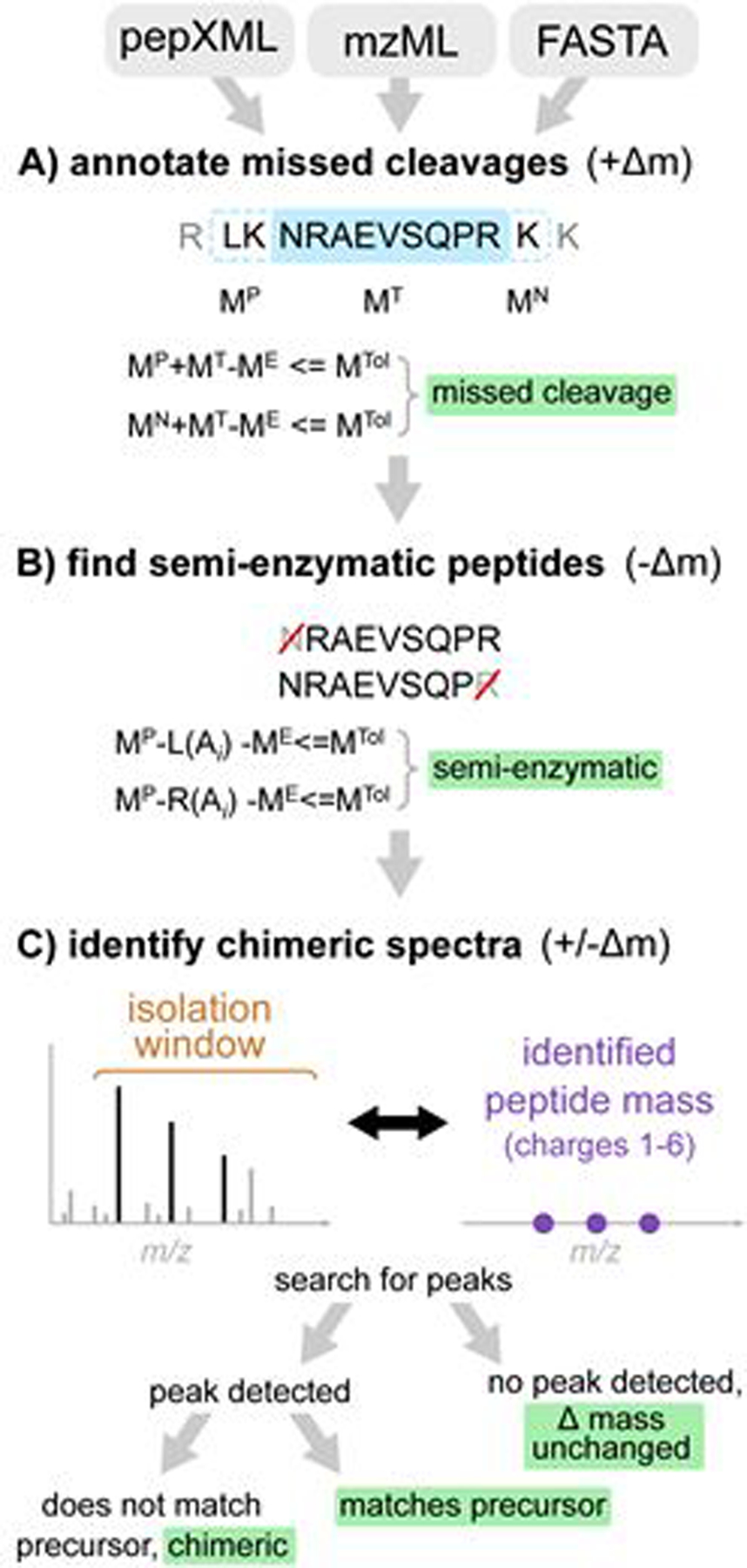
Figure 1.
Figure 1.
The workflow of Crystal-C as applied to each PSM from open search results. A) Find potential missed cleavage sites by searching the previous and next fully-enzymatic peptides of the identified peptide, where MTol is the mass tolerance (20 ppm by default), ME is the precursor neutral mass, MT is the identified peptide mass, and MP and MN are the previous and next adjacent fully enzymatic peptide masses, respectively. B) Check whether the PSM is semi-enzymatic by deleting one amino acid from the left or right side of the identified peptide sequence at a time and calculating the mass difference between ME and the remaining peptide sequence. If the mass difference is smaller than MTol, the remaining peptide sequence is regarded as semi-enzymatic. C) Find chimeric MS/MS spectra. Crystal-C searches for peaks from the identified peptide within the isolation window by comparing theoretical isotopic clusters (purple)to the MS1 spectrum. If a peak matching one of the theoretical isotope clusters is found in the isolation window and does not belong to the precursor, the PSM is considered chimeric.
Figure 2.
Figure 2.
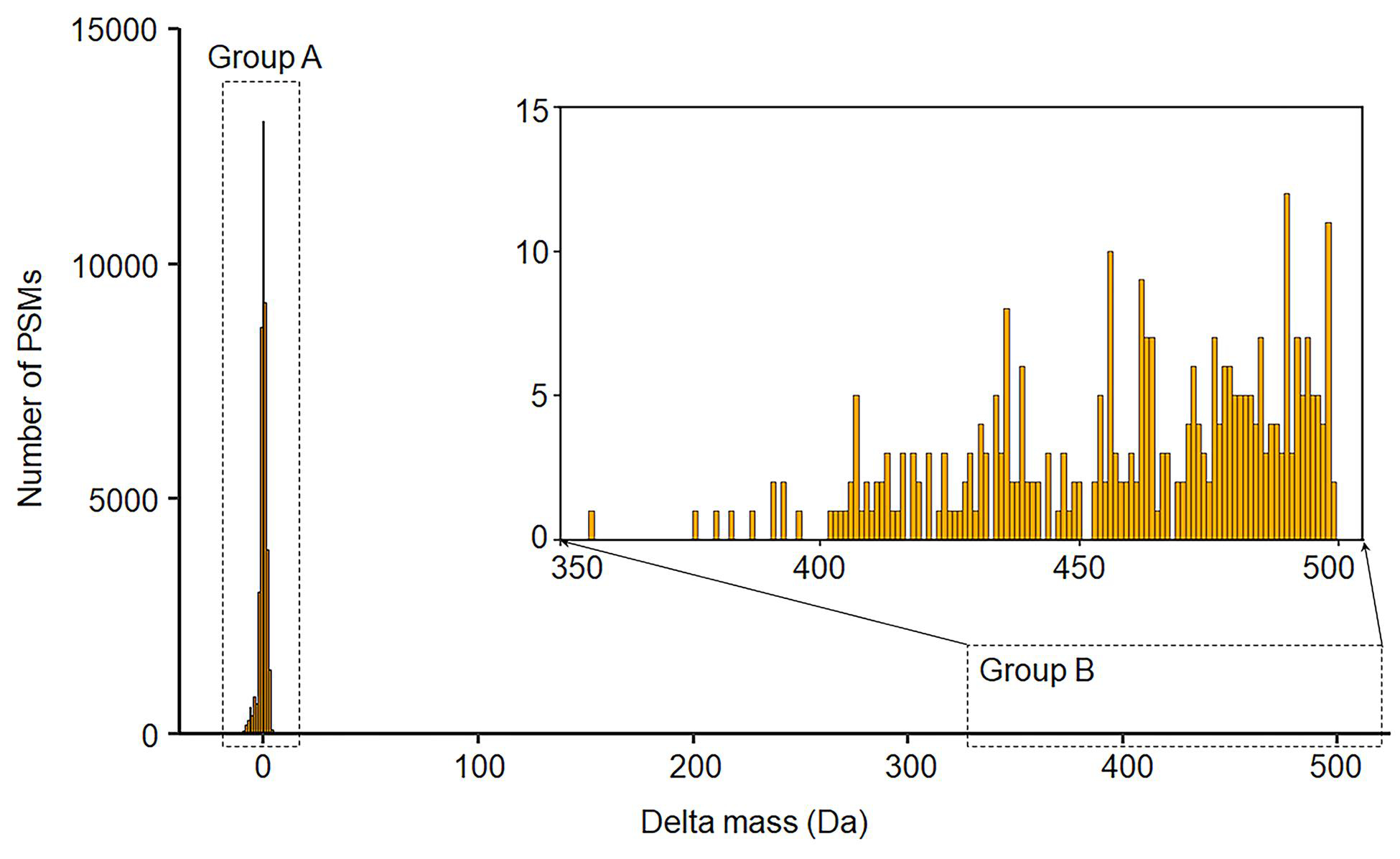
The delta mass shift of the 42370 PSMs annotated as chimeric spectra by Crystal-C. Note that the delta masses of these PSMs are found between-12.84 and 3.99 (group A), and from 356.05 to 499.34 (group B).

References

    1. Doerig C, Rayner JC, Scherf A & Tobin AB Post-translational protein modifications in malaria parasites. Nat Rev Microbiol 13, 160–172, doi: 10.1038/nrmicro3402 (2015). - DOI - PubMed
    1. Benjdia A, Guillot A, Ruffie P, Leprince J & Berteau O Post-translational modification of ribosomally synthesized peptides by a radical SAM epimerase in Bacillus subtilis. Nat Chem 9, 698–707, doi: 10.1038/nchem.2714 (2017). - DOI - PMC - PubMed
    1. Riley NM & Coon JJ Phosphoproteomics in the Age of Rapid and Deep Proteome Profiling. Anal Chem 88, 74–94, doi: 10.1021/acs.analchem.5b04123 (2016). - DOI - PMC - PubMed
    1. Pagel O, Loroch S, Sickmann A & Zahedi RP Current strategies and findings in clinically relevant post-translational modification-specific proteomics. Expert Rev Proteomic 12, 235–253, doi: 10.1586/14789450.2015.1042867 (2015). - DOI - PMC - PubMed
    1. Yang XY & Qian KV Protein O-GlcNAcylation: emerging mechanisms and functions. Nat Rev Mol Cell Bio 18, 452–465, doi: 10.1038/nrm.2017.22 (2017). - DOI - PMC - PubMed

Publication types