


COVID-19-Related Web Search Behaviors and Infodemic Attitudes in Italy: Infodemiological Study
- PMID: 32338613
- PMCID: PMC7202310
- DOI: 10.2196/19374
COVID-19-Related Web Search Behaviors and Infodemic Attitudes in Italy: Infodemiological Study
Abstract
Background: Since the beginning of the novel coronavirus disease (COVID-19) outbreak, fake news and misleading information have circulated worldwide, which can profoundly affect public health communication.
Objective: We investigated online search behavior related to the COVID-19 outbreak and the attitudes of "infodemic monikers" (ie, erroneous information that gives rise to interpretative mistakes, fake news, episodes of racism, etc) circulating in Italy.
Methods: By using Google Trends to explore the internet search activity related to COVID-19 from January to March 2020, article titles from the most read newspapers and government websites were mined to investigate the attitudes of infodemic monikers circulating across various regions and cities in Italy. Search volume values and average peak comparison (APC) values were used to analyze the results.
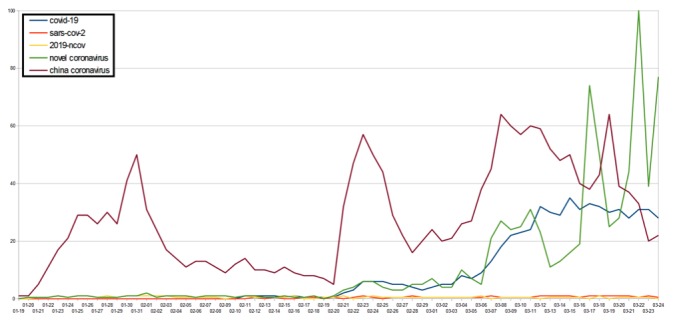
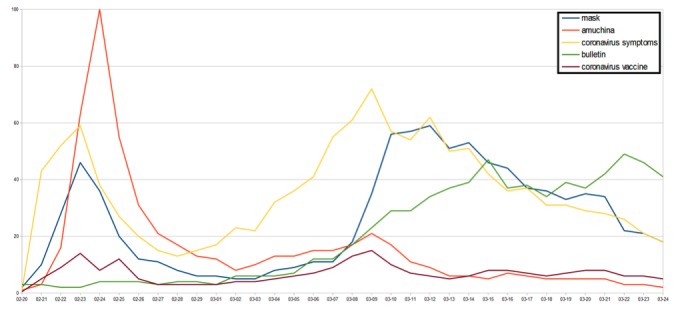
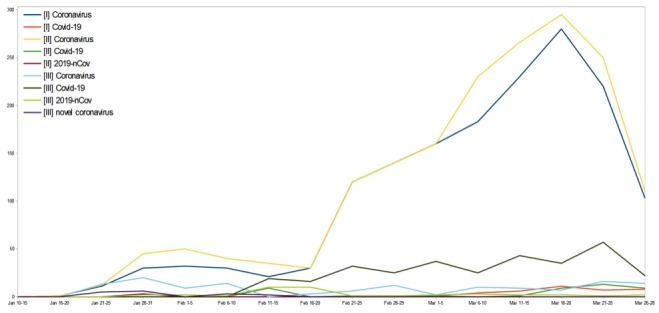
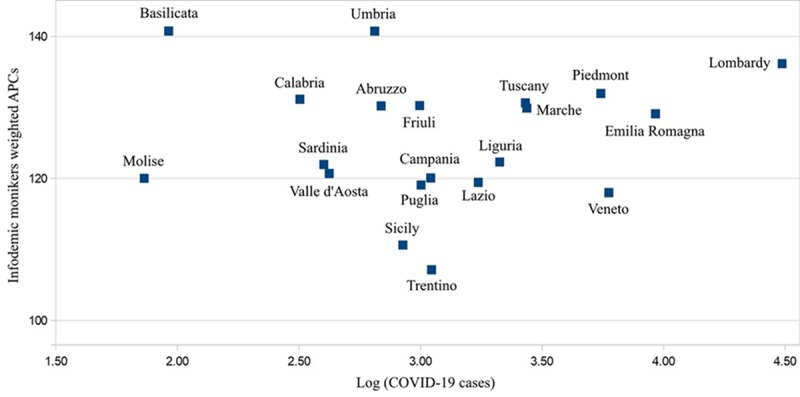
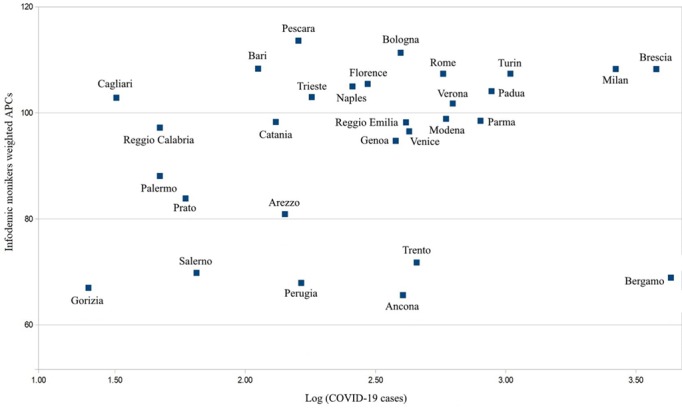
Results: Keywords such as "novel coronavirus," "China coronavirus," "COVID-19," "2019-nCOV," and "SARS-COV-2" were the top infodemic and scientific COVID-19 terms trending in Italy. The top five searches related to health were "face masks," "amuchina" (disinfectant), "symptoms of the novel coronavirus," "health bulletin," and "vaccines for coronavirus." The regions of Umbria and Basilicata recorded a high number of infodemic monikers (APC weighted total >140). Misinformation was widely circulated in the Campania region, and racism-related information was widespread in Umbria and Basilicata. These monikers were frequently searched (APC weighted total >100) in more than 10 major cities in Italy, including Rome.
Conclusions: We identified a growing regional and population-level interest in COVID-19 in Italy. The majority of searches were related to amuchina, face masks, health bulletins, and COVID-19 symptoms. Since a large number of infodemic monikers were observed across Italy, we recommend that health agencies use Google Trends to predict human behavior as well as to manage misinformation circulation in Italy.
Keywords: Google Trends; behavior; communication; digital health; infodemiology, infodemic monikers, Italy; novel coronavirus, COVID-19, Google search; online search; public health.
©Alessandro Rovetta, Akshaya Srikanth Bhagavathula. Originally published in JMIR Public Health and Surveillance (http://publichealth.jmir.org), 05.05.2020.
Conflict of interest statement
Conflicts of Interest: None declared.
Figures
References
-
- International Telecommunications Union/UNESCO. 2017. Aug 01, [2020-04-07]. The state of broadband 2017: broadband catalyzing sustainable development https://www.itu.int/dms_pub/itu-s/opb/pol/S-POL-BROADBAND.18-2017-PDF-E.pdf.
-
- Mollema L, Harmsen IA, Broekhuizen E, Clijnk R, De Melker H, Paulussen T, Kok G, Ruiter R, Das E. Disease detection or public opinion reflection? Content analysis of tweets, other social media, and online newspapers during the measles outbreak in The Netherlands in 2013. J Med Internet Res. 2015 May 26;17(5):e128. doi: 10.2196/jmir.3863. https://www.jmir.org/2015/5/e128/ - DOI - PMC - PubMed
-
- Mohamed NA. Knowledge, Attitude and Practice on Bats-Borne Diseases among Village Residents: A Pilot Study. MH. 2018 Dec 31;13(2):48–57. doi: 10.17576/MH.2018.1302.05. https://www.cabdirect.org/globalhealth/abstract/20193459604 - DOI
MeSH terms
LinkOut - more resources
Full Text Sources
Miscellaneous
