. 2020 Apr 28;4(8):1737-1745.
doi: 10.1182/bloodadvances.2019000425.

Coagulation factor XII contributes to hemostasis when activated by soil in wounds

Affiliations

Coagulation factor XII contributes to hemostasis when activated by soil in wounds

Lih Jiin Juang et al. Blood Adv. .

Abstract

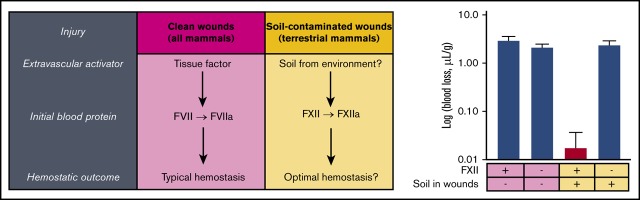
Bleeding is a common contributor to death and morbidity in animals and provides strong selective pressure for the coagulation system to optimize hemostasis for diverse environments. Although coagulation factor XII (FXII) is activated by nonbiologic surfaces, such as silicates, which leads to blood clotting in vitro, it is unclear whether FXII contributes to hemostasis in vivo. Humans and mice lacking FXII do not appear to bleed more from clean wounds than their counterparts with normal FXII levels. We tested the hypothesis that soil, a silicate-rich material abundant in the environment and wounds of terrestrial mammals, is a normal and potent activator of FXII and coagulation. Blood loss was compared between wild-type (WT) and FXII-knocked out (FXII-/-) mice after soil or exogenous tissue factor was applied to transected tails. The activation of FXII and other components of the coagulation and contact system was assessed with in vitro coagulation and enzyme assays. Soils were analyzed by time-of-flight secondary ionization mass spectrometry and dynamic light scattering. Soil reduced blood loss in WT mice, but not FXII-/- mice. Soil accelerated clotting of blood plasma from humans and mice in a FXII-dependent manner, but not plasma from a cetacean or a bird, which lack FXII. The procoagulant activity of 13 soils strongly correlated with the surface concentration of silicon, but only moderately correlated with the ζ potential. FXII augments coagulation in soil-contaminated wounds of terrestrial mammals, perhaps explaining why this protein has a seemingly minor role in hemostasis in clean wounds.


Conflict of interest statement

Conflict-of-interest disclosure: The authors declare no competing financial interests.

Figures
None
Graphical abstract
Figure 1.
Figure 1.
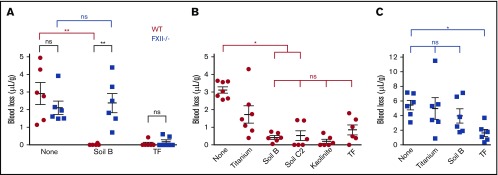
Soils are hemostatic in mouse wounds, dependent on FXII. (A) Blood loss with or without applying materials to transected tails of WT and FXII−/− mice without ASA. Total blood loss in WT (B) and FXII−/− (C) mice receiving ASA. n = 6-7. *P < .05; **P < .01. Error bars represent standard error of the mean (SEM). ns, no significant difference.
Figure 2.
Figure 2.
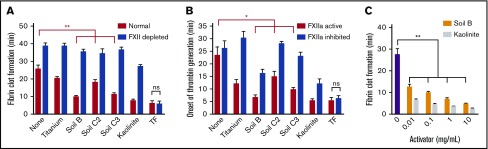
Soils accelerate clotting of plasma, dependent on FXII. (A) Clot times of human normal and FXII-depleted plasma by soils and kaolinite clay. (B) Onset of thrombin generation in human plasma by soils with CTI (FXIIa inhibited) or without CTI (FXIIa active). (C) Clot times with increasing concentration of soil and kaolinite, measured by thromboelastography. n = 8-9 (A-B), n = 5 (C). *P < .01; **P < .001. Error bars represent SEM.
Figure 3.
Figure 3.
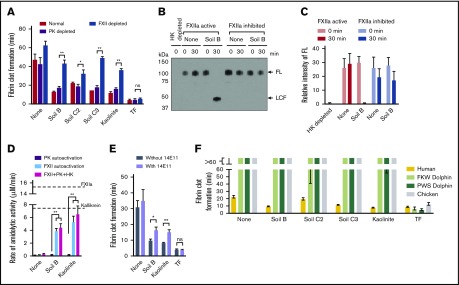
Soils accelerate clotting of plasma from humans but not from dolphins or a bird. (A) Clot times of normal, PK-depleted, or FXII-depleted plasma by soils. (B) Western blot analysis of plasma, supplemented with or without CTI, after incubation with soil B. Full-length (FL) HK was fully converted to light chain fragment (LCF) after 30 minutes. No HK or LCF is seen in the lane with HK-depleted plasma. (C) Quantifying data in panel E, using densitometry of bands of FL and LCF. (D) Activation of purified PK and HK by soil. Dashed lines represent fully converted FXIIa and kallikrein activity after activation of PK by purified FXIIa. (E) Clot times with an antibody that inhibits FXI activation by FXIIa (14E11). (F) Clot times of plasma, comparing FXII-deficient vertebrates with humans. n = 5. *P < .01; **P < .001. Error bars represent SEM.
Figure 4.
Figure 4.
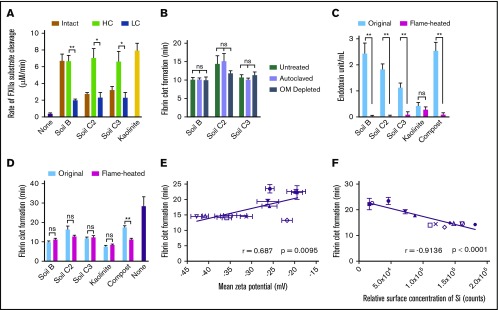
Silicates are the component of soil that triggers faster clotting via activation of FXII. (A) FXII activation in plasma by intact, HC, and LC fractionated soils. (B) Clot times of plasma by sterilized (autoclaved) or OM-depleted soils. (C) Endotoxin quantification of soils after treating with a flame for 1 hour (flamed-heated). (D) Clot times of plasma by original and flame-heated soils. (E) Pearson’s correlation between clot times and ζ potential of soils, determined by dynamic light scattering. (F) Pearson’s correlation between clot times and concentration of Si on the surface of soils, determined by TOF-SIMS. Substrate cleavage and clot formation measurements were n = 5 (A, C-F) and n = 3 in triplicate (B). *P < .01; **P < .001. Error bars represent SEM.

References

    1. Semple S, Cowlishaw G, Bennett PM. Immune system evolution among anthropoid primates: parasites, injuries and predators. Proc Biol Sci. 2002;269(1495):1031-1037. - PMC - PubMed
    1. Terio KA, Kinsel MJ, Raphael J, et al. Pathologic lesions in chimpanzees (Pan trogylodytes schweinfurthii) from Gombe National Park, Tanzania, 2004-2010. J Zoo Wildl Med. 2011;42(4):597-607. - PMC - PubMed
    1. Kauvar DS, Lefering R, Wade CE. Impact of hemorrhage on trauma outcome: an overview of epidemiology, clinical presentations, and therapeutic considerations. J Trauma. 2006;60(6 Suppl):S3-S11. - PubMed
    1. Curry N, Hopewell S, Dorée C, Hyde C, Brohi K, Stanworth S. The acute management of trauma hemorrhage: a systematic review of randomized controlled trials. Crit Care. 2011;15(2):R92. - PMC - PubMed
    1. Doolittle RF. Step-by-step evolution of vertebrate blood coagulation. Cold Spring Harb Symp Quant Biol. 2009;74(0):35-40. - PubMed

Publication types