


Novel Percutaneous Tracheostomy for Critically Ill Patients With COVID-19
- PMID: 32339508
- PMCID: PMC7182508
- DOI: 10.1016/j.athoracsur.2020.04.010
Novel Percutaneous Tracheostomy for Critically Ill Patients With COVID-19
Abstract
Background: Coronavirus 2019 (COVID-19) is a worldwide pandemic, with many patients requiring prolonged mechanical ventilation. Tracheostomy is not recommended by current guidelines as it is considered a superspreading event owing to aerosolization that unduly risks health care workers.
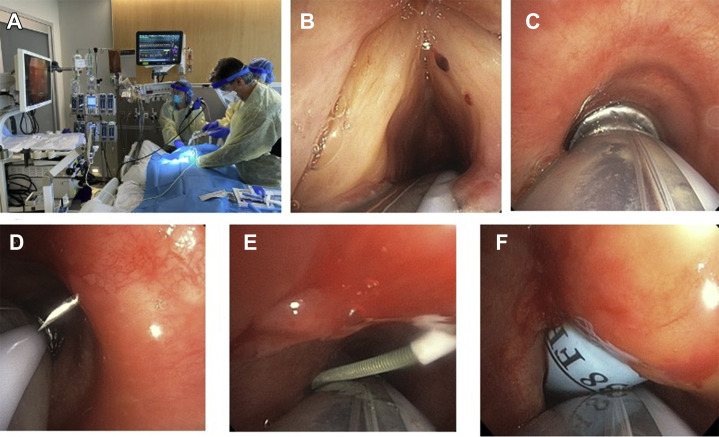
Methods: Patients with severe COVID-19 who were on mechanical ventilation for 5 days or longer were evaluated for percutaneous dilational tracheostomy. We developed a novel percutaneous tracheostomy technique that placed the bronchoscope alongside the endotracheal tube, not inside it. That improved visualization during the procedure and continued standard mechanical ventilation after positioning the inflated endotracheal tube cuff in the distal trachea. This technique offers a significant mitigation for the risk of virus aerosolization during the procedure.
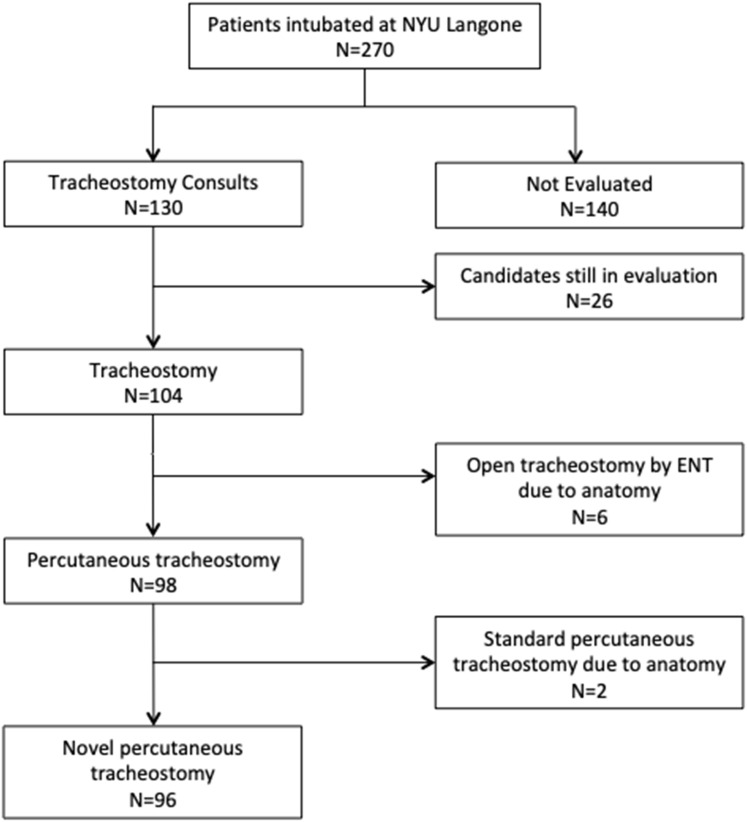
Results: From March 10 to April 15, 2020, 270 patients with COVID-19 required invasive mechanical ventilation at New York University Langone Health Manhattan's campus; of those, 98 patients underwent percutaneous dilational tracheostomy. The mean time from intubation to the procedure was 10.6 ± 5 days. Currently, 32 patients (33%) do not require mechanical ventilatory support, 19 (19%) have their tracheostomy tube downsized, and 8 (8%) were decannulated. Forty patients (41%) remain on full ventilator support, and 19 (19%) are weaning from mechanical ventilation. Seven patients (7%) died as a result of respiratory and multiorgan failure. Tracheostomy-related bleeding was the most common complication (5 patients). None of health care providers has had symptoms or tested positive for COVID-19.
Conclusions: Our percutaneous tracheostomy technique appears to be safe and effective for COVID-19 patients and safe for health care workers.
Copyright © 2020 The Society of Thoracic Surgeons. Published by Elsevier Inc. All rights reserved.
Figures
Comment in
-
Traditional Technique in Lieu of Novel Percutaneous Tracheostomy Technique During COVID-19.Ann Thorac Surg. 2021 Feb;111(2):729. doi: 10.1016/j.athoracsur.2020.06.002. Epub 2020 Jun 11. Ann Thorac Surg. 2021. PMID: 32535043 Free PMC article. No abstract available.
-
Pause Ventilation Tracheostomy.Ann Thorac Surg. 2021 Jan;111(1):381. doi: 10.1016/j.athoracsur.2020.05.021. Epub 2020 Jun 12. Ann Thorac Surg. 2021. PMID: 32540441 Free PMC article. No abstract available.
-
Leveraging Scarcity to Optimize Value and Clinical Operations: Reply.Ann Thorac Surg. 2021 Jan;111(1):381-382. doi: 10.1016/j.athoracsur.2020.06.003. Epub 2020 Jun 12. Ann Thorac Surg. 2021. PMID: 32540444 Free PMC article. No abstract available.
-
Policies Should Be Based on Data Not Dogma in Medicine and Government: Reply.Ann Thorac Surg. 2021 Feb;111(2):729. doi: 10.1016/j.athoracsur.2020.06.009. Epub 2020 Jul 3. Ann Thorac Surg. 2021. PMID: 32622793 Free PMC article. No abstract available.
-
Tracheostomy Techniques in COVID-19 Patients: No Flow Through an Open Door Is Protector.Ann Thorac Surg. 2021 Feb;111(2):731. doi: 10.1016/j.athoracsur.2020.06.010. Epub 2020 Jul 7. Ann Thorac Surg. 2021. PMID: 32649947 Free PMC article. No abstract available.
-
Permissive Apnea in COVID-19 Tracheostomy: Alternative Health Worker Safe Procedure in Intensive Care Unit.Ann Thorac Surg. 2021 Feb;111(2):730. doi: 10.1016/j.athoracsur.2020.06.011. Epub 2020 Jul 10. Ann Thorac Surg. 2021. PMID: 32653361 Free PMC article. No abstract available.
-
Many Ways to Skin a Cat: Reply.Ann Thorac Surg. 2021 Feb;111(2):730-731. doi: 10.1016/j.athoracsur.2020.07.006. Epub 2020 Jul 24. Ann Thorac Surg. 2021. PMID: 32717232 Free PMC article. No abstract available.
References
-
- Center for Systems Science and Engineering. Coronavirus COVID-19 global cases by the Center for Systems Science and Engineering (CSSE) at Johns Hopkins University. https://coronavirus.jhu.edu/map.html Available at:
-
- Petrilli CM, Jones SA, Yang J, et al. Factors associated with hospitalization and critical illness among 4,103 patients with COVID-19 in New York City [preprint]. MedRXiv., accessed April 16, 2020. - DOI
-
- Wu Z., McGoogan J.M. Characteristics of and important lessons from the coronavirus disease 2019 (COVID-2019) outbreak in China: summary of a report of 72314 cases from the Chinese Center for Disease Control and Prevention. JAMA. 2020;323:1239–1242. - PubMed
-
- Intensive Care National Audit and Research Center Report on COVID-19 in critical care, April 10, 2020. https://www.icnarc.org/our-audit/audits/cmp/reports Available at:
MeSH terms
LinkOut - more resources
Full Text Sources
Miscellaneous
