


Intelligent, Autonomous Machines in Surgery
- PMID: 32339787
- PMCID: PMC7594619
- DOI: 10.1016/j.jss.2020.03.046
Intelligent, Autonomous Machines in Surgery
Abstract
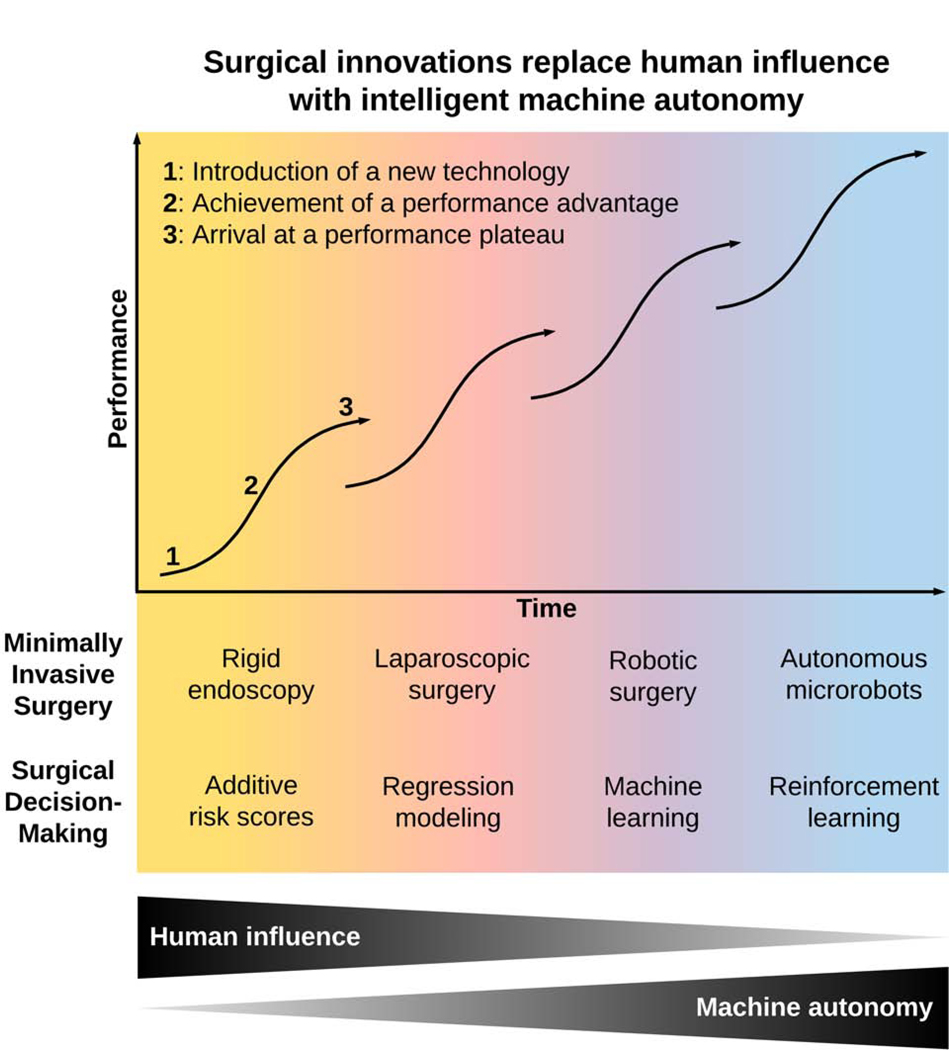
Surgeons perform two primary tasks: operating and engaging patients and caregivers in shared decision-making. Human dexterity and decision-making are biologically limited. Intelligent, autonomous machines have the potential to augment or replace surgeons. Rather than regarding this possibility with denial, ire, or indifference, surgeons should understand and steer these technologies. Closer examination of surgical innovations and lessons learned from the automotive industry can inform this process. Innovations in minimally invasive surgery and surgical decision-making follow classic S-shaped curves with three phases: (1) introduction of a new technology, (2) achievement of a performance advantage relative to existing standards, and (3) arrival at a performance plateau, followed by replacement with an innovation featuring greater machine autonomy and less human influence. There is currently no level I evidence demonstrating improved patient outcomes using intelligent, autonomous machines for performing operations or surgical decision-making tasks. History suggests that if such evidence emerges and if the machines are cost effective, then they will augment or replace humans, initially for simple, common, rote tasks under close human supervision and later for complex tasks with minimal human supervision. This process poses ethical challenges in assigning liability for errors, matching decisions to patient values, and displacing human workers, but may allow surgeons to spend less time gathering and analyzing data and more time interacting with patients and tending to urgent, critical-and potentially more valuable-aspects of patient care. Surgeons should steer these technologies toward optimal patient care and net social benefit using the uniquely human traits of creativity, altruism, and moral deliberation.
Keywords: Artificial intelligence; Automation; Innovation; Machine learning; Surgery.
Copyright © 2020 Elsevier Inc. All rights reserved.
Figures
References
-
- Healey MA, Shackford SR, Osler TM, Rogers FB, Burns E. Complications in surgical patients. Arch Surg 2002; 137: 611–617; discussion 617–618. - PubMed
-
- Birkmeyer JD, Finks JF, O’Reilly A, et al. Surgical skill and complication rates after bariatric surgery. N Engl J Med 2013; 369: 1434–1442. - PubMed
-
- Begg CB, Riedel ER, Bach PB, et al. Variations in morbidity after radical prostatectomy. N Engl J Med 2002; 346: 1138–1144. - PubMed
-
- Carmeli E, Patish H, Coleman R. The aging hand. J Gerontol A Biol Sci Med Sci 2003; 58: 146–152. - PubMed
Publication types
MeSH terms
Grants and funding
LinkOut - more resources
Full Text Sources
