Review
. 2020 Oct:66:27-34.
doi: 10.1016/j.coi.2020.04.002. Epub 2020 Apr 15.

Conserved strategies for pathogen evasion of cGAS-STING immunity

Affiliations
Review

Conserved strategies for pathogen evasion of cGAS-STING immunity

James B Eaglesham et al. Curr Opin Immunol. 2020 Oct.

Abstract

The cyclic GMP-AMP synthase (cGAS)- Stimulator of Interferon Genes (STING) pathway of cytosolic DNA sensing allows mammalian cells to detect and respond to infection with diverse pathogens. Pathogens in turn encode numerous factors that inhibit nearly all steps of cGAS-STING signal transduction. From masking of cytosolic DNA ligands, to post-translational modification of cGAS and STING, and degradation of the nucleotide second messenger 2'3'-cGAMP, pathogens have evolved convergent mechanisms to evade cGAS-STING sensing. Here we examine pathogen inhibitors of innate immunity in the context of newly discovered regulatory features controlling cellular cGAS-STING activation. Comparative analysis of these strategies provides insight into mechanisms of action and suggests aspects of cGAS-STING regulation and immune evasion that remain to be discovered.


Figures

Figure 1
Figure 1
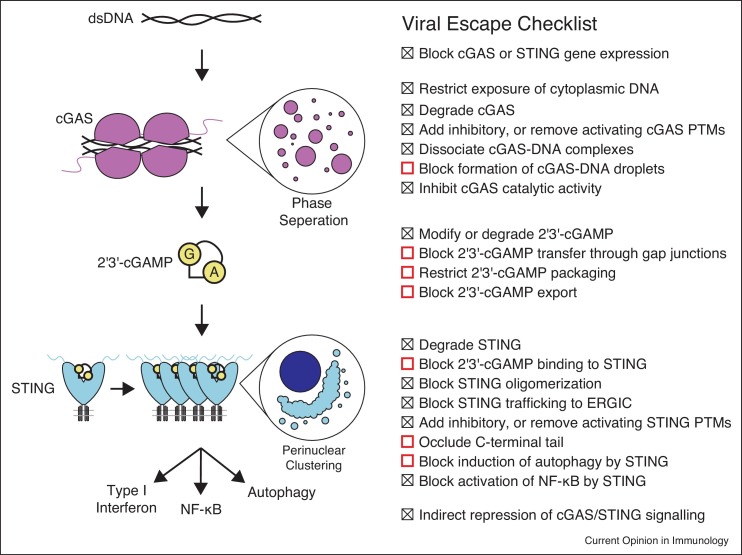
Summary of the cGAS–STING pathway and potential pathogen evasion strategies. Recognition of cytosolic double-stranded DNA triggers assembly of cGAS into DNA ladder structures, and liquid droplets. Oligomerization into a minimal 2:2 cGAS:DNA complex is required for activation to produce the second messenger 2′3′-cGAMP from ATP and GTP. 2′3′-cGAMP is subsequently recognized by STING which oligomerizes to form a signalosome complex and traffics to the ERGIC and perinuclear regions. This leads to recruitment of the downstream kinase TBK1 to promote innate immune signaling. Points in the pathway which are known (checked box) or potential (red open box) pathogen targets for restriction of cGAS–STING signaling are summarized on the right in the viral escape checklist.
Figure 2
Figure 2
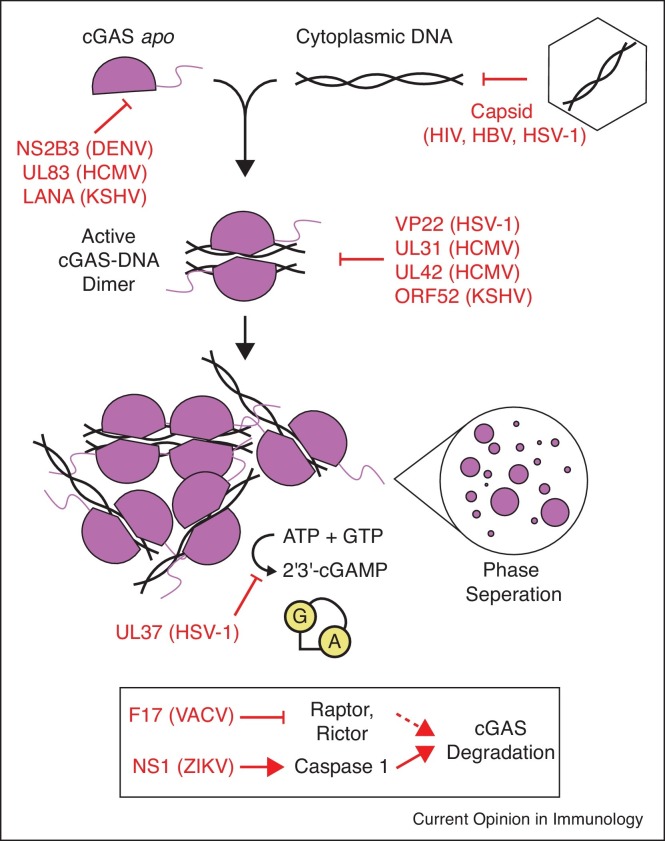
Pathogen factors block cGAS activation. Upon DNA binding, cGAS undergoes a conformational change activating 2′3′-cGAMP synthesis. Assembly into a minimal 2:2 complex is required for catalytic activity, but further assembly into long DNA ladder structures and larger oligomers bridged by interactions with the unstructured N-terminus results in formation of phase-separated liquid droplets. ATP and GTP are converted in a two-step process to 2′3′-cGAMP within the cGAS active site, which is released into the cytosol and diffuses throughout the cell. Red text and arrows indicate steps in this process at which different viral and bacterial factors prevent or interfere with signaling. The box at the bottom indicates indirect viral strategies which trigger cGAS degradation.
Figure 3
Figure 3
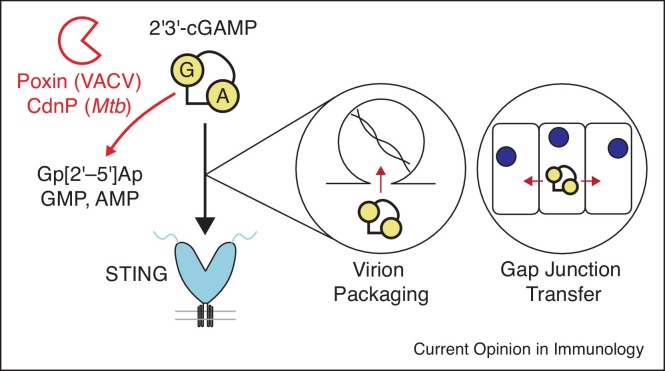
Viral and bacterial enzymes degrade 2′3′-cGAMP. The second messenger 2′3′-cGAMP is highly stable in the mammalian cytosol. 2′3′-cGAMP can be packaged within budding virions to activate STING in newly infected cells, or spread cell-to-cell through gap junctions to activate bystander immunity in neighboring uninfected cells. Viral and bacterial enzymes degrade 2′3′-cGAMP in order to prevent binding to STING, and activation of downstream immune signaling.
Figure 4
Figure 4
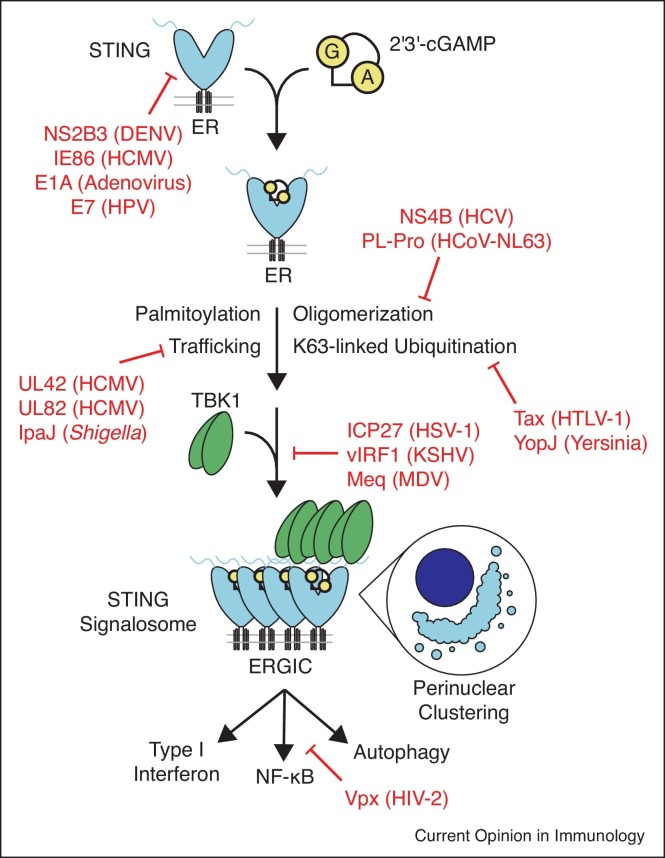
Pathogen strategies for restriction of STING signaling. STING binding to 2′3′-cGAMP triggers a conformational change which drives STING oligomerization and assembly into a signalosome complex through palmitoylation, oligomerization, ER to ERGIC trafficking, and ubiquitination. The downstream kinase TBK1 is recruited into the STING signalosome, driving trans-phosphorylation and activation of this kinase to promote downstream IRF3 binding and activation of type I interferon signaling. STING also stimulates NF-κB and autophagy signaling to restrict pathogen replication. Red text and arrows show steps at which pathogens intervene to prevent activation of downstream signaling by STING.

References

    1. Sun L., Wu J., Du F., Chen X., Chen Z.J. Cyclic GMP-AMP synthase is a cytosolic DNA sensor that activates the type I interferon pathway. Science. 2013;339:786–791. - PMC - PubMed
    1. Gao P., Ascano M., Wu Y., Barchet W., Gaffney B.L., Zillinger T., Serganov A.A., Liu Y., Jones R.A., Hartmann G. Cyclic [G(2′,5′)pA(3′,5′)p] is the metazoan second messenger produced by DNA-activated cyclic GMP-AMP synthase. Cell. 2013;153:1094–1107. - PMC - PubMed
    1. Diner E.J., Burdette D.L., Wilson S.C., Monroe K.M., Kellenberger C.A., Hyodo M., Hayakawa Y., Hammond M.C., Vance R.E. The innate immune DNA sensor cGAS produces a noncanonical cyclic dinucleotide that activates human STING. Cell Rep. 2013;3:1355–1361. - PMC - PubMed
    1. Zhang X., Shi H., Wu J., Zhang X., Sun L., Chen C., Chen Z.J. Cyclic GMP-AMP containing mixed phosphodiester linkages is an endogenous high-affinity ligand for STING. Mol Cell. 2013;51:226–235. - PMC - PubMed
    1. Ablasser A., Goldeck M., Cavlar T., Deimling T., Witte G., Röhl I., Hopfner K.-P., Ludwig J., Hornung V. cGAS produces a 2′-5′-linked cyclic dinucleotide second messenger that activates STING. Nature. 2013;498:380–384. - PMC - PubMed

Publication types

Substances