


The ACE-2 in COVID-19: Foe or Friend?
- PMID: 32340044
- PMCID: PMC7339082
- DOI: 10.1055/a-1155-0501
The ACE-2 in COVID-19: Foe or Friend?
Abstract
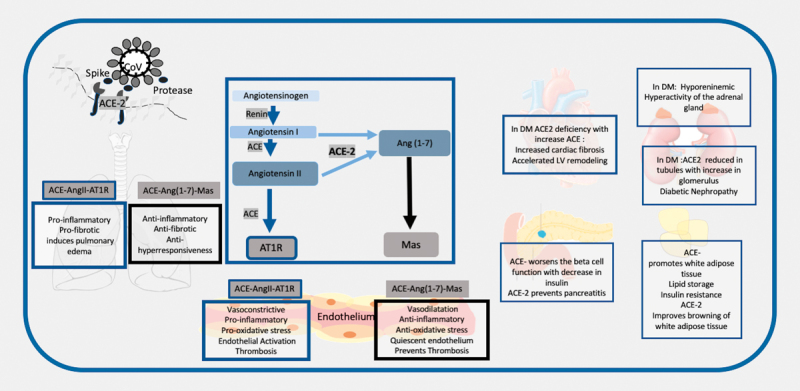
COVID-19 is a rapidly spreading outbreak globally. Emerging evidence demonstrates that older individuals and people with underlying metabolic conditions of diabetes mellitus, hypertension, and hyperlipidemia are at higher risk of morbidity and mortality. The SARS-CoV-2 infects humans through the angiotensin converting enzyme (ACE-2) receptor. The ACE-2 receptor is a part of the dual system renin-angiotensin-system (RAS) consisting of ACE-Ang-II-AT1R axis and ACE-2-Ang-(1-7)-Mas axis. In metabolic disorders and with increased age, it is known that there is an upregulation of ACE-Ang-II-AT1R axis with a downregulation of ACE-2-Ang-(1-7)-Mas axis. The activated ACE-Ang-II-AT1R axis leads to pro-inflammatory and pro-fibrotic effects in respiratory system, vascular dysfunction, myocardial fibrosis, nephropathy, and insulin secretory defects with increased insulin resistance. On the other hand, the ACE-2-Ang-(1-7)-Mas axis has anti-inflammatory and antifibrotic effects on the respiratory system and anti-inflammatory, antioxidative stress, and protective effects on vascular function, protects against myocardial fibrosis, nephropathy, pancreatitis, and insulin resistance. In effect, the balance between these two axes may determine the prognosis. The already strained ACE-2-Ang-(1-7)-Mas in metabolic disorders is further stressed due to the use of the ACE-2 by the virus for entry, which affects the prognosis in terms of respiratory compromise. Further evidence needs to be gathered on whether modulation of the renin angiotensin system would be advantageous due to upregulation of Mas activation or harmful due to the concomitant ACE-2 receptor upregulation in the acute management of COVID-19.
© Georg Thieme Verlag KG Stuttgart · New York.
Conflict of interest statement
The authors declare that they have no conflict of interest.
Figures
References
-
- Special Expert Group for Control of the Epidemic of Novel Coronavirus Pneumonia of the Chinese Preventive Medicine Association[An update on the epidemiological characteristics of novel coronavirus pneumonia COVID-19] Zhonghua Liu Xing Bing Xue Za Zhi 202041139–144. - PubMed
-
- Korean Society of Infectious Diseases, Korean Society of Pediatric Infectious Diseases, Korean Society of Epidemiology, Korean Society for Antimicrobial Therapy, Korean Society for Healthcare-associated Infection Control and Prevention, Korea Centers for Disease Control and Prevention. Report on the Epidemiological Features of Coronavirus Disease 2019 (COVID-19) Outbreak in the Republic of Korea from January 19 to March 2, 2020. J Korean Med Sci. 2020;35:e112. - PMC - PubMed
MeSH terms
Substances
Grants and funding
LinkOut - more resources
Full Text Sources
Miscellaneous
