


Ultrasensitive RT-QuIC assay with high sensitivity and specificity for Lewy body-associated synucleinopathies
- PMID: 32342188
- PMCID: PMC7299922
- DOI: 10.1007/s00401-020-02160-8
Ultrasensitive RT-QuIC assay with high sensitivity and specificity for Lewy body-associated synucleinopathies
Erratum in
-
Correction to: Ultrasensitive RT-QuIC assay with high sensitivity and specificity for Lewy body-associated synucleinopathies.Acta Neuropathol. 2020 Aug;140(2):245. doi: 10.1007/s00401-020-02170-6. Acta Neuropathol. 2020. PMID: 32556961 Free PMC article.
Abstract
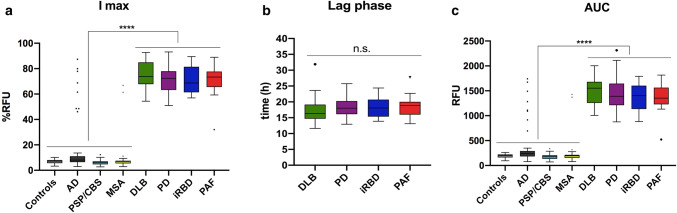
The clinical diagnosis of synucleinopathies, including Parkinson's disease (PD), dementia with Lewy bodies (DLB), and multiple system atrophy (MSA), is challenging, especially at an early disease stage, due to the heterogeneous and often non-specific clinical manifestations. The discovery of reliable specific markers for synucleinopathies would consequently be of great aid to the diagnosis and management of these disorders. Real-Time Quaking-Induced Conversion (RT-QuIC) is an ultrasensitive technique that has been previously used to detect self-templating amyloidogenic proteins in the cerebrospinal fluid (CSF) and other biospecimens in prion disease and synucleinopathies. Using a wild-type recombinant α-synuclein as a substrate, we applied RT-QuIC to a large cohort of 439 CSF samples from clinically well-characterized, or post-mortem verified patients with parkinsonism or dementia. Of significance, we also studied patients with isolated REM sleep behavior disorder (iRBD) (n = 18) and pure autonomic failure (PAF) (n = 28), representing clinical syndromes that are often caused by a synucleinopathy, and may precede the appearance of parkinsonism or cognitive decline. The results show that our RT-QuIC assay can accurately detect α-synuclein seeding activity across the spectrum of Lewy Body (LB)-related disorders (LBD), including DLB, PD, iRBD, and PAF, with an overall sensitivity of 95.3%. In contrast, all but two patients with MSA showed no α-synuclein seeding activity in the applied experimental setting. The analysis of the fluorescence response reflecting the amount of α-synuclein seeds revealed no significant differences between the clinical syndromes associated with LB pathology. Finally, the assay demonstrated 98% specificity in a neuropathological cohort of 101 cases lacking LB pathology. In conclusion, α-synuclein RT-QuIC provides an accurate marker of synucleinopathies linked to LB pathology and may have a pivotal role in the early discrimination and management of affected patients. The finding of no α-synuclein seeding activity in MSA seems to support the current view that MSA and LBD are associated with different conformational strains of α-synuclein.
Keywords: Biomarker; Diagnosis; Multiple system atrophy; Parkinson’s disease; Prion disease; α-Synuclein.
Conflict of interest statement
CDO, AGH, and BC are inventors on a related US Patent pending No. 62/567079. All other authors declare that they have no competing interests.
Figures

References
Publication types
MeSH terms
Substances
Grants and funding
LinkOut - more resources
Full Text Sources
Medical
