


Association of Childhood Psychosocial Environment With 30-Year Cardiovascular Disease Incidence and Mortality in Middle Age
- PMID: 32342717
- PMCID: PMC7428574
- DOI: 10.1161/JAHA.119.015326
Association of Childhood Psychosocial Environment With 30-Year Cardiovascular Disease Incidence and Mortality in Middle Age
Abstract
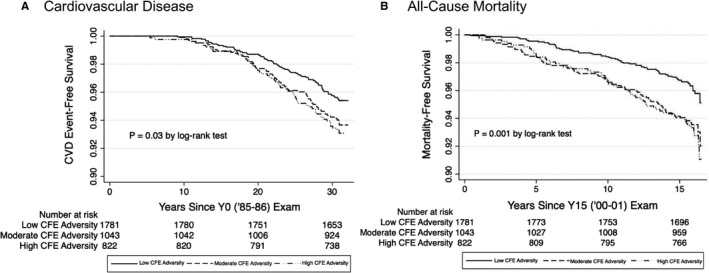
Background Childhood adversity and trauma have been shown to be associated with poorer cardiovascular disease (CVD) outcomes in adulthood. However, longitudinal studies of this association are rare. Methods and Results Our study used the CARDIA (Coronary Artery Risk Development in Young Adults) Study, a longitudinal cohort that has followed participants from recruitment in 1985-1986 through 2018, to determine how childhood psychosocial environment relates to CVD incidence and all-cause mortality in middle age. Participants (n=3646) completed the Childhood Family Environment (CFE) questionnaire at the year 15 (2000-2001) CARDIA examination and were grouped by high, moderate, or low relative CFE adversity scores. We used sequential multivariable regression models to estimate hazard ratios of incident (CVD) and all-cause mortality. Participants were 25.1±3.6 years old, 47% black, and 56% female at baseline and 198 participants developed CVD (17.9 per 10 000 person-years) during follow-up. CVD incidence was >50% higher for those in the high CFE adversity group compared with those in the low CFE adversity group. In fully adjusted models, CVD hazard ratios (95% CI) for participants who reported high and moderate CFE adversity versus those reporting low CFE adversity were 1.40 (0.98-2.11) and 1.25 (0.89-1.75), respectively. The adjusted hazard ratios for all-cause mortality was 1.68 (1.17-2.41) for those with high CFE adversity scores and 1.55 (1.11-2.17) for those with moderate CFE adversity scores. Conclusions Adverse CFE was associated with CVD incidence and all-cause mortality later in life, even after controlling for CVD risk factors in young adulthood.
Keywords: adverse childhood experiences; cardiovascular events; lifetime risk; longitudinal cohort study; mortality; stress.
Figures
Comment in
-
Stepping Stones From Childhood Adversity to Cardiovascular Disease and Premature Mortality.J Am Heart Assoc. 2020 May 5;9(9):e016162. doi: 10.1161/JAHA.120.016162. Epub 2020 Apr 28. J Am Heart Assoc. 2020. PMID: 32342720 Free PMC article. No abstract available.
-
Childhood adversity is associated with cardiovascular disease in later life.Nat Rev Cardiol. 2020 Jul;17(7):384. doi: 10.1038/s41569-020-0391-y. Nat Rev Cardiol. 2020. PMID: 32393854 No abstract available.
References
-
- Felitti VJ, Anda RF, Nordenberg D, Williamson DF, Spitz AM, Edwards V, Koss MP, Marks JS. Relationship of childhood abuse and household dysfunction to many of the leading causes of death in adults: the adverse childhood experiences (ACE) study. Am J Prev Med. 1998;14:245–258. - PubMed
-
- Lloyd‐Jones DM, Hong Y, Labarthe D, Mozaffarian D, Appel LJ, Van Horn L, Greenlund K, Daniels S, Nichol G, Tomaselli GF. Defining and setting national goals for cardiovascular health promotion and disease reduction: the American Heart Association's strategic impact goal through 2020 and beyond. Circulation. 2010;121:586–613. - PubMed
-
- Anda RF, Croft JB, Felitti VJ, Nordenberg D, Giles WH, Williamson DF, Giovino GA. Adverse childhood experiences and smoking during adolescence and adulthood. JAMA. 1999;282:1652–1658. - PubMed
Publication types
MeSH terms
Grants and funding
LinkOut - more resources
Full Text Sources
