


Whether to Waive Parental Permission in HIV Prevention Research Among Adolescents: Ethical and Legal Considerations
- PMID: 32342775
- PMCID: PMC8367279
- DOI: 10.1177/1073110520917010
Whether to Waive Parental Permission in HIV Prevention Research Among Adolescents: Ethical and Legal Considerations
Abstract
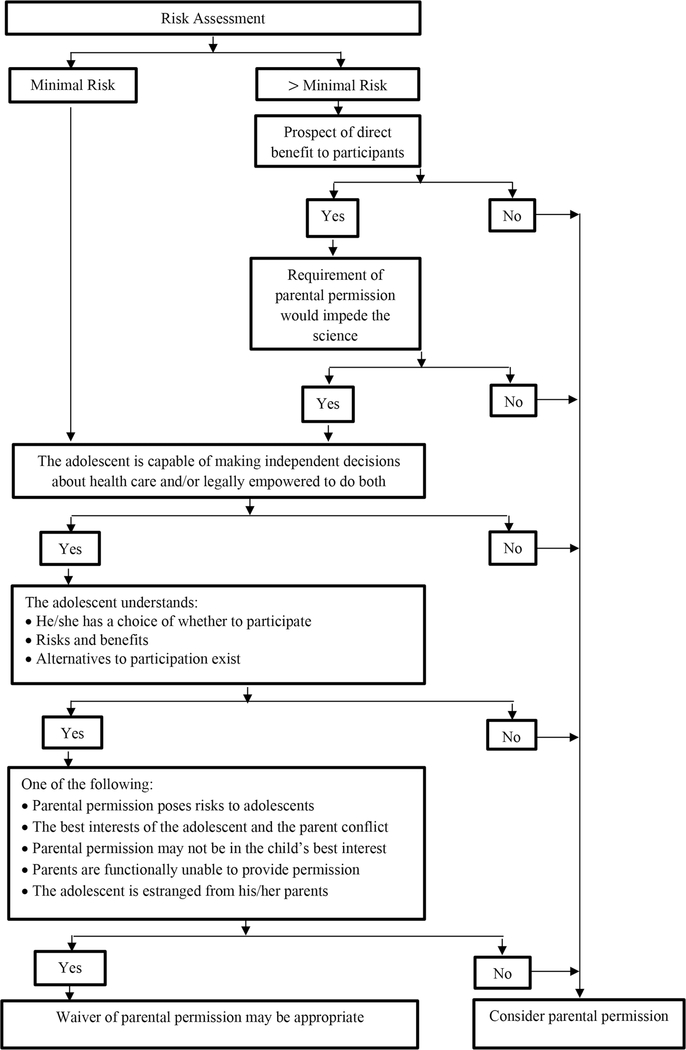
Critical ethical questions arise concerning whether studies among adolescents of new behavioral and biomedical HIV preventive interventions such as Pre-Exposure Prophylaxis (PrEP) should obtain parental permission. This paper examines the relevant regulations and ethical guidance concerning waivers of parental permission, and arguments for and against such waivers. Opponents of such waivers may argue that adolescent decision-making is "too immature" and that parents always have rights to decide how to protect their children. Yet requiring parental permission may put adolescents at risk, and/or limit adolescent participation, jeopardizing study findings' validity. This paper presents recommendations on when researchers and Institutional Review Boards (IRB) should waive parental permission, and what special protections should be adopted for adolescents who consent for themselves, e.g., assuring adolescent privacy and confidentiality, screening for capacity to consent, and identifying adolescents who are at elevated risk from study participation. We also present a series of specific areas for future research to design tools to help make these assessments, and to inform researcher and IRB decisions. These recommendations can help ensure that research is conducted that can aid adolescents at risk for HIV, while minimizing risks and protecting these individuals' rights as much as possible.
Figures
References
-
- Centers for Disease Control and Prevention, HIV Among Youth, available at <https://www.cdc.gov/hiv/group/age/youth/index.html> (last visited February 24, 2020); Centers for Disease Control and Prevention, National Center for HIV/AIDS, Viral Hepatitis, STD, and TB Prevention Division of HIV/AIDS Prevention, HIV Among Youth, available at <https://www.cdc.gov/nchhstp/> (last visited February 24, 2020).
-
- Curtis AC, “Defining Adolescence,” Journal of Adolescent and Family Health 7, no. 2 (2015): 1–39.
-
- Centers for Disease Control and Prevention, HIV Surveillance Report: Diagnoses of HIV Infection in the United States and Dependent Areas 2017, available at <https://www.cdc.gov/hiv/library/reports/hiv-surveillance.html> (last visited February 24, 2020); See Centers for Disease Control and Prevention, supra note 1, CDC reference 2.
-
- Silver E and Bauman L, “The Association of Sexual Experience with Attitudes, Beliefs, and Risk Behaviors of Inner-City Adolescents,” Journal of Research on Adolescence 16, no. 1 (2006): 29–45; D.K. Eaton et al., Youth Risk Behavior Surveillance - United States, 2009, available at <https://www.cdc.gov/mmwr/preview/mmwrhtml/ss5905a1.htm> (last visited February 24, 2020); L. Kann et al., Youth Risk Behavior Surveillance — United States, 2017, available at <https://www.cdc.gov/mmwr/volumes/67/ss/ss6708a1.htm> (last visited February 24, 2020); W.D. Mosher, A. Chandra, and J. Jones, Sexual Behavior and Selected Health Measures: Men and Women 15–44 Years of Age, United States, 2002, Centers for Disease Control. Advance Data no. 362 (2005): 1–55; J. Côté, “Identity Formation and Self Development in Adolescence,” in Handbook of Adolescent Psychology Volume 1: Individual Bases of Adolescent Development, ed. R.L.L. Steinberg (Hoboken, N.J.: John Wiley & Sons, 2009), 266–304.
Publication types
MeSH terms
Grants and funding
LinkOut - more resources
Full Text Sources
Medical
Miscellaneous