Haploidentical BMT for severe aplastic anemia with intensive GVHD prophylaxis including posttransplant cyclophosphamide
- PMID: 32343796
- PMCID: PMC7189283
- DOI: 10.1182/bloodadvances.2020001729
Haploidentical BMT for severe aplastic anemia with intensive GVHD prophylaxis including posttransplant cyclophosphamide
Abstract
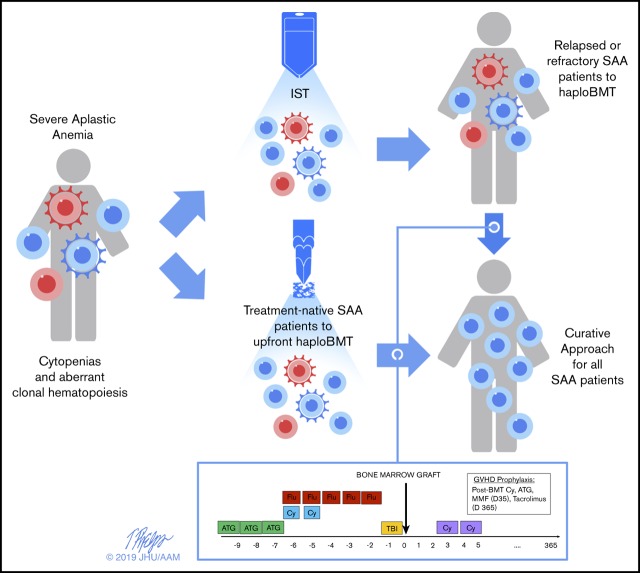
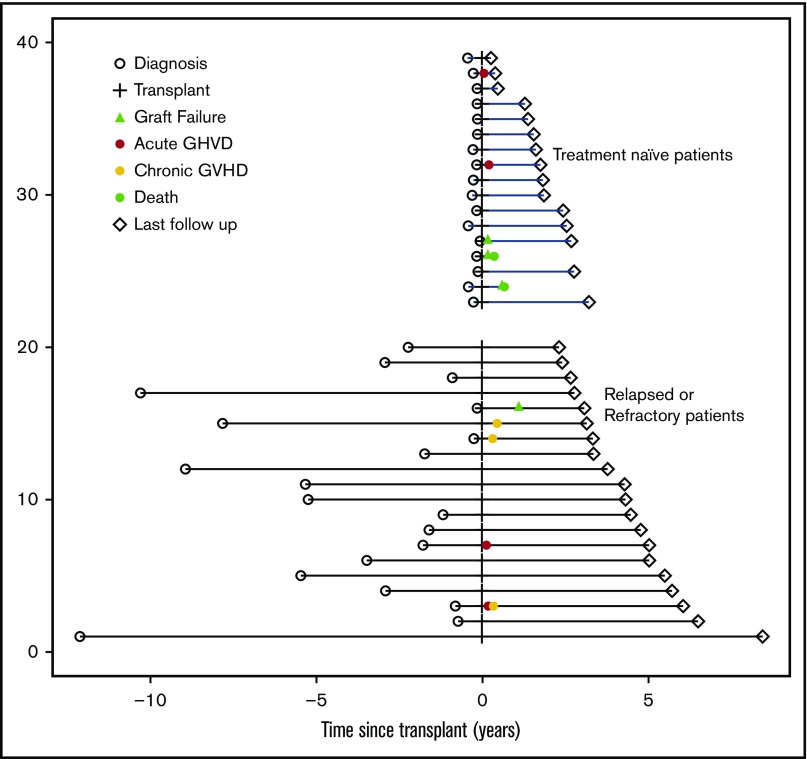
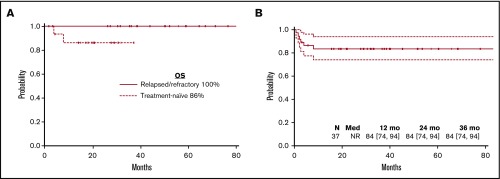
Severe aplastic anemia (SAA) is a stem cell disorder often treated with bone marrow transplantation (BMT) to reconstitute hematopoiesis. Outcomes of related HLA-haploidentical (haplo) donors after reduced-intensity conditioning with intensive graft-versus-host disease (GVHD) prophylaxis including posttransplantation cyclophosphamide are presented here from 37 SAA, 20 relapsed/refractory (R/R), and 17 treatment-naïve (TN) SAA patients. Median follow-up is 32 months (90% confidence interval [CI], 29-44). The median age was 25 (range, 4-69) years. The median time to neutrophil recovery was 17 days (range, 15-88). Four of 37 patients (11%) experienced graft failure (GF). There was 1 primary GF of 20 patients in the R/R group and 3 of 17 in the TN group at 200 cGy (1 primary, 2 secondary), but none in the 10 patients who received 400 cGy total body irradiation. Two patients with GF succumbed to infection and 2 were rescued with second haplo BMT. The overall survival for all patients is 94% (90% CI, 88-100) at 1 and 2 years. The cumulative incidence of grade II-IV acute GVHD at day 100 is 11%. The cumulative index of chronic GVHD at 2 years is 8%. Similar results were seen in 10 SAA patients who received the identical nonmyeloablative regimen with posttransplant cyclophosphamide but matched donor transplants. Haplo BMT with posttransplant cyclophosphamide represents a potential cure in SAA, with all 20 R/R currently alive, disease-free, and with no evidence of active GVHD. Extending this approach to TN patients was associated with higher GF rates, but an increase in total body irradiation dose to 400 cGy was associated with durable engraftment without greater early toxicity. Nonmyeloablative haplo BMT in TN SAA could lead to a paradigm shift, such that essentially all patients can proceed quickly to safe, curative BMT. These trials were registered at www.cincialtrials.gov as #NCT02224872) and #NCT02833805.
© 2020 by The American Society of Hematology.
Conflict of interest statement
Conflict-of-interest disclosure: The authors declare no competing financial interests.
Figures
References
-
- Brodsky RA, Jones RJ. Aplastic anaemia. Lancet. 2005;365(9471):1647-1656. - PubMed
-
- Bacigalupo A. How I treat acquired aplastic anemia. Blood. 2017;129(11):1428-1436. - PubMed
-
- Young NS. Acquired bone marrow failure. Philadelphia, PA: JB Lippincott; 1995.
-
- Alter BP. Diagnosis, genetics, and management of inherited bone marrow failure syndromes. Hematology Am Soc Hematol Educ Program. 2007;2007:29-39. - PubMed
Publication types
MeSH terms
Substances
Associated data
Grants and funding
LinkOut - more resources
Full Text Sources
Medical
Research Materials