


An alternative penicillin-binding protein involved in Salmonella relapses following ceftriaxone therapy
- PMID: 32344200
- PMCID: PMC7186495
- DOI: 10.1016/j.ebiom.2020.102771
An alternative penicillin-binding protein involved in Salmonella relapses following ceftriaxone therapy
Abstract
Background: Salmonella causes intracellular infections in humans. Besides quinolones, third generation cephalosporins are first line drugs used for salmonellosis therapy. An unresolved anomaly of this practice involves high relapse rates associated to quinolone- or cephalosporin-susceptible Salmonella isolates in patients that are discharged clinically following initial recovery. Reduced drug accessibility to intracellular locations has been hypothesized to impair pathogen eradication although supporting evidence is lacking in vivo. Here, we uncover a novel penicillin-binding protein as the first Salmonella factor likely contributing to relapse following beta-lactam, mainly ceftriaxone, therapy.
Methods: We used Salmonella enterica serovar Typhimurium mutants lacking the alternative penicillin-binding proteins PBP2SAL or PBP3SAL. Affinity of PBP2SAL and PBP3SAL for beta-lactam antibiotics was tested. Relapse after ceftriaxone therapy was analysed in the murine typhoid model.
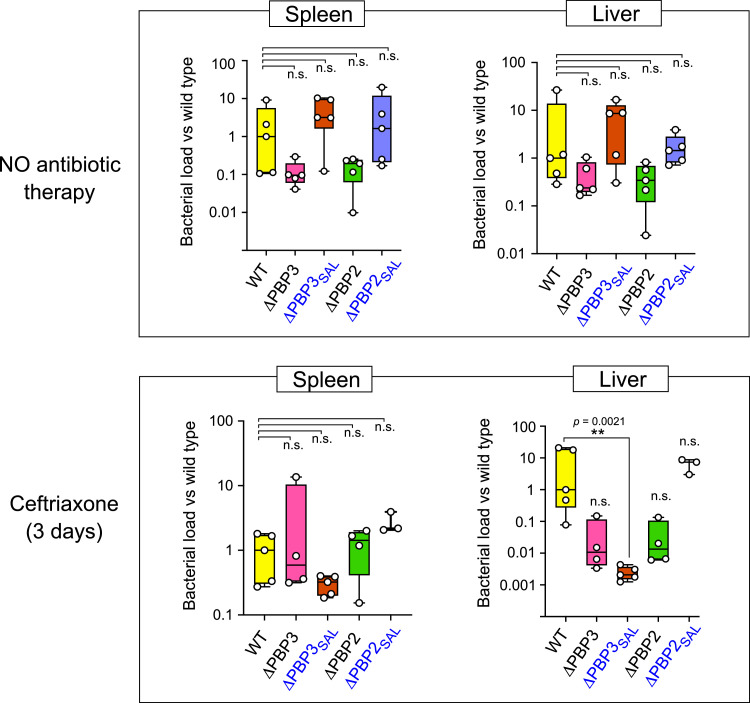
Findings: S. Typhimurium does not express PBP2SAL or PBP3SAL in the Mueller-Hinton medium used for susceptibility testing. The pathogen produces these PBPs in response to acidic pH and nutrient limitation, conditions found in phagosomes of mammalian cells. PBP3SAL has low affinity for beta-lactams, even at acidic pH. In vitro susceptibility to ceftriaxone at low pH is strongly reduced. S. Typhimurium lacking PBP3SAL was unable to cause relapse in mice following ceftriaxone therapy.
Interpretation: The reduced capacity of ceftriaxone to clear S. Typhimurium in vivo is favoured by a switch in beta-lactam targets. This switch, involving production of the less-susceptible PBP3SAL, remains invisible for standard procedures used in clinical therapy. We conclude that eradication of salmonellosis will be possible only upon targeting of PBP3SAL with novel drugs.
Keywords: Ceftriaxone; Intracellular; Penicillin-binding protein; Phagosome; Relapse; Salmonella enterica.
Copyright © 2020 The Author(s). Published by Elsevier B.V. All rights reserved.
Conflict of interest statement
Declarations of Competing Interest The authors declare no conflict of interest. Dr. García-del Portillo, Dr. Pucciarelli, Dr. Castanheira, Dr. Cestero and, David López-Escarpa have a patent EP20382036 pending to Spanish Office of Patents, which is relevant to this work.
Figures


Comment in
-
Salmonella intracellular adaptation is key to understand cephalosporin treatment relapse.EBioMedicine. 2020 Jun;56:102802. doi: 10.1016/j.ebiom.2020.102802. Epub 2020 May 23. EBioMedicine. 2020. PMID: 32454404 Free PMC article. No abstract available.
References
-
- Hiyoshi H., Tiffany C.R., Bronner D.N., Baumler A.J. Typhoidal Salmonella serovars: ecological opportunity and the evolution of a new pathovar. FEMS Microbiol Rev. 2018;42(4):527–541. - PubMed
-
- Abed N., Couvreur P. Nanocarriers for antibiotics: a promising solution to treat intracellular bacterial infections. Int J Antimicrob Agents. 2014;43(6):485–496. - PubMed
