Review
. 2020 Apr 24;8(4):616.
doi: 10.3390/microorganisms8040616.

Recent Advances in Strategies for Activation and Discovery/Characterization of Cryptic Biosynthetic Gene Clusters in Streptomyces

Affiliations
Review

Recent Advances in Strategies for Activation and Discovery/Characterization of Cryptic Biosynthetic Gene Clusters in Streptomyces

Chung Thanh Nguyen et al. Microorganisms. .

Abstract

Streptomyces spp. are prolific sources of valuable natural products (NPs) that are of great interest in pharmaceutical industries such as antibiotics, anticancer chemotherapeutics, immunosuppressants, etc. Approximately two-thirds of all known antibiotics are produced by actinomycetes, most predominantly by Streptomyces. Nevertheless, in recent years, the chances of the discovery of novel and bioactive compounds from Streptomyces have significantly declined. The major hindrance for obtaining such bioactive compounds from Streptomyces is that most of the compounds are not produced in significant titers, or the biosynthetic gene clusters (BGCs) are cryptic. The rapid development of genome sequencing has provided access to a tremendous number of NP-BGCs embedded in the microbial genomes. In addition, the studies of metabolomics provide a portfolio of entire metabolites produced from the strain of interest. Therefore, through the integrated approaches of different-omics techniques, the connection between gene expression and metabolism can be established. Hence, in this review we summarized recent advancements in strategies for activating cryptic BGCs in Streptomyces by utilizing diverse state-of-the-art techniques.

Keywords: Streptomyces; activation; biosynthetic gene cluster; cryptic; natural product.


Conflict of interest statement

The authors declare no conflict of interest.

Figures

Figure 1
Figure 1
Overview of High-Throughput Elicitor Screens (HiTES) combined reporter-guided screening approach using rational elicitor. (A) Overview of HiTES combined reporter-guided screening approach using rational elicitor. The red arrows represent the promoter. The green arrows represent the reporter gene. (B) Structure of compounds are activated by HiTES combined reporter-guided screening approach using rational elicitor.
Figure 2
Figure 2
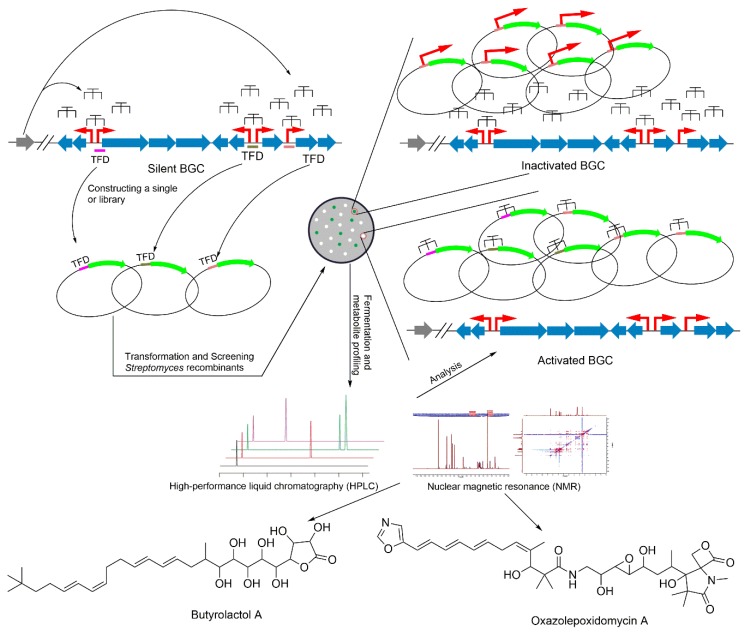
Overview of transcription factor decoy (TFD) strategy. The red arrows represent the promoter. The green arrows represent the reporter gene.
Figure 3
Figure 3
Overview of promoter replacement strategy using CRISPR-Cas9 technique. (A) Promoter replacement strategy using CRISPR-Cas9 technique. The dark blue arrows represent for Cas9 gene. The green arrows represent for gRNA. The light blue arrows represent for homology arms. (B) Structure of compounds are activated by promoter replacement strategy.

References

    1. Pishchany G., Kolter R. On the possible ecological roles of antimicrobials. Mol. Microbiol. 2020;113:580–587. doi: 10.1111/mmi.14471. - DOI - PubMed
    1. Dhakal D., Sohng J.K., Pandey R.P. Engineering actinomycetes for biosynthesis of macrolactone polyketides. Microb. Cell Fact. 2019;18 doi: 10.1186/s12934-019-1184-z. - DOI - PMC - PubMed
    1. Thomford N.E., Senthebane D.A., Rowe A., Munro D., Seele P., Maroyi A., Dzobo K. Natural products for drug discovery in the 21st century: Innovations for novel drug discovery. Int. J. Mol. Sci. 2018;19:1578. doi: 10.3390/ijms19061578. - DOI - PMC - PubMed
    1. Newman D.J., Cragg G.M. Natural products as sources of new drugs over the 30 years from 1981 to 2010. J. Nat. Prod. 2012;75:311–335. doi: 10.1021/np200906s. - DOI - PMC - PubMed
    1. Barka E.A., Vatsa P., Sanchez L., Gaveau-Vaillant N., Jacquard C., Meier-Kolthoff J.P., Klenk H.P., Clément C., Ouhdouch Y., van Wezel G.P. Taxonomy, physiology, and natural products of Actinobacteria. Microbiol. Mol. Biol. Rev. 2016;80:1–43. doi: 10.1128/MMBR.00019-15. - DOI - PMC - PubMed

LinkOut - more resources