


A New Citrinin Derivative from the Indonesian Marine Sponge-Associated Fungus Penicillium citrinum
- PMID: 32344725
- PMCID: PMC7230553
- DOI: 10.3390/md18040227
A New Citrinin Derivative from the Indonesian Marine Sponge-Associated Fungus Penicillium citrinum
Abstract
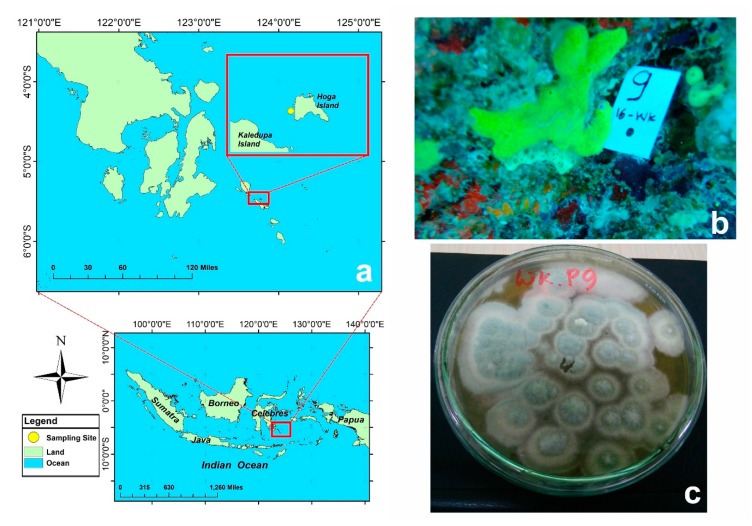
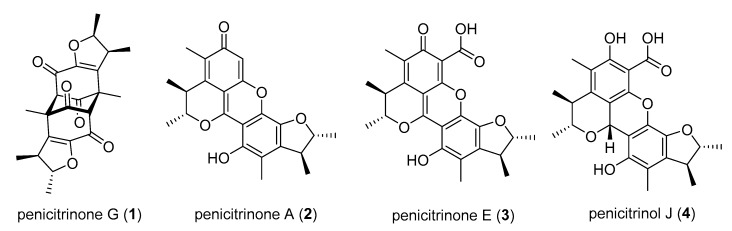
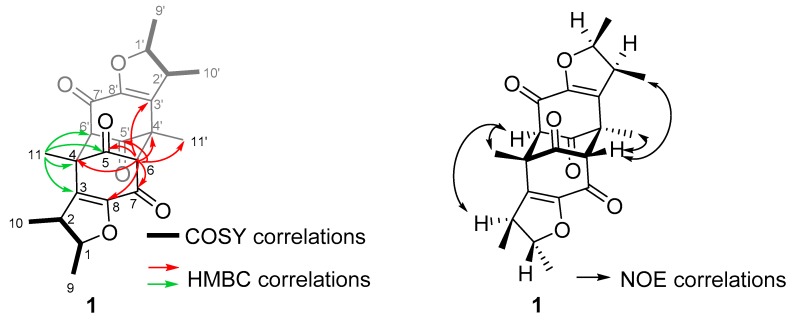
Sponge-associated fungi are attractive targets for the isolation of bioactive natural products with different pharmaceutical purposes. In this investigation, 20 fungi were isolated from 10 different sponge specimens. One isolate, the fungus Penicillium citrinum strain WK-P9, showed activity against Bacillus subtilis JH642 when cultivated in malt extract medium. One new and three known citrinin derivatives were isolated from the extract of this fungus. The structures were elucidated by 1D and 2D NMR spectroscopy, as well as LC-HRMS. Their antibacterial activity against a set of common human pathogenic bacteria and fungi was tested. Compound 2 showed moderate activity against Mycobacterium smegmatis ATCC607 with a minimum inhibitory concentration (MIC) of 32 µg/mL. Compound 4 exhibited moderate growth inhibition against Bacillus subtilis JH642, B. megaterium DSM32, and M. smegmatis ATCC607 with MICs of 16, 16, and 32 µg/mL, respectively. Furthermore, weak activities of 64 µg/mL against B. subtilis DSM10 and S. aureus ATCC25923 were observed for compound 4.
Keywords: Penicillium citrinum; antibacterial; citrinin derivatives; marine sponges; marine-derived fungi; penicitrinone.
Conflict of interest statement
The authors declare no conflict of interest.
Figures
References
-
- Abad M.J., Bedoya L.M., Bermejo P. Marine compounds and their antimicrobial activities. Fortamex. 2011;51:1293–1306.
-
- Dyshlovoy S.A., Fedorov S.N., Shubina L.K., Kuzmich A.S., Bokemeyer C., Keller-Von Amsberg G., Honecker F. Aaptamines from the marine sponge Aaptos sp. display anticancer activities in human cancer cell lines and modulate AP-1-, NF-κB-, and p53-dependent transcriptional activity in mouse JB6 Cl41 cells. Biomed. Res. Int. 2014;2014:469309. doi: 10.1155/2014/469309. - DOI - PMC - PubMed
-
- Lai K.H., Liu Y.C., Su J.H., El-Shazly M., Wu C.F., Du Y.C., Hsu Y.M., Yang J.C., Weng M.K., Chou C.H., et al. Antileukemic Scalarane Sesterterpenoids and Meroditerpenoid from Carteriospongia (Phyllospongia) sp., Induce Apoptosis via Dual Inhibitory Effects on Topoisomerase II and Hsp90. Sci. Rep. 2016;6:36170–36183. doi: 10.1038/srep36170. - DOI - PMC - PubMed
MeSH terms
Substances
Grants and funding
LinkOut - more resources
Full Text Sources
Medical
Molecular Biology Databases
