. 2020 Apr 24;20(8):2435.
doi: 10.3390/s20082435.

Medication Adherence and Liquid Level Tracking System for Healthcare Provider Feedback

Affiliations

Medication Adherence and Liquid Level Tracking System for Healthcare Provider Feedback

Nolan Payne et al. Sensors (Basel). .

Abstract

A common problem for healthcare providers is accurately tracking patients' adherence to medication and providing real-time feedback on the management of their medication regimen. This is a particular problem for eye drop medications, as the current commercially available monitors focus on measuring adherence to pills, and not to eye drops. This work presents an intelligent bottle sleeve that slides onto a prescription eye drop medication bottle. The intelligent sleeve is capable of detecting eye drop use, measuring fluid level, and sending use information to a healthcare team to facilitate intervention. The electronics embedded into the sleeve measure fluid level, dropper orientation, the state of the dropper top (on/off), and rates of angular motion during an application. The sleeve was tested with ten patients (age ≥65) and successfully identified and timestamped 94% of use events. On-board processing enabled event detection and the measurement of fluid levels at a 0.4 mL resolution. These data were communicated to the healthcare team using Bluetooth and Wi-Fi in real-time, enabling rapid feedback to the subject. The healthcare team can therefore monitor a log of medication use behavior to make informed decisions on treatment or support for the patient.

Keywords: adherence; embedded sensing; eye drop medication; fluid level sensing; glaucoma; internet of things.


Conflict of interest statement

The authors declare no conflicts of interest.

Figures

Figure 1
Figure 1
Overview of information flow in the system. (A) The prescription bottle is placed in the sleeve with the embedded sensors and electronics. (B) Data from the sensors detect use and monitor fluid level. (C) Data and usage information are transmitted from the system to a smart phone or another Bluetooth connected device. (D) Healthcare providers use this information to inform clinical decisions.
Figure 2
Figure 2
Mechanical layout of the bottle and sleeve assembly. (1) Bar magnets placed in the cap, and (2) reed switches in the sleeve are used to sense the cap removal. Electronics are embedded in the base of the system and were designed around an (4) nRF51422 system-on-a-chip. (5) BLE was used to transfer data, and the system was powered using (6) a single rechargeable coin cell battery. (3) The two-part capacitive sensor consisted of two rectangular copper sheets (a) and (b) surrounding the bottle. The bottom left view illustrates the electric field measured by the capacitance sensor.
Figure 3
Figure 3
Fluid level sensor calibration results for changes over the entire bottle volume (left) and a higher resolution test with 0.2 mL increments (right). Results indicate a linear relationship between fluid volume and capacitance reading with a resolution of approximately 0.4 mL.
Figure 4
Figure 4
Example Institutional Review Board (IRB) trial data for z-axis accelerometer from one participant. (1) Participant walked with the system in a pocket/purse for one minute. (2) Participant dispensed medication five times while in a standing position and placed the eyedropper on the table between each use. (3) Participant removed the cap from the eye dropper and placed the eye dropper on the table without dispensing medication five times. (4) Participant shook the sleeve with the cap still on five times. (5) Participant removed eye dropper cap and executed a simulated eye drop event five times. (6) Participant dispensed medication five times while in a reclined position and placed the eyedropper on the table between each use.
Figure 5
Figure 5
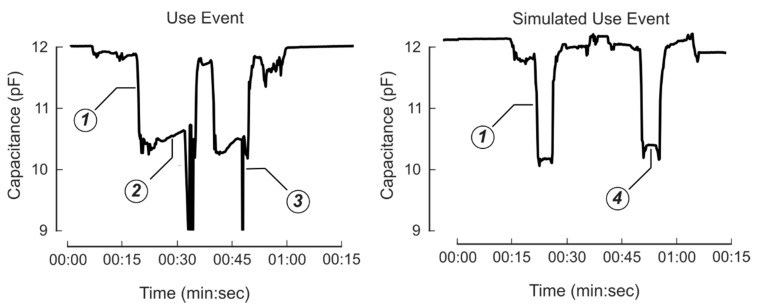
Raw capacitance data of a use event (left) and a simulated use (right). For both cases, the capacitance dropped as the bottle was flipped (1) because the fluid flowed out of the bottle body and into the nozzle. There was a gradual increase in capacitance for the use case (2), which was caused by the participant squeezing the bottle. Then, there was an occasional sharp drop caused by the suction of air after the participant finished the squeezing action (3). Neither the slope nor the spike was present in the simulated use case (4).
Figure 6
Figure 6
Data from the sleeve during three consecutive use events. Reed switch status indicates cap state (on or off). When the bottle was inverted, there was a change in orientation most clearly visible in the accelerometer data. The changing angular velocity at the beginning and end of each application was present in the recorded angular velocity. Data from the capacitance sensor showed the initial drop in capacitance was due to movement of the fluid into the top of the bottle, and then the additional drop in was capacitance created as the droplets were dispensed.
Figure 7
Figure 7
Receiver operating characteristic (ROC) curves of each algorithm. ROC curves plot the false positive rate (FPR) versus the true positive rate (TPR). Therefore, the closer the ROC curve is to the upper left corner, the higher the overall accuracy of the model.
Figure 8
Figure 8
Information gained (IG) is the percentage of total information the model gained by a feature in classifying use events. Using the average IG of all features with respect to the sensor, the importance of a sensor in classifying a use event can be determined. Sensors ranked were the accelerometer (A), magnetometer (M), gyroscope (W), and capacitance sensor (C). Data from sensors related to the orientation of the bottle and the capacitance were the most important. Reed switches were not included in importance rankings because the built in algorithm only runs when the reed switches indicate the cap has been removed.

References

    1. Bourne R.R.A., Stevens G.A., White R.A., Smith J.L., Flaxman S.R., Price H., Jonas J.B., Keeffe J., Leasher J., Naidoo K., et al. Causes of vision loss worldwide, 1990–2010: A systematic analysis. Lancet Glob. Health. 2013;1:e339–e349. doi: 10.1016/S2214-109X(13)70113-X. - DOI - PubMed
    1. Wittenborn J., Rein D. The Future of Vision: Forecasting the Prevalence and Costs of Vision Problems. [(accessed on 16 October 2019)];2014 Available online: https://www.preventblindness.org/sites/default/files/national/documents/....
    1. McKean-Cowdin R., Varma R., Wu J., Hays R.D., Azen S.P. Severity of Visual Field Loss and Health-related Quality of Life. Am. J. Ophthalmol. 2007;143:1013–1023. doi: 10.1016/j.ajo.2007.02.022. - DOI - PMC - PubMed
    1. McKean-Cowdin R., Wang Y., Wu J., Azen S.P., Varma R. Impact of Visual Field Loss on Health-Related Quality of Life in Glaucoma: The Los Angeles Latino Eye Study. Ophthalmology. 2008;115:941–948.e1. doi: 10.1016/j.ophtha.2007.08.037. - DOI - PMC - PubMed
    1. Freeman E.E., Muñoz B., West S.K., Jampel H.D., Friedman D.S. Glaucoma and Quality of Life: The Salisbury Eye Evaluation. Ophthalmology. 2008;115:233–238. doi: 10.1016/j.ophtha.2007.04.050. - DOI - PubMed

Substances

LinkOut - more resources