. 2020 May;13(2):105-114.
doi: 10.14802/jmd.20042. Epub 2020 Apr 30.

COVID-19: An Early Review of Its Global Impact and Considerations for Parkinson's Disease Patient Care

Affiliations

COVID-19: An Early Review of Its Global Impact and Considerations for Parkinson's Disease Patient Care

Roongroj Bhidayasiri et al. J Mov Disord. 2020 May.

Abstract

While many infectious disorders are unknown to most neurologists, COVID-19 is very different. It has impacted neurologists and other health care workers, not only in our professional lives but also through the fear and panic within our own families, colleagues, patients and their families, and even in the wider public. COVID-19 affects all sorts of individuals, but the elderly with underlying chronic conditions are particularly at risk of severe disease, or even death. Parkinson's disease (PD) shares a common profile as an age-dependent degenerative disorder, frequently associated with comorbidities, particularly cardiovascular diseases, so PD patients will almost certainly fall into the high-risk group. Therefore, the aim of this review is to explore the risk of COVID-19 in PD based on the susceptibility to severe disease, its impact on PD disease severity, potential long-term sequelae, and difficulties of PD management during this outbreak, where neurologists face various challenges on how we can maintain effective care for PD patients without exposing them, or ourselves, to the risk of infection. It is less than six months since the identification of the original COVID-19 case on New Year's Eve 2019, so it is still too early to fully understand the natural history of COVID-19 and the evidence on COVID-19-related PD is scant. Though the possibilities presented are speculative, they are theory-based, and supported by prior evidence from other neurotrophic viruses closely related to SARS-CoV-2. Neurologists should be on high alert and vigilant for potential acute and chronic complications when encountering PD patients who are suspected of having COVID-19.

Keywords: COVID-19; Coronavirus; Pandemic; Parkinson’s disease; SARS-CoV-19.


Conflict of interest statement

Conflicts of Interest

The authors have no financial conflicts of interest.

Figures
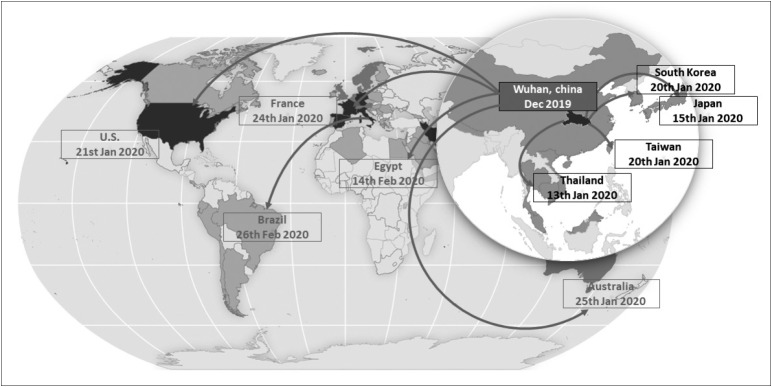
Figure 1.
Figure 1.
World map showing how COVID-19, first identified in Wuhan city, Hubei province, China, has spread over time to the rest of the world. On December 31, 2019, China reported a cluster of pneumonia in people associated with the Huanan seafood wholesale market in Wuhan, Hubei Province. On January 7, 2020, Chinese health authorities confirmed that this cluster was associated with a novel coronavirus (2019-nCoV). On January 13, 2020, Thailand reported the first imported case of 2019-nCoV infection in a 61-year-old Chinese woman from Wuhan who did not report visiting Huanan seafood market before her trip to Thailand. On January 15, 2020, Japan confirmed the first imported case of 2019-nCoV infection in a 30-year-old Chinese man who was hospitalized four days previously because of lower respiratory tract pneumonia, but did not report traveling to the Huanan seafood market. On January 20, 2020, South Korea and Taiwan confirmed the first imported cases of 2019-nCoV infection. Both cases were travelers from Wuhan, but they did not visit the Huanan seafood market. On January 20, 2020, the Centers for Disease Control and Prevention (CDC) confirmed the first case of 2019-nCoV infection in a 35-year-old man who returned to Washington State after traveling to visit his family in Wuhan. Again, he did not visit Huanan seafood market. On January 21, 2020, WHO confirmed human-to-human transmission of 2019-nCoV. On January 24, 2020, the first 2019-nCoV case was confirmed in France, representing the first confirmed case in continental Europe. On January 28, 2020, a Chinese tourist with 2019-nCoV was admitted to the hospital in Paris and died on February 14, 2020, the first mortality case outside Asia. On January 25, 2020, the first 2019-nCoV case was confirmed in Australia. On February 14, 2020, the first 2019-nCoV case was confirmed in Egypt, the first case on the African continent. On February 25, 2020, the first 2019-nCoV case was confirmed in Brazil, a 61-year-old Brazilian man who returned from Lombardy, Italy, the first case on the South American continent.
Figure 2.
Figure 2.
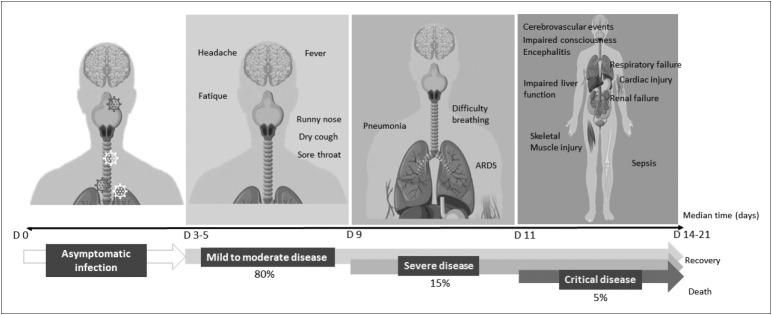
A schematic diagram demonstrating the evolution of the four stages of COVID-19 symptoms. The first stage is asymptomatic, but the majority of the relatively rare cases who are asymptomatic on the date of identification went on to develop disease. Approximately 80% of laboratory confirmed patients had mild-to-moderate disease (Second stage) with typical signs and symptoms including fever, dry cough, fatigue, sputum production, shortness of breath, sore throat, and headache. Approximately 15% have severe disease (Third stage), manifested as severe pneumonia and acute respiratory distress syndrome. Approximately 5–6% are critical (Fourth stage), characterized by respiratory failure, septic shock and/or multiorgan failure.
Figure 3.
Figure 3.
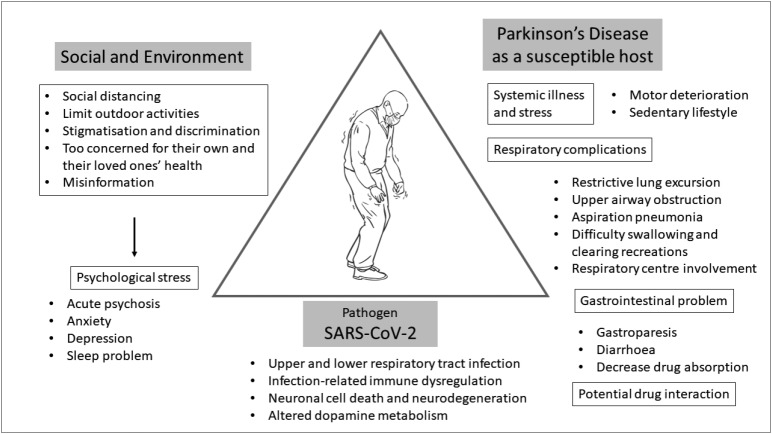
A schematic diagram depicting the disease triangle of COVID-19 in Parkinson’s disease (PD), showing possible interactions between PD patients, the environment, and the pathogen (SARS-CoV-2). Diagram reflecting how COVID-19 may affect Parkinson’s disease patients, ranging from respiratory complications, gastrointestinal symptoms, worsening motor symptoms due to systemic infection, and multiorgan failure when the disease becomes critical. PD patients may also have drug interactions between monoamine oxidase inhibitors (MAOI) and cough syrup or nasal decongestants. The impact of COVID-19 on the social and environment of PD patients may contribute to psychological stress and worsening outcomes. The pathogen, SARS-CoV-2, has been shown to cause primarily lower respiratory tract infections, but potentially can lead to immune dysregulation, neuronal cell death and altered dopamine metabolism. The disease triangle is a conceptual model that shows the interaction between the environment, the host, and the infectious agent 71. This model can be used to predict the epidemiological outcomes in public health.

References

    1. Coronavirus disease (COVID-19) Pandemic. World Health Organization; 2020 [updated 2020; cited 2020 9 April]; Available from: https://www.who.int/emergencies/diseases/novel-coronavirus-2019.
    1. Zhu N, Zhang D, Wang W, Li X, Yang B, Song J, et al. A Novel Coronavirus from Patients with Pneumonia in China, 2019. N Engl J Med. 2020;382:727–733. - PMC - PubMed
    1. Guan WJ, Ni ZY, Hu Y, Liang WH, Ou CQ, He JX, et al. Clinical Characteristics of Coronavirus Disease 2019 in China. N Engl J Med. 2020 - PMC - PubMed
    1. Report of the WHO-China Joint Mission on Coronavisus Disease 2019 (COVID-19) World Health Organization; 2020.
    1. The L. COVID-19: protecting health-care workers. Lancet. 2020;395:922. - PMC - PubMed

LinkOut - more resources