


Toxin expression in snake venom evolves rapidly with constant shifts in evolutionary rates
- PMID: 32345154
- PMCID: PMC7282918
- DOI: 10.1098/rspb.2020.0613
Toxin expression in snake venom evolves rapidly with constant shifts in evolutionary rates
Abstract
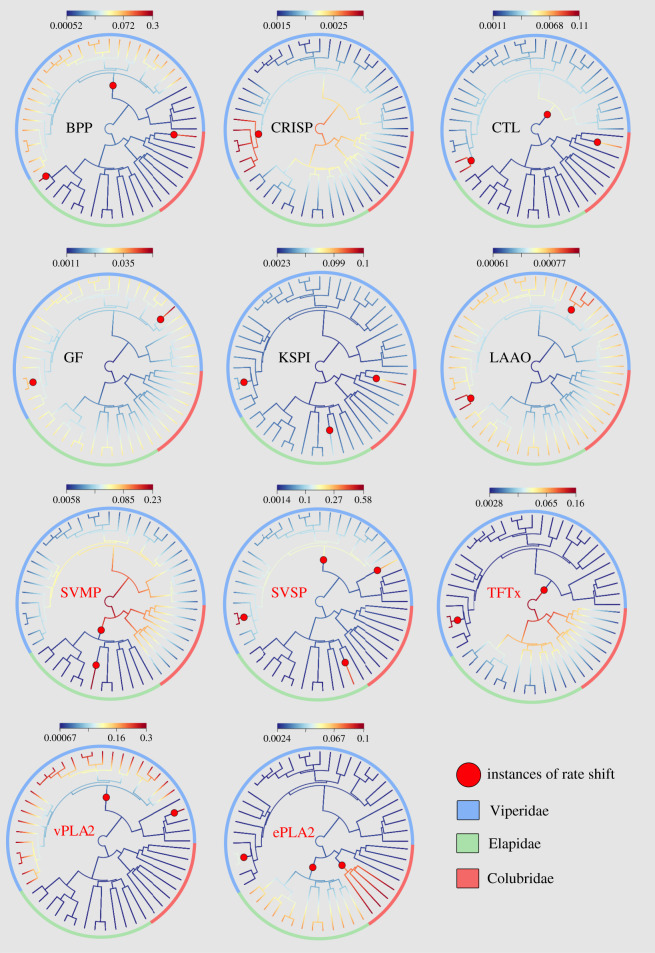
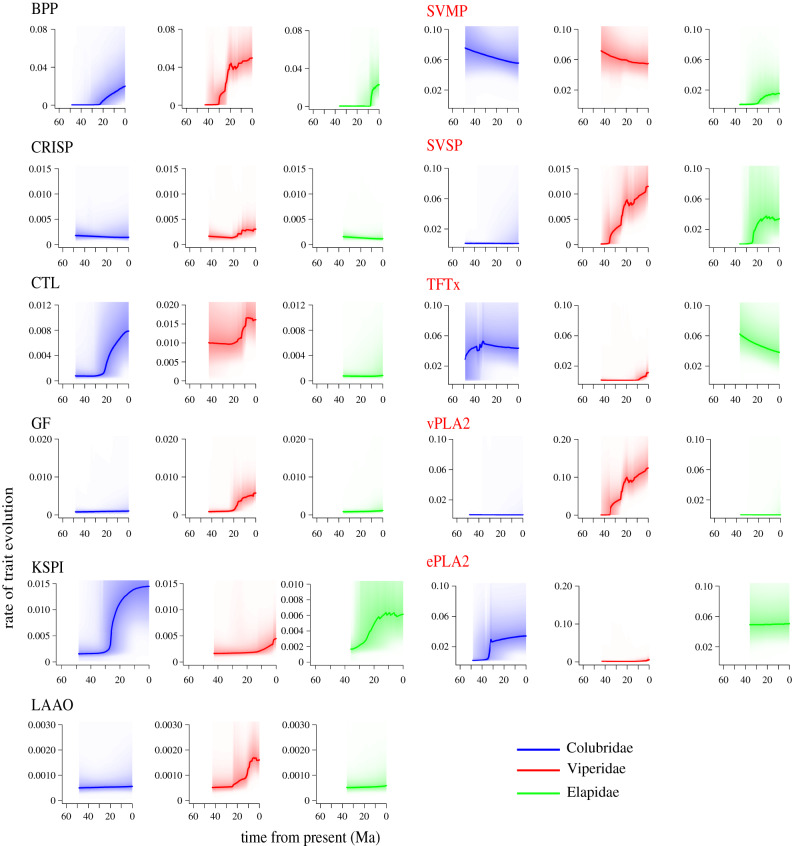
Key innovations provide ecological opportunity by enabling access to new resources, colonization of new environments, and are associated with adaptive radiation. The most well-known pattern associated with adaptive radiation is an early burst of phenotypic diversification. Venoms facilitate prey capture and are widely believed to be key innovations leading to adaptive radiation. However, few studies have estimated their evolutionary rate dynamics. Here, we test for patterns of adaptive evolution in venom gene expression data from 52 venomous snake species. By identifying shifts in tempo and mode of evolution along with models of phenotypic evolution, we show that snake venom exhibits the macroevolutionary dynamics expected of key innovations. Namely, all toxin families undergo shifts in their rates of evolution, likely in response to changes in adaptive optima. Furthermore, we show that rapid-pulsed evolution modelled as a Lévy process better fits snake venom evolution than conventional early burst or Ornstein-Uhlenbeck models. While our results support the idea of snake venom being a key innovation, the innovation of venom chemistry lacks clear mechanisms that would lead to reproductive isolation and thus adaptive radiation. Therefore, the extent to which venom directly influences the diversification process is still a matter of contention.
Keywords: complex traits; early burst; gene expression evolution; key innovation; snake venom.
Conflict of interest statement
We declare we have no competing interests.
Figures
References
-
- Galis F. 2001. Key innovations and radiations. In The character concept in evolutionary biology (ed. Wagner GP.), pp. 581–605. San Diego, CA: Academic Press.
-
- Simpson GG. 1953. The major features of evolution. New York: NY: Columbia University Press.
MeSH terms
Substances
Associated data
LinkOut - more resources
Full Text Sources
