


Study protocol for optimising glycaemic control in type 1 diabetes treated with multiple daily insulin injections: intermittently scanned continuous glucose monitoring, carbohydrate counting with automated bolus calculation, or both? A randomised controlled trial
- PMID: 32345699
- PMCID: PMC7213884
- DOI: 10.1136/bmjopen-2019-036474
Study protocol for optimising glycaemic control in type 1 diabetes treated with multiple daily insulin injections: intermittently scanned continuous glucose monitoring, carbohydrate counting with automated bolus calculation, or both? A randomised controlled trial
Abstract
Introduction: There are beneficial effects of advanced carbohydrate counting with an automatic bolus calculator (ABC) and intermittently scanned continuous glucose monitoring (isCGM) in persons with type 1 diabetes. We aim to compare the effects of isCGM, training in carbohydrate counting with ABC and the combination of the two concepts with standard care.
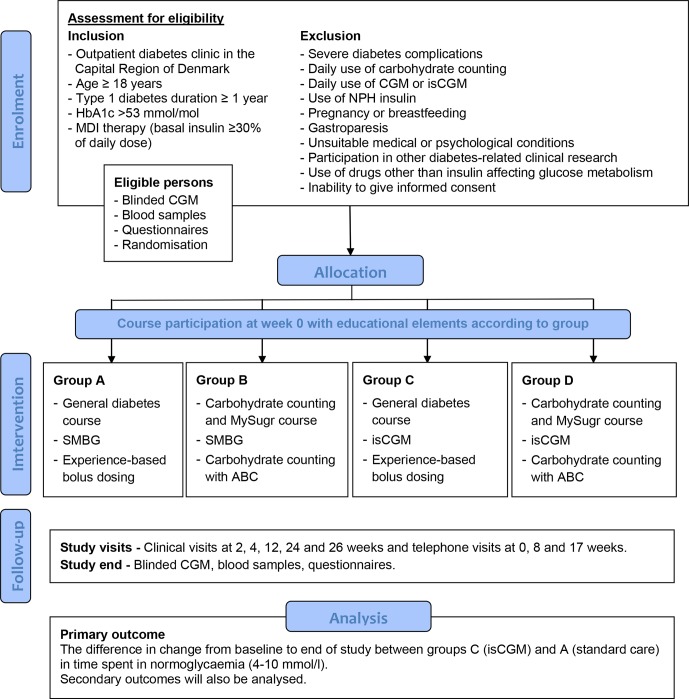
Methods and analysis: A multi-centre randomised controlled trial with inclusion criteria: ≥18 years, type 1 diabetes ≥1 year, injection therapy, HbA1c >53 mmol/mol, whereas daily use of carbohydrate counting and/or CGM/isCGM wear are exclusion criteria. Inclusion was initiated in October 2018 and is ongoing. Eligible persons are randomised into four groups: standard care, ABC, isCGM or ABC+isCGM. Devices used are FreeStyle Libre Flash and smart phone diabetes application mySugr. Participants attend group courses according to treatment allocation with different educational contents. Participants are followed for 26 weeks with clinical visits and telephone consultations. At baseline and at study end, participants wear blinded CGM, have blood samples performed and fill in questionnaires on person-related outcomes, and at baseline also on personality traits and hypoglycaemia awareness. The primary outcome is the difference in time spent in normoglycaemia (4-10 mmol/L) at study end versus baseline between the isCGM group and the standard care group. Secondary outcomes will also be analysed. Results are expected in 2020.
Ethics and dissemination: Regional Scientific Ethics Committee approval (H-17040573). Results will be sought disseminated at conferences and in high impact journals.Trial registration numberClinicalTrial.gov registry (NCT03682237).
Keywords: biotechnology & bioinformatics; general diabetes; nutrition & dietetics.
© Author(s) (or their employer(s)) 2020. Re-use permitted under CC BY-NC. No commercial re-use. See rights and permissions. Published by BMJ.
Conflict of interest statement
Competing interests: KN is a shareholder of Novo Nordisk; has received research support from Novo Nordisk, Roche Diagnostics, Dexcom and Zealand Pharma; has received lecture fees from Medtronic, Roche Diagnostics, Rubin Medical, Sanofi, Zealand Pharma, Novo Nordisk and Dexcom and has served on advisory panels for Medtronic, Abbott and Novo Nordisk. UP-B has served on advisory boards for AstraZeneca, Bristol-Myers Squibb, Sanofi-Aventis, Novo Nordisk and Zealand Pharma and has received lecture fees from AstraZeneca, Bristol-Myers Squibb, Sanofi-Aventis and Novo Nordisk. TPA holds stocks in Novo Nordisk. ALS, OLS, BG-R, LD and DV do not have any competing interests.
Figures
References
-
- Meldgaard M, Damm-Frydenberg C, Vesth U, et al. Use of advanced carbohydrate counting and an automated bolus calculator in clinical practice: the BolusCal ® training concept. International Diabetes Nursing 2015;12:8–13. 10.1179/2057331615Z.0000000002 - DOI
Publication types
MeSH terms
Substances
Associated data
LinkOut - more resources
Full Text Sources
Medical
