. 2020 Apr 28;10(1):7160.
doi: 10.1038/s41598-020-63120-6.

Comprehensive characterization of mainstream marijuana and tobacco smoke

Affiliations

Comprehensive characterization of mainstream marijuana and tobacco smoke

Brian M Graves et al. Sci Rep. .

Abstract

Recent increases in marijuana use and legalization without adequate knowledge of the risks necessitate the characterization of the billions of nanoparticles contained in each puff of smoke. Tobacco smoke offers a benchmark given that it has been extensively studied. Tobacco and marijuana smoke particles are quantitatively similar in volatility, shape, density and number concentration, albeit with differences in size, total mass and chemical composition. Particles from marijuana smoke are on average 29% larger in mobility diameter than particles from tobacco smoke and contain 3.4× more total mass. New measurements of semi-volatile fractions determine over 97% of the mass and volume of the particles from either smoke source are comprised of semi-volatile compounds. For tobacco and marijuana smoke, respectively, 4350 and 2575 different compounds are detected, of which, 670 and 536 (231 in common) are tentatively identified, and of these, 173 and 110 different compounds (69 in common) are known to cause negative health effects through carcinogenic, mutagenic, teratogenic, or other toxic mechanisms. This study demonstrates striking similarities between marijuana and tobacco smoke in terms of their physical and chemical properties.


Conflict of interest statement

The authors declare no competing interests.

Figures
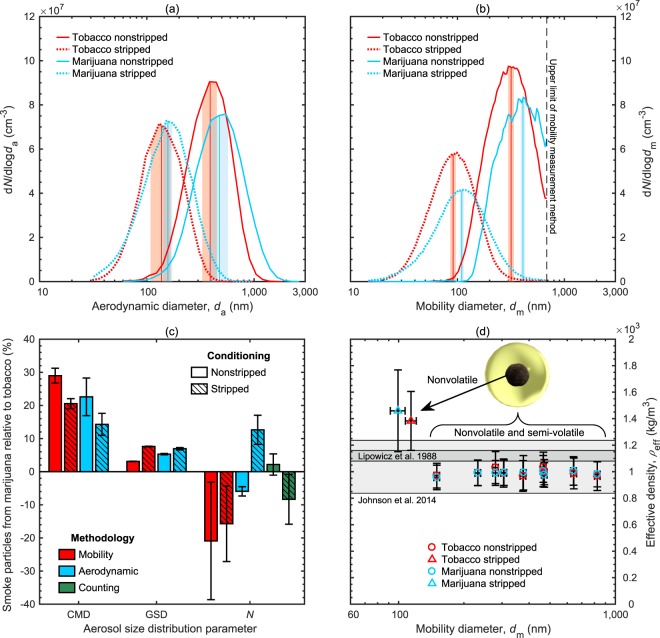
Figure 1
Figure 1
(a) Averaged aerodynamic size distributions where nonstripped, aged aerosols from smoking marijuana joints or tobacco cigarettes had average count median diameters (CMDs) of 477 nm (±95 nm) or 389 nm (±61 nm), respectively, while catalytic stripping the aged aerosols produced average CMDs of 157 nm (±15 nm) or 137 nm (±29 nm), respectively. Geometric standard deviations of the averaged log-normal fits ranged between 1.57 and 1.69. (b) Averaged mobility size distributions where nonstripped, aged aerosols from smoking marijuana joints or tobacco cigarettes had average CMDs of 410 nm (±20 nm) or 318 nm (±19 nm), respectively, while catalytic stripping the aged aerosols produced average CMDs of 110 nm (±5 nm) or 91 nm (±5 nm), respectively. Geometric standard deviations of the averaged log-normal fits ranged between 1.63 and 1.75. (c) Percent differences between size distribution parameters for either nonstripped or stripped aged smoke particles from a marijuana joint relative to a tobacco cigarette. (d) Effective densities of nonstripped and stripped aged smoke particles. For (a,b), the center line and shaded regions represent each CMD and its corresponding total uncertainty, while for (c,d) the error bars represent the total uncertainties, with the exception of GSD error bars in (c) which represent its precision uncertainty.
Figure 2
Figure 2
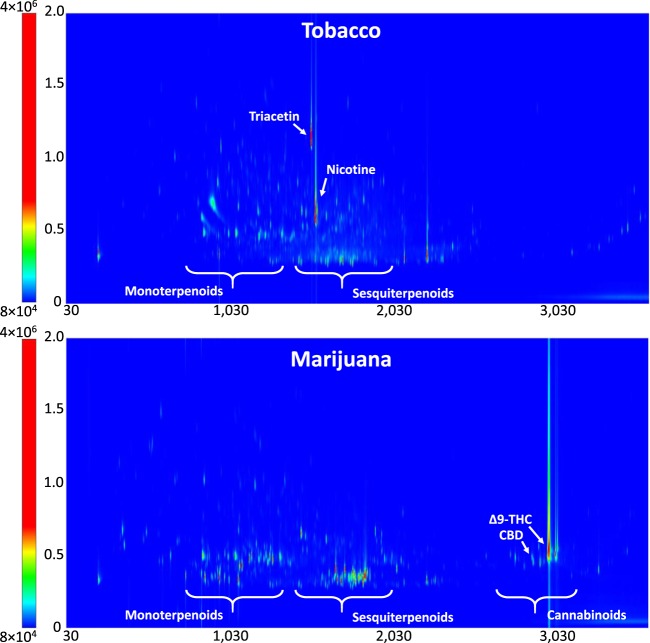
SPME-GC×GC-TOFMS chromatograms of the particulate phase fraction of mainstream smoke from tobacco and marijuana. The x-axis denotes first-dimension retention time (seconds), while the y-axis denotes second-dimension retention time (seconds). Peak intensity is indicated based on the colour bar.
Figure 3
Figure 3
Relative peak distribution of compounds based on the number of peaks detected in the particulate phase fraction of mainstream tobacco or marijuana smoke, along with the average relative peak area (n = 3) of selected analytes. These peak areas were normalized to the peak area of dodecane. The error bars represent one standard deviation, while the plus sign (+) denotes compounds with a response multiplied by 10× and the asterisk (*) highlights compounds which are members of the Hoffmann List of biologically and toxicologically active compounds found in tobacco cigarette smoke.

References

    1. World Health Organization. The health and social effects of nonmedical cannabis use. https://www.who.int/substance_abuse/publications/cannabis/en/ (2016).
    1. World Drug Report 2018. United Nations publication, Sales No. E.18.XI.9. https://www.unodc.org/wdr2018/. (2018).
    1. Pacula, R. L. & Smart, R. Medical marijuana and marijuana legalization. Annual review of clinical psychology 13 397–419, 10.1146/annurev-clinpsy-032816–045128 (2017). - PMC - PubMed
    1. National Conference of State Legislatures (NCSL). State medical marijuana laws. http://www.ncsl.org/research/health/state-medical-marijuana-laws.aspx (2019).
    1. National Conference of State Legislatures (NCSL). Marijuana overview. http://www.ncsl.org/research/civil-and-criminal-justice/marijuana-overvi... (2019).

Publication types